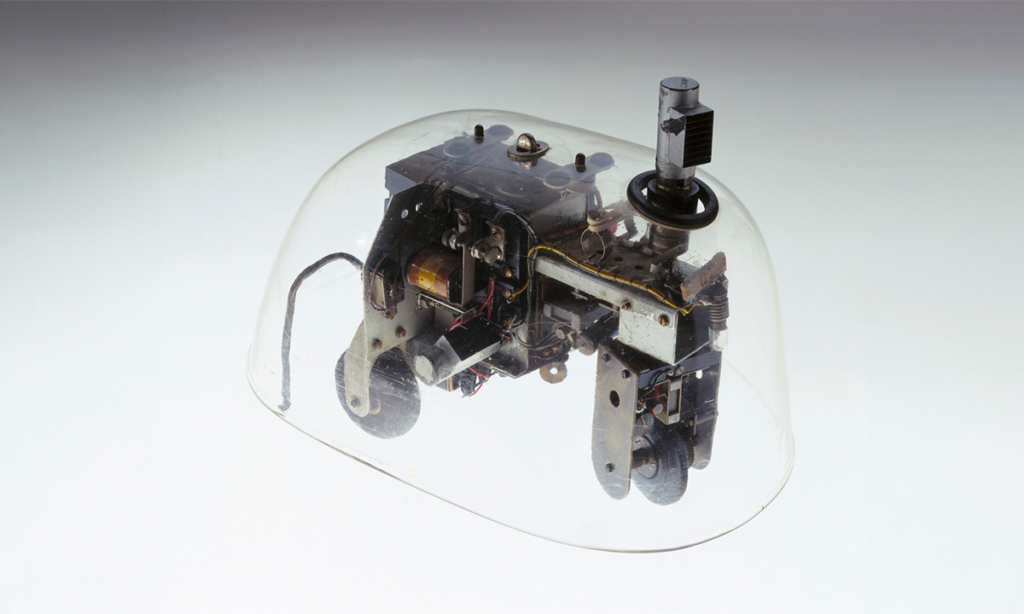
In the early days of cybernetics, a groundbreaking experiment captivated the scientific community—a pair of mechanical tortoises that maneuvered their environment with an uncanny sense of autonomy. These robotic pioneers were the brainchild of W. Grey Walter, a neurophysiologist whose work bridged the gap between biology and robotics, sowing seeds for the evolution of artificial intelligence.
Born in 1910 in Kansas City, Missouri, Walter’s journey into the realm of brain activity began at Cambridge University, leading him to join Maudsley Hospital’s research team in London. There, he became instrumental in advancing electroencephalography (EEG), a technique first envisioned in 1929 by German psychiatrist Hans Berger. Berger’s initial attempts to record brain electrical activity through a galvanometer laid the groundwork for Walter’s future innovations.
At Maudsley Hospital, Walter’s collaboration with Frederick Lucien Golla significantly advanced EEG technology, enabling Walter to achieve milestones such as identifying brain tumors and discovering delta waves, which are associated with deep sleep. His work in brain wave research was foundational to understanding neurological functions.
Venturing into cybernetics, Walter designed robots to replicate animal behavior, inspired by the scientific study of control and communication in animals and machines, a concept pioneered by Norbert Wiener. Walter’s hypothesis that simple neural connections could dictate complex behaviors was put to the test with his tortoise-like robots.
Between 1948 and 1949, Walter constructed Elmer and Elsie, the first autonomous robots, utilizing innovations in electronic motors and computing to mimic animal intelligence. These robots featured vacuum tube “brains” analogous to neurons, housed in plastic shells that gave them a tortoise-like appearance. Their name derived from an Alice in Wonderland character.
Equipped with three wheels, Elmer and Elsie navigated their surroundings using sensors for touch and sight. A rotating photocell served as their “eye” to seek light, while another sensor reacted to physical contact by altering the robot’s course. This allowed them to explore a room and find their way to a charging station when needed. “This robot explores its environment actively, persistently, systematically as most animals do,” Walter observed.
In a fascinating twist, Walter indicated in 1950 that the robots exhibited a form of free will and unpredictability. For instance, one robot began to “flicker, twitter, and jig” before a mirror, behavior Walter suggested might indicate a degree of self-awareness—an insight he likened to evidence of a new species, Machina speculatrix.
Walter’s subsequent project, Machina docilis—from the Latin for teachable—sought to incorporate memory into these devices. This model included a sound detector, enabling it to learn behaviors in response to light, sounds, or obstacles, echoing Pavlovian conditioning principles, a nod to Walter’s childhood meeting with Ivan Pavlov.
By merging biological insights with robotics, Walter not only influenced future scientific exploration but also laid early groundwork for artificial intelligence, a field that continues to shape modern life. His legacy lives on in the complex and autonomous machines that populate today’s world.
Original Story at nautil.us