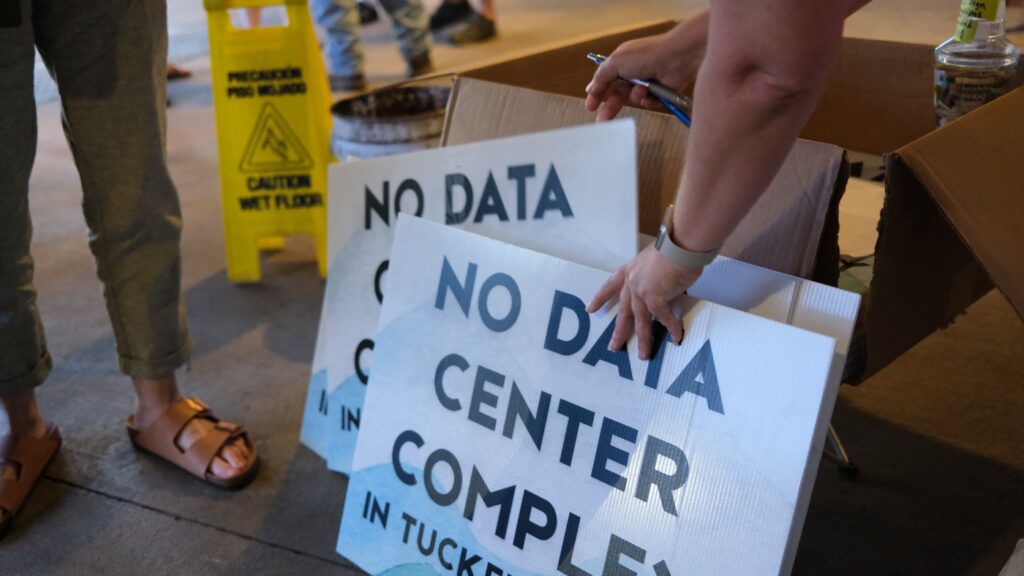
Volunteers hand out yard signs in June against a data center complex in West Virginia.
Ulysse Bellier/AFP via Getty Images
hide caption
toggle caption
Ulysse Bellier/AFP via Getty Images
As Google sought to establish a considerable presence within Franklin, Indiana, local residents stood firm against its proposal to develop a vast data center campus. The tech giant’s plan involved rezoning over 450 acres in the suburb of Indianapolis, but significant opposition arose due to concerns about the facility’s resource consumption and its limited local benefits.
Community resistance became evident during a public meeting in September when a Google representative announced the withdrawal of the data center proposal, prompting applause from the crowd. This scenario is not unique, as similar situations are unfolding nationwide, where tech companies are investing heavily in data centers to support artificial intelligence advancements. Residents, however, are voicing environmental concerns and questioning the impact on power costs and local communities.
According to experts, the manner in which tech firms and government officials address these issues will significantly influence the industry’s trajectory and the nation’s competitive edge in the technology sector.
Joseph Majkut from the Center for Strategic and International Studies highlights that local opposition could lead to unanticipated distribution patterns for the industry, potentially slowing its growth. “Slowing down the development of the industry or distributing it in sort of weird regional patterns is probably the most overlooked potential outcome in this conversation,” he states.
Understanding Data Centers
Data centers are expansive facilities that house computer hardware essential for storing and processing digital data, serving as the backbone of the internet. Some data centers span over a million square feet, equivalent to more than 17 football fields. These centers are crucial for various online activities, such as reading articles, sending emails, or conducting online banking transactions.
However, the environmental impact of data centers is substantial. A typical AI data center consumes as much electricity as 100,000 households, with the largest centers under construction expected to use 20 times more, as noted by the International Energy Agency (IEA). Additionally, these centers require billions of gallons of water to maintain optimal operating temperatures for their computer hardware.
The Current Surge in Data Center Construction
While data centers have existed for many years, a recent surge in AI investments is driving a construction boom. The growth is propelled by the increasing interest in AI from consumers and businesses alike, with examples like ChatGPT’s rapid adoption following its 2022 launch. According to the IEA, within a span of two years, around 40% of households in the U.S. and U.K. reported using AI chatbots, and a similar percentage of large companies embraced AI technologies by the previous year.
Tech companies are investing significantly in data centers and AI computer chips, anticipating a rise in technology adoption. Projections suggest that by 2027, AI could represent 28% of the global data center market, according to Goldman Sachs, more than doubling its current share.
Geographic Expansion of Data Centers
As investments flow in, developers are gravitating towards regions with established data center infrastructures, such as Northern Virginia’s Data Center Alley and parts of Texas, as per the IEA. Yet, there are indications that development is extending to new markets like Las Vegas, which offer affordable land, renewable power sources, and industry incentives.
The Federal Reserve Bank of Minneapolis recently indicated a potential data center boom beginning in regions such as Minnesota, Montana, North Dakota, South Dakota, and parts of Michigan and Wisconsin. “It definitely feels like we are starting to see the rollout of what these massive investments in data centers are potentially going to start to look like on the ground,” remarks Melissa Scanlan of the University of Wisconsin-Milwaukee’s Center for Water Policy.
Advantages of AI
Artificial intelligence encompasses computer systems capable of performing tasks that typically require human intelligence, such as reasoning and decision-making, according to NASA.
AI applications range from generating digital images and videos to advancing medical research, such as mapping protein structures for drug development. In the energy sector, AI aids in detecting pipeline leaks and managing electricity grids, while in meteorology, it enhances weather forecasts.
Maintaining competitiveness in AI is crucial for the U.S., as Majkut explains, “To remain competitive, the U.S. needs to be able to respond to what the market demands, whether it’s more AI in the form of robotics, or we want much more in the form of digital services to make professionals more productive.”
Community Concerns About Data Centers
Local opposition to data centers often stems from concerns about the transformation of community landscapes due to industrial facilities and their associated noise and light pollution. Additionally, residents worry about the depletion of local water resources for cooling systems, potential increases in electricity costs, and the environmental impact of data centers relying on fossil fuels.
For instance, in regions around the Great Lakes, where numerous data centers are being developed, Melissa Scanlan likens the lakes to a “giant pitcher of water with straws going into it” from various utilities and industries. The challenge lies in determining the lakes’ capacity to support data centers and associated power plants sustainably.
In Georgia, data center development has reportedly affected local water supplies, while Arizona cities have imposed restrictions on water deliveries to high-consumption facilities, including data centers.
The industry is actively working to mitigate these concerns. Dan Diorio from the Data Center Coalition mentions efforts to reduce water consumption, such as using closed-loop systems and exploring waterless cooling solutions. “It’s a balance between water and electricity,” he notes, emphasizing the trade-offs between these resources.
Electricity Demand and Data Centers
Rising electricity bills are another concern, as data centers contribute to increased power demand in certain areas. An analysis by the Union of Concerned Scientists revealed that in 2024, residents in several states faced $4.3 billion in additional costs from transmission projects needed to supply power to data centers.
Diorio emphasizes the industry’s commitment to covering its electricity costs, stating that “the data center industry is fully committed to paying its full cost of service for electricity.”
Beyond data centers, new power demands arise from factory construction and the growing adoption of electric vehicles and appliances like electric stoves.
The lack of transparency from tech companies about their operations further complicates matters. Communities often lack the information needed to make informed decisions about data center development. Diorio mentions that companies aim to be “responsible partners” but face challenges in balancing transparency with competitive considerations.
Future Challenges in Data Center Development
The primary challenge facing data center development is ensuring adequate electricity supply to meet rising demand. The Trump administration’s policies limiting renewable energy development pose a challenge, as renewables are seen as crucial for expanding power capacity efficiently.
Pavan Venkatakrishnan from the Institute for Progress notes a “clear conflict” between the administration’s stance on renewables and its desire to accelerate data center construction. A White House spokesperson, Kush Desai, stated, “AI cannot be beholden to unreliable sources of energy that must be heavily subsidized to be economical.”
While solar and wind power, coupled with battery storage, are reliable energy sources, natural gas and nuclear power are also expected to contribute significantly. However, deploying these technologies quickly enough to meet immediate needs presents a challenge.
Note: Google is a financial supporter of NPR.
Original Story at www.npr.org