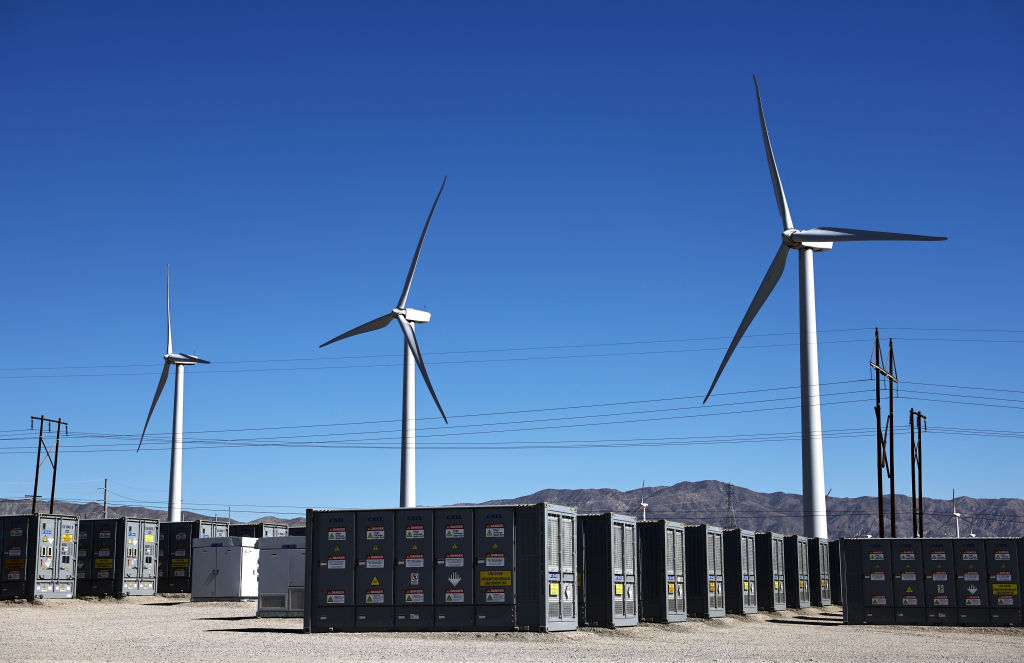
America’s power grid is undergoing one of its fastest transformations in decades, and a technology the size of a shipping container is at the center of the debate. Battery storage farms are spreading across the country at a record pace — but not everyone is ready to welcome them as neighbors.
Known as battery energy storage systems, or BESS, these facilities store electricity in banks of lithium-ion batteries housed in buildings or large containers. When demand spikes — typically in the evening hours when people return home and switch on appliances — the stored power flows onto the grid. The concept is straightforward, but the scale of the buildout is anything but small.
Battery storage capacity on the U.S. grid currently exceeds 50 gigawatts, up from just 5 gigawatts at the start of 2022 — a tenfold increase in roughly three years. Another 54 gigawatts is expected to come online by the end of 2028. Combined, that would be enough to power approximately 75 million homes, though battery farms are designed to supply electricity for one to four hours at a time rather than around the clock.
“The meteoric growth is continuing,”
said Noah Roberts, executive director of the U.S. Energy Storage Coalition.
“For state policymakers who are focused on the energy transition and decarbonizing the grid, (battery) storage is essential.”
Why Battery Farms Are in Demand
The surge in battery storage is closely tied to the expansion of solar and wind power. Solar panels generate their peak electricity in the afternoon, but grid demand typically peaks in the evening. Without storage, that surplus daytime power goes to waste — or utilities must fire up expensive natural gas “peaker” plants to meet evening demand. Battery farms bridge that gap.
Industry leaders point out that the technology benefits states across the political spectrum. Texas and California, though different in many ways, both rely heavily on wind and solar and have faced serious grid stress in recent years. Battery storage, backers say, has already helped stabilize both states’ grids.
Speed is another selling point. Battery farms can be deployed in a matter of months, far faster than other types of energy infrastructure.
“As we’re dealing with a power supply crisis, energy storage is the obvious solution for adding capacity and getting more out of the grid that we’ve already paid for,”
Roberts said.
Policy has also accelerated the industry’s growth. Thirteen states have set formal targets requiring utilities to deploy specific amounts of energy storage. Maryland passed legislation in 2025 directing regulators to solicit bids for 1,600 megawatts of storage capacity.
Maryland Democratic Del. Lorig Charkoudian, who authored that law, described the approach as a low-risk investment.
“It’s basically a no-regret path,”
she said.
“Over time once we bring more renewables on, they will be that much more valuable because there’s battery storage.”
Community Pushback Is Growing
Despite the grid benefits, residents in communities across the country have raised alarms about proposed battery farms near their homes, schools, and parks. The central concern is fire. Lithium-ion batteries can ignite and trigger a process called thermal runaway — a self-sustaining reaction that is extremely difficult to extinguish and can release toxic smoke.
The most high-profile incident came in early 2025, when the Moss Landing Power Plant in Monterey County, California, caught fire, burned for several days, and released 55,000 pounds of toxic metals into nearby wetlands. The event amplified fears that had already been building in communities where battery projects were being proposed.
In Watsonville, California, resident Phoenix Artemisia has been a vocal opponent of a proposed facility there.
“They’re making us collateral damage,”
she said.
“We have 12 schools within two miles of us here, but these out-of-state developers are telling us what we’re going to do in our backyard.”
Opposition has spread widely. Carina Energy, a development services firm, has tracked nearly 200 battery farm moratoriums enacted or proposed by communities across the United States.
What the Data Shows About Safety
Industry representatives argue that the fears, while understandable, do not reflect the current state of battery technology. The Moss Landing facility used an older design, they say, built before updated safety standards from the National Fire Protection Association were widely adopted. Newer systems use different battery chemistry that burns at lower temperatures and store batteries in isolated, modular containers to prevent fires from spreading.
An independent analysis published by the Electric Power Research Institute examined battery system failures dating back to 2011. It found that failures — defined as large thermal events including arc flashes, fires, or explosions — have declined 97% in the U.S. since 2018, when measured against the amount of battery capacity on the grid.
Lakshmi Srinivasan, who authored the report, said recent incidents in newer systems have largely been small and contained.
“Specific design choices have really reduced not only the likelihood of a failure, but the impact of a failure if it happens,”
she said. She added that the risk profile of modern battery farms is now comparable to that of electrical transformers, which already exist in most communities.
Still, some residents say even a small risk is unacceptable when the potential consequences are severe. In Snoqualmie, Washington, residents pushed back on a proposed battery project near homes, a playground, a waterway, and a key evacuation route. The city and several neighboring communities responded by passing moratoriums on battery storage construction.
Snoqualmie City Council member Dan Murphy acknowledged the improving technology but urged caution.
“We need to think more carefully about what the worst-case scenario is, not just what’s typical,”
he said.
“The science says (battery farms) are getting safer, but we’re still early.”
Murphy said locals felt blindsided by the developer, Jupiter Power, which he said kept the community in the dark until the project seemed nearly finalized.
“We are a very reserved and polite community,”
he said.
“To see the outcry and the animation and the mobilization, it’s really struck a nerve with our residents.”
A Siting Problem Without Easy Answers
One friction point in the debate is location. Battery farms must connect to electrical substations, which are already built close to population centers. In a response to community concerns, Jupiter Power noted that all 157 substations suitable for a battery project in King County, Washington, are located within a quarter-mile of schools, daycares, hospitals, natural areas, or other sensitive sites — making it structurally difficult to place battery farms far from people.
Kelsey Nyland, communications director with Clean and Prosperous, a Washington-based nonprofit focused on emissions reduction, pointed to a broader double standard in how communities evaluate energy projects.
“For any battery storage project there will inherently already be energy infrastructure nearby,”
she said.
“It often feels like we expect clean energy projects to be perfect in a way that we don’t expect from fossil fuel projects.”
Nyland noted that Washington state ranks last in the nation for clean energy growth despite its ambitious climate targets, and that battery storage could help western Washington communities tap surplus wind and solar power generated in the rural east.
Earlier this month, two former Biden administration economic officials wrote in The Washington Post that battery farms have been caught up in a broader backlash against data centers — industrial facilities that, unlike battery farms, actually increase strain on the grid. The authors called the “conflation” of the two an expensive mistake.
Malaquias Encarnacion, managing director with Carina Energy, said some community moratoriums have simply been a way for local governments to buy time to understand the technology before making permanent decisions. He encouraged developers to engage communities early rather than presenting projects as fait accompli.
“If I didn’t know anything about it, I would be nervous as well,”
he said.