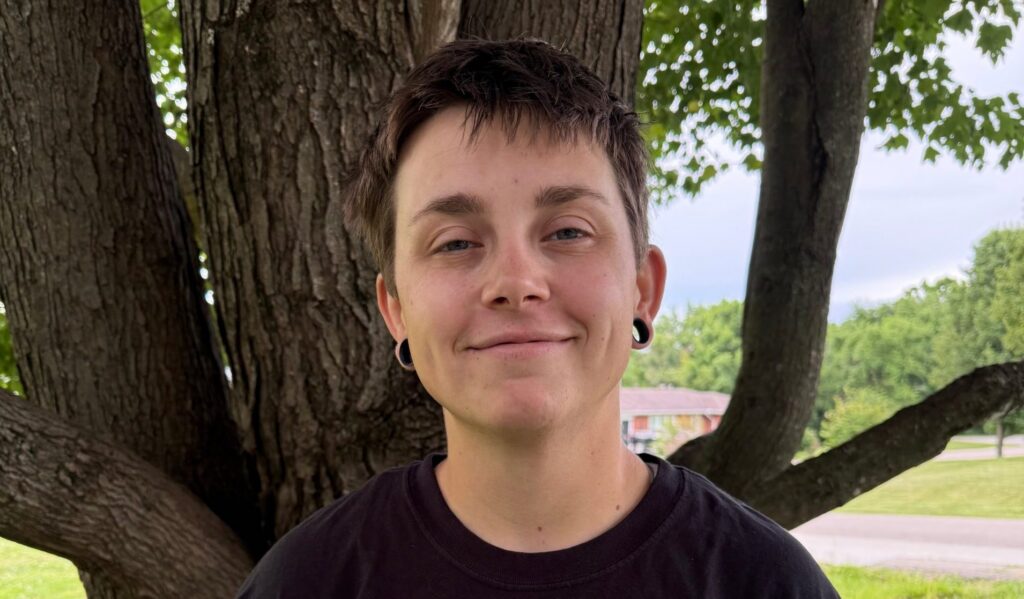
A painter from a small Kentucky county is earning international attention for work that refuses easy categorization — blending queer identity, Appalachian pride, and vivid color into something entirely her own. Ceirra Evans is building a body of work that challenges what rural American art can look like and who it speaks to.
Evans grew up in Bath County, on the edge of Eastern Kentucky, before attending Spalding University in Louisville, where she earned an interdisciplinary liberal arts degree in 2021. It was after graduation, while working at the Speed Art Museum in Louisville, that her painting practice took off. That momentum earned her a first gallery show and has carried her ever since — from solo exhibitions in Lexington, Kentucky to Paris, France, to a 2026 acquisition by the Ogden Museum of Southern Art in New Orleans.
Her work has been reviewed by Hyperallergic and The New Yorker, and is held in private collections across the United States and the United Kingdom. The following is an edited conversation with Evans, conducted by Trish J. Gibson, an editor at Backwoods Literary Press and a contributor to Path Finders, the Daily Yonder’s weekly rural Q&A newsletter.
Painting for People Who Look Like Her
Evans describes her paintings as rooted in family stories and regional identity — work that plays with the “hillbilly” stereotype while also moving beyond it. When asked who she makes work for, her answer is direct.
“My audience is people that look like me. You know, queer kids from Eastern Kentucky that are proud of their culture while also looking to create something new.”
Her 2025 solo show “Come Rain or Shine” at Institute 193 in Lexington drew on that same sensibility — bright, familiar imagery that is specific to the Appalachian South without being sentimental or reductive. The show coincided with an artist talk that Gibson attended, and it reflected what Evans describes as an ongoing negotiation between representing a place and reimagining it.
That tension became vivid during Evans’ solo show in Paris, where she found herself, at least initially, completely alone in the gallery with an audience that had no reference point for her world.
“It was really interesting to see how myself and the audience were on a level playing field of, ‘I don’t know nothing about you, and you don’t know nothing about me.’ And how do we talk about that? And I did just automatically get these references like ‘KFC,’ ‘do you wear shoes?’ and all the bullshit that comes with the stereotypes of the region. But that’s the fun part is then you get to be the one to break that down.”
The Influences Behind the Work
Evans is quick to name her biggest artistic influence: Nicole Eisenman, a French-American painter and sculptor who is also butch and gender-fluid. For Evans, encountering Eisenman’s work as a teenager was a turning point.
“I can just remember, when I was fourteen/fifteen, reading through art books and thinking, okay, these people get their influences from however many decades ago and they’re talking about whatever ‘ism’ in art history…but, how do I find the person that will lead the way for me? And I was like, ‘well…I’m just gonna look up butch painters.'”
Eisenman was among the first results — and Evans says the experience has been, in her words,
“very much an idolizing experience.”
For her most recent body of work, shown at the Atlanta Art Fair, Evans says painter Jennifer Packer was frequently on her mind. Packer is known for richly textured portraits of Black people she knows personally, and a quote attributed to her stayed with Evans throughout the process:
“paint what’s important and don’t think about the rest.”
Evans paraphrases the sentiment but says it helped her keep the work feeling alive rather than overworked.
Her influences don’t stop at the art world. Evans says the Muppets genuinely shape how she thinks about texture, color, and storytelling — and that she watches the Gumby movie before every show. She also cites a lesser-known but deeply Appalachian touchstone: Henry and Homer, a puppet show performed by the late preacher Bill Holman of Estill County, which toured Kentucky public schools for years.
“If any Eastern Kentucky kid’s gonna read this, they know exactly what I’m talking about. It was this old man, who had two puppets, one’s a city boy, one’s a country boy, and they talk about bullying and it always ends in stories of Jesus…He had such an intense presence…What he did was true storytelling.”
A Sixteen-Foot Trailer Full of Memory
This past summer, Evans began her first multimedia sculpture during a residency at Josephine Sculpture Park in Frankfort, Kentucky. The piece, titled “Reunion,” draws directly from childhood memory: a spring potluck at a cousin’s house, the last home on a gravel road, where a sixteen-foot flatbed tobacco trailer would be loaded with food and family.
“My uncle Bobby would be at the end, sitting in a chair, frying fish in one of them big old pots, and it’s all such a visceral memory for me. I was a little queer, quiet kid, and I was around like a thousand cousins and everybody would be talking and pecking and wanting to know what you think about their cobbler versus whoever else’s.”
The sculpture itself is built around an actual sixteen-foot tobacco trailer Evans sourced from Facebook Marketplace, lined with pots. The piece is still in progress, but Evans says her intention is to create a space that feels communal — somewhere people could gather and share a meal. It represents a significant stretch for an artist whose practice has been grounded in painting, where she typically moves quickly from sketch to canvas.
Beyond Red and Blue
Evans is direct about what she finds most troubling in how Appalachia gets represented today — not the old hillbilly caricature, but the flattening of an entire region into a political monolith.
“It’s not even a stereotype of like the ‘billy anymore. It’s more red state versus blue state narratives and everything gets piled into like one thing, one identity, one narrative. I think that’s very troublesome, toxic, and demonizing to put a monolith right on a whole state or a whole big region of the country.”
At the same time, Evans says she genuinely loves the hillbilly stereotype — not as a slur, but as a set of cultural values that often go unrecognized as such.
“Being of the land, being autonomous, being a caring individual, being somebody that will help you out. I think the thing that keeps coming to mind always is that like these people with the least, often give the most.”
For Evans, the goal isn’t to replace one narrative with another. It’s to create enough space for many different stories to exist at once — a point her interviewer connected to a quote from culture writer Wesley Morris about queer media: that there should be enough of it that the great and the mediocre can all find a place. Evans agreed fully.
“Yeah, there should be room for really awesome work, room for really pitiful work, room for all of it. I wanna see every bit of it.”
This article originally appeared in Path Finders, a weekly newsletter from the Daily Yonder, and is republished under a Creative Commons Attribution-NoDerivatives 4.0 International License. See the Daily Yonder’s Republishing Guidelines for more information.