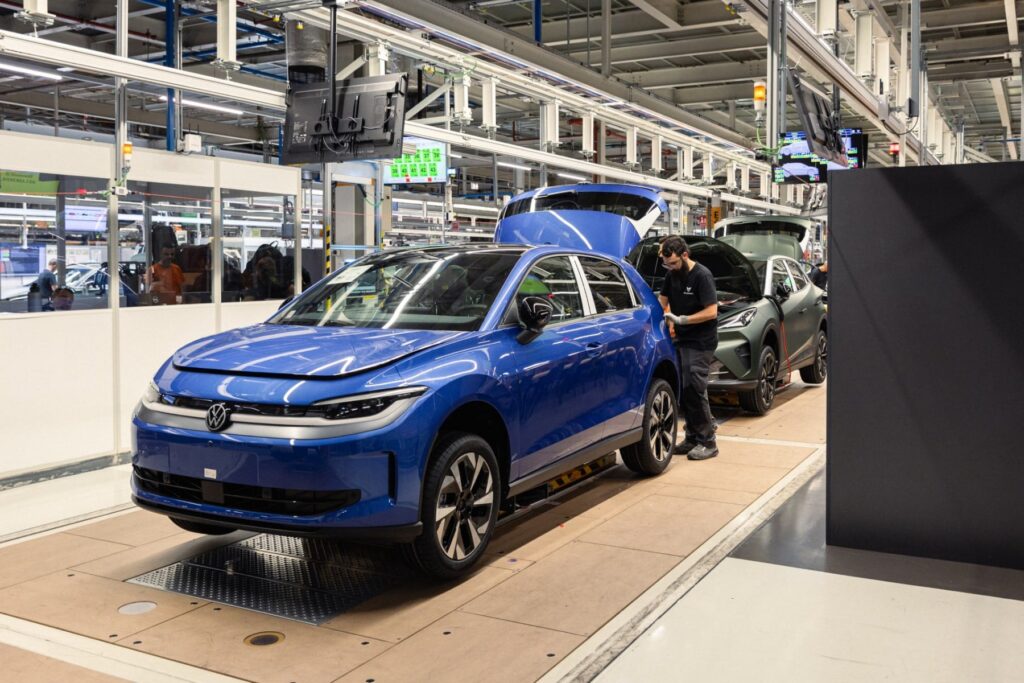
The Volkswagen ID. Polo has rapidly gained popularity, making it a surprise hit in the electric vehicle market. This unexpected demand, however, has posed significant challenges for Volkswagen in terms of production and delivery. As of September’s end, the electric compact car had received approximately 53,000 orders, a figure disclosed by VW brand chief Thomas Schäfer at the Paris Motor Show in October, which is likely even higher now.
Customers looking to purchase the VW ID. Polo are facing extensive waiting periods, as reported by dealers to Automobilwoche. The wait has increased to over a year, compared to the ten months reported in September. According to Motor.es, delivery times fluctuate based on the model: the base Trend version priced at €24,995 in Germany may take up to 21 months to deliver, while the Sportline and GTI models have shorter wait times of five and seven months, respectively.
VW ID. Polo Production Expansion Plans
Volkswagen is experiencing this surge in demand at a challenging time. Production at the Martorell plant in Spain, which also manufactures the Cupra Raval, is yet to reach full capacity. A VW spokesperson noted that the plant currently produces up to 1,000 electric cars daily. Plans are in place to increase production to three shifts, aiming for 1,200 vehicles per day, or about 300,000 units annually, by the first half of 2027.
A VW representative explained to Automobilwoche, “Production capacities and the ramp-up of new models are planned long-term and cannot be adjusted short-term to the same extent as this dynamically increasing demand.” The demand has been “significantly more dynamic than originally expected.”
Seat-Cupra CEO Markus Haupt commented to Spanish media in October that expanding production would take time, initially increasing to two and a half shifts, with daily production of around 930 vehicles. Transitioning to three shifts will require secured supplier logistics and workforce planning, leading Seat to hire nearly 1,000 additional employees.
Battery Supply Challenges
Supply chain issues have further complicated production, notably with battery cells. In October, a shortage led to a temporary halt in production at Martorell, reportedly resulting in about 1,900 unbuilt vehicles, according to union representatives. Spanish reports also noted ongoing disruptions and challenges in transporting battery cells from China.
Despite these challenges, Martorell has a high-capacity battery assembly facility capable of producing up to 1,200 battery systems daily. The cells themselves are supplied by companies such as Gotion. VW’s PowerCo gigafactory in Sagunto, Spain, is expected to begin stable series production in the first half of 2027, with pre-series production scheduled for autumn.
Impact on Cupra Raval and Other Models
The VW ID. Polo’s demand is mirrored by the Cupra Raval, which has also exceeded production forecasts with over 52,000 orders. Combined, these models have amassed over 100,000 orders. For Volkswagen’s Electric Urban Car Family, which includes the VW ID. Polo, Cupra Raval, VW ID. Cross, and Škoda Epiq, there were about 150,000 orders by the end of September.
The Pamplona plant produces the two compact electric SUVs, sharing an assembly line with internal combustion models T-Cross and Taigo. Volkswagen plans to manufacture a total of 360,000 vehicles there in 2027. The Škoda Epiq is also seeing high demand, with Spanish media reporting over 80,000 orders and wait times of up to 17 months in Germany.
Challenges for Volkswagen’s Electric Vehicle Strategy
Volkswagen faces the task of deciding how quickly to expand production capacities and determine model prioritization. Increasing ID. Polo production in Martorell without altering current utilization could affect the Cupra Raval’s output. Additional production lines would involve significant investment and months of planning. Moreover, short-term supplier orders could increase procurement costs. The success of Volkswagen’s new electric compact car family presents substantial challenges in production, supply chains, and profitability.
The high demand for electric vehicles is not unique to Volkswagen. According to the German Association of Automobile Dealers (VAD), over 40 percent of new car orders involve electric vehicles, with delivery times ranging from three months to over a year, depending on the manufacturer. VAD president Burkhard Weller stated, “Our customers sometimes have to wait extremely long for their electric cars and are rightfully frustrated.” Despite high registration figures for electric cars, with a recent 37 percent market share in Germany, many orders remain undelivered and unregistered, reflecting the trend with a delay.
automobilwoche.de (DE), motor.es (Spanish), autohaus.de (DE)
Original Story at www.electrive.com