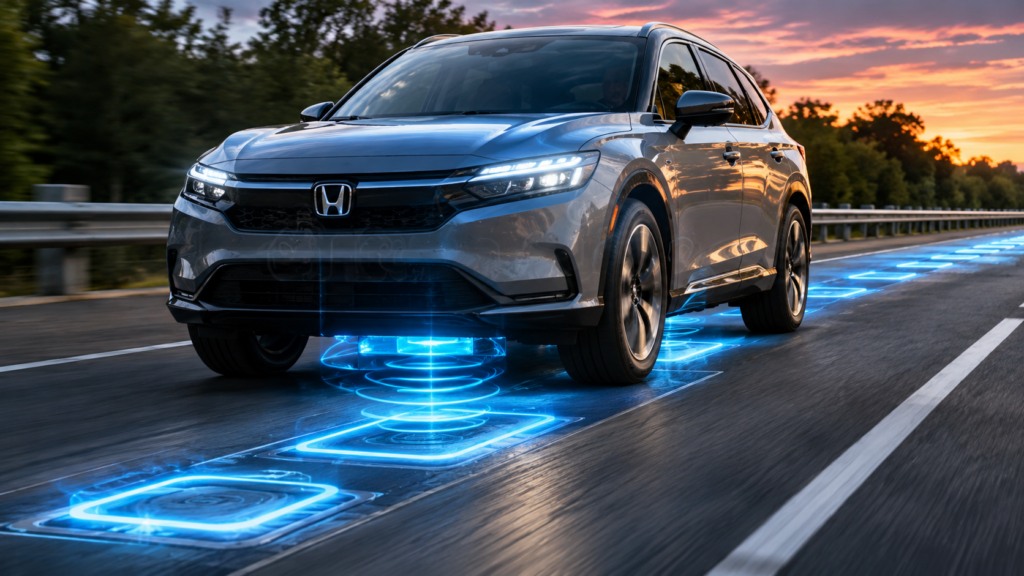
Imagine a world where electric vehicles could charge on the move, eliminating the need for lengthy stops at charging stations. This futuristic vision is inching closer to reality as automakers and researchers explore wireless charging technology for roads.
Charging Roads: A Revolutionary Concept
Honda, in collaboration with Japanese companies Taisei and Taisei Rotec, is pioneering a system to wirelessly power vehicles via roads. The technology, akin to the wireless charging used for smartphones, involves embedding coils within the pavement to create a magnetic field that transmits electricity to receivers under vehicles.
The company’s ambitious project aims to test this system on a public highway by Japan’s fiscal year 2027, targeting a power delivery of up to 150 kilowatts—comparable to existing highway fast-charging stations. This development could potentially allow vehicles to recharge without pausing their journey.
Global Efforts in Wireless Charging
The exploration of in-motion vehicle charging isn’t limited to Honda. In the United States, Purdue University, in collaboration with the Indiana Department of Transportation and Cummins, has demonstrated this technology by charging an electric semi-truck while it traveled at 65 mph. Their system, installed on a quarter-mile stretch in West Lafayette, Indiana, delivered between 50 to 190 kilowatts with an efficiency rate nearing 85%.

Image: Purdue University/Photo by Kelsey Lefever
Beyond the U.S., Electreon, an Israeli company, has been instrumental in creating wireless charging roads, with installations in Detroit and on France’s A10 motorway. Florida is also joining the trend with a project to establish a three-quarter-mile charging section on State Road 516, aiming to deliver up to 200 kilowatts of power.
The Federal Highway Administration is backing these initiatives, recognizing the potential benefits despite the high costs. An Indiana study suggests that each mile of wireless charging lane might exceed $6 million, but the payoff could transform the electric vehicle landscape.
Trucking Industry: A Catalyst for Change
Wireless charging could be particularly transformative for the trucking industry. Electric trucks require large, costly batteries for long hauls. If they could recharge while on the move, smaller and lighter batteries would suffice, optimizing cargo space and reducing costs. This practical approach could make it feasible to electrify key trucking routes, enhancing efficiency without overhauling the entire highway system.

With focused efforts on busy routes frequented by commercial trucks, wireless charging stands as a promising advancement in sustainable transportation, potentially reshaping how electric vehicles are powered and paving the way for a more efficient future.
Original Story at banyanhill.com