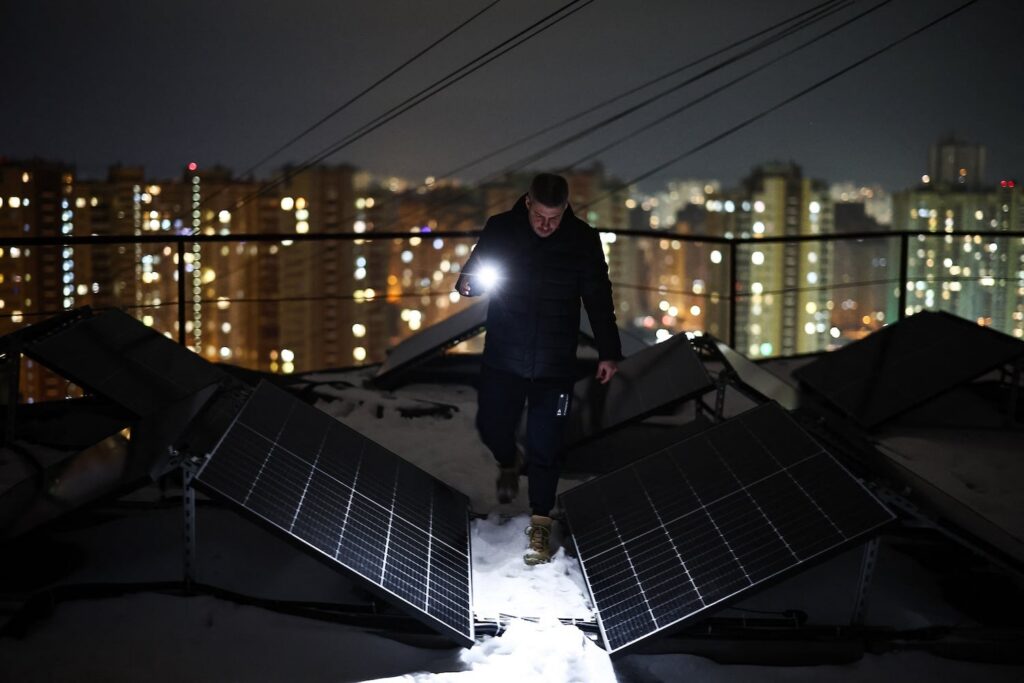
Ukraine’s Energy Struggle: Renewables and Resilience Amidst Conflict
As winter approaches, Ukraine faces a daunting challenge: maintaining energy security in the face of relentless Russian strikes on its conventional energy infrastructure. The threat of cities like Kyiv becoming uninhabitable has prompted Ukraine to enhance its decentralized energy systems, integrating small gas-fired plants and renewable sources as a protective measure against large-scale disruptions.
Ukrainian officials and analysts agree that renewables and nuclear energy are pivotal for the nation’s security, while natural gas is essential for grid stability. Despite significant progress in deploying decentralized energy systems, the transformation is not keeping pace with the urgent demands of winter and ongoing conflict. By mid-2026, Ukraine had increased its renewable energy capacity by approximately 16 percent from early 2025 levels. The country installed 70 wind turbines in the Mykolaiv and Odesa regions and launched its largest wind farm near the Black Sea.
Solar energy has also seen a boost, with enough capacity added to power between 600,000 to 800,000 European households. European nations have funded solar-plus-battery systems for over 100 healthcare facilities in Ukraine. The country now ranks as Europe’s fourth-largest battery storage market, driven by significant investments from homeowners and businesses, marking a fivefold increase over 2024.
Maxim Timchenko, CEO of DTEK, Ukraine’s largest utility, highlighted at the World Economic Forum that decentralized energy resources like wind, solar, and storage offer resilience, being “harder to target, quicker to repair and more capable of stabilizing the grid during emergencies.” Despite this, DTEK still focuses more on restoring coal-fired plants than on expanding renewable and gas-fired systems.
Ukrainian energy expert Mykhailo Lukianyk noted the practicality of restoring conventional heating supplies, given the circumstances. “A larger makeover requires more investment, planning, and time,” he emphasized. Andriy Martynyuk, director of Ecoclub, echoed the sentiment, acknowledging the challenge of finding a single energy solution suitable for Ukraine’s harsh winters and wartime conditions.
In Rivne, emergency outages have been managed better than in other regions, thanks to renewable energy’s role in supporting critical infrastructure. The City Center Hospital’s 214 solar panels, paired with batteries funded by the German government, have maintained operations during blackouts, although they cannot fully replace grid power.
Rivne’s energy resilience extends to an intelligent monitoring system tracking consumption across 188 public buildings. This system, developed with EU funding, aids in emissions reduction and energy upgrades, offering a real-time overview of municipal resource usage.
The cost-effectiveness of renewables is significant, especially with high gas prices. Facilities with solar and battery setups can cut energy costs by up to 70 percent, making them an attractive option for energy savings.
However, challenges remain. Ukraine’s distributed generation program falls short of its ambitions, with less than half of healthcare facilities equipped with renewable systems. Volodymyr Kudrytskyi criticized the program as “effectively a failure,” advocating for a network that is “dozens of times harder to scout and destroy.”
Despite international funding efforts, such as the Ukraine Energy Support Fund, the financial support does not match the scale of destruction. The Razumkov Center highlighted the disparity between plans and reality, noting the difficulty in securing international investment due to war-risk factors.
The International Energy Agency praised Ukraine’s renewable energy efforts as vital for resilience but stressed that reliance on energy imports and local cogeneration remains essential. Ultimately, maintaining air defense is crucial for the nation’s energy system amidst the conflict.
Original Story at foreignpolicy.com