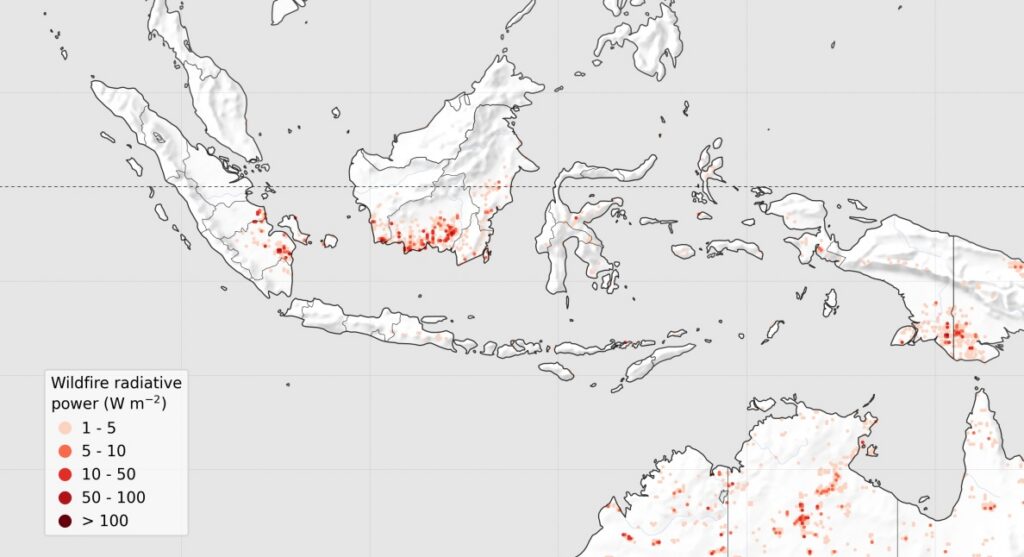
Escalating Fire Crisis in Southeast Asia Sparks Health and Economic Concerns
Climate change and El Niño conditions have converged to fuel one of the most severe fire seasons in recent history across Indonesia and Papua New Guinea. The resulting fires have devastated the region, causing widespread health issues and significant economic losses.
The Copernicus Atmosphere Monitoring Service (CAMS), part of the European Union’s Earth Observation Programme, has labeled the fire season as “exceptional” in a recent report. Mark Parrington, a scientist at the European Centre for Medium-Range Weather Forecasts (ECMWF), highlighted the significant health impacts and poor air quality resulting from the persistent fires.
Regional Health and Environmental Consequences
In Indonesia alone, the fires have scorched over 88,000 km2, leading to thousands of deaths and hundreds of thousands of respiratory infections, according to the Centre for Research on Energy and Clean Air (CRECA). The smoke has impacted air quality across Southeast Asia, including Singapore, Malaysia, and the Philippines, with Singapore experiencing severe haze episodes and substantial economic costs.
Long-Term Air Quality Challenges
Since September, Southeast Asia has faced prolonged air pollution, exacerbated by the fires. As of mid-November, fire emissions in Indonesia had reached the third highest levels since 2003, releasing 200 megatonnes of carbon, according to CAMS Global Fire Assimilation System data. The emissions are comparable to previous El Niño years, with Papua New Guinea also recording high emissions.
Historical Fire Emission Patterns
This year’s emissions starkly contrast with the unusually low levels recorded in previous dry seasons. Despite efforts by Indonesia and ASEAN countries to mitigate fire events, the 2026 season has been particularly severe, driven by both natural and human-induced factors.
Climate Change and El Niño’s Role
El Niño, while natural, intensifies dry conditions in Southeast Asia, making peatlands susceptible to fires. These ecosystems, crucial for carbon storage, are at risk when drained for agriculture, leading to prolonged underground fires. Laurence Rouil, director of CAMS, noted, “High temperatures and a lack of rainfall… driven by strong El Niño conditions and human-induced climate change, favoured this exceptional fire season.”
Image Credits: Copernicus, Minh Tran, CAMS, CAMS Global Fire Assimilation System v1.2., International Peatland Society.
Original Story at healthpolicy-watch.news