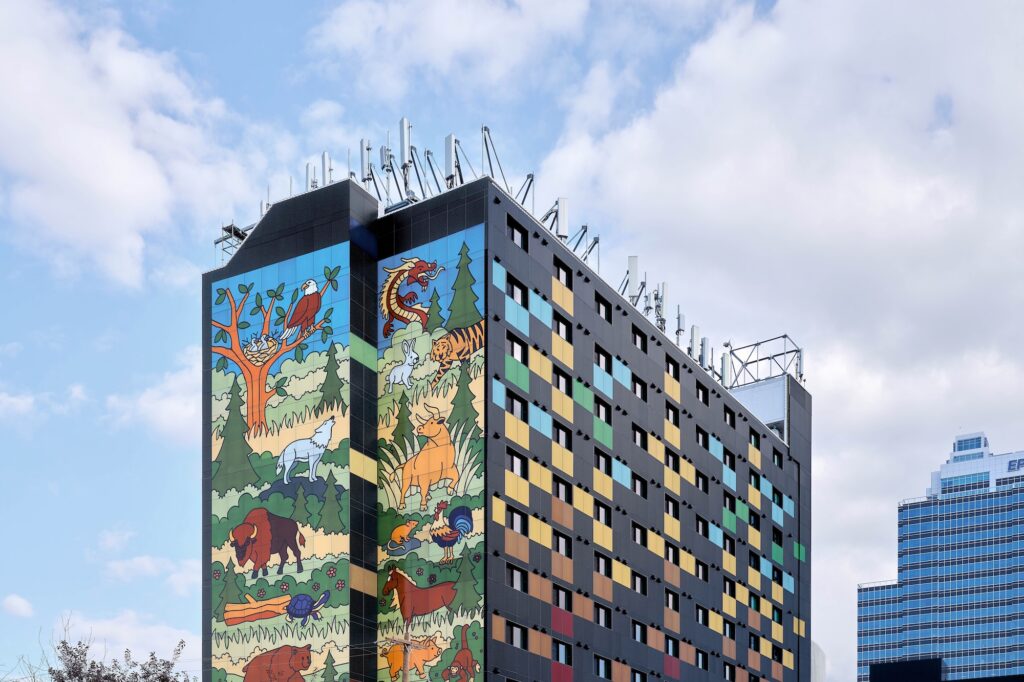
In downtown Edmonton, Canada, a unique structure stands out not only for its height but also for its innovative design. The SunRise Tower, a 12-story building, is adorned with the world’s largest solar panel mural, covering an impressive 4,000 square feet. This mural artistically represents animals significant to both Chinese and Cree cultures, showcasing the area’s rich cultural diversity.
The typical aesthetic of black solar panels has often met with resistance from communities concerned about maintaining visual appeal, especially in relation to historical preservation and local landscapes. However, the integration of solar art, as seen in Edmonton, offers a potential solution to these concerns. Yet, this approach does come with challenges distinct from traditional solar panels.
Understanding Solar Art
Unlike traditional solar panels that aim to blend into rooftops or remain out of sight, solar art embraces visibility. This innovative approach transforms solar panels into vibrant murals that capture solar energy while also serving as public art.

Initially, solar art installations were small-scale sculptures in public and museum settings. These projects primarily aimed to make an artistic statement rather than to generate power. However, more recent endeavors, like the Edmonton mural, integrate art into functional energy solutions for buildings with renewable goals.
The Aesthetic Appeal of Solar Panels
The expansion of solar panels over the years is largely due to decreased costs, making them more common in communities. Despite this, concerns about aesthetics and other issues persist. Artfully designed solar panels might address some of these concerns by making photovoltaics visually appealing.

While concrete evidence on the public’s acceptance of solar art is limited, a 2026 preprint study from Singapore indicates that solar murals are more visually appealing to people than traditional black panels, especially on historic buildings.
Performance of Solar Art Panels
Traditional solar panels are typically black to maximize sunlight absorption. In contrast, solar panels with art are less efficient. For instance, Edmonton’s mural panels are approximately 30 percent less efficient than regular panels, according to Dustin Tonsi, project manager at Chandos Construction.

The aesthetic aspect adds additional costs, as the artwork requires custom designs printed on special film to cover standard panels. These costs are generally not covered by typical renewable energy subsidies.
Examples and Future of Solar Art
Prominent examples of solar art include the Edmonton SunRise Tower’s mural, designed by Indigenous artist Lance Cardinal, which features culturally significant animals. Despite a slight efficiency loss, the building’s redesign met sustainability requirements with the help of the Canada Infrastructure Bank.

Smaller projects like the murals at Cherry Street Farm in Seattle, supported by the Land Art Generator Initiative, also demonstrate the community value of solar art. These initiatives highlight the potential for solar art to enhance public spaces while promoting renewable energy.
While public funding, such as grants from the U.S. Department of Energy, has supported some solar art projects, widespread investment in aesthetically pleasing solar panels remains limited. As a result, solar murals are still relatively rare but are gaining attention as a creative approach to integrating renewable energy in public and historical spaces.
Original Story at triplepundit.com