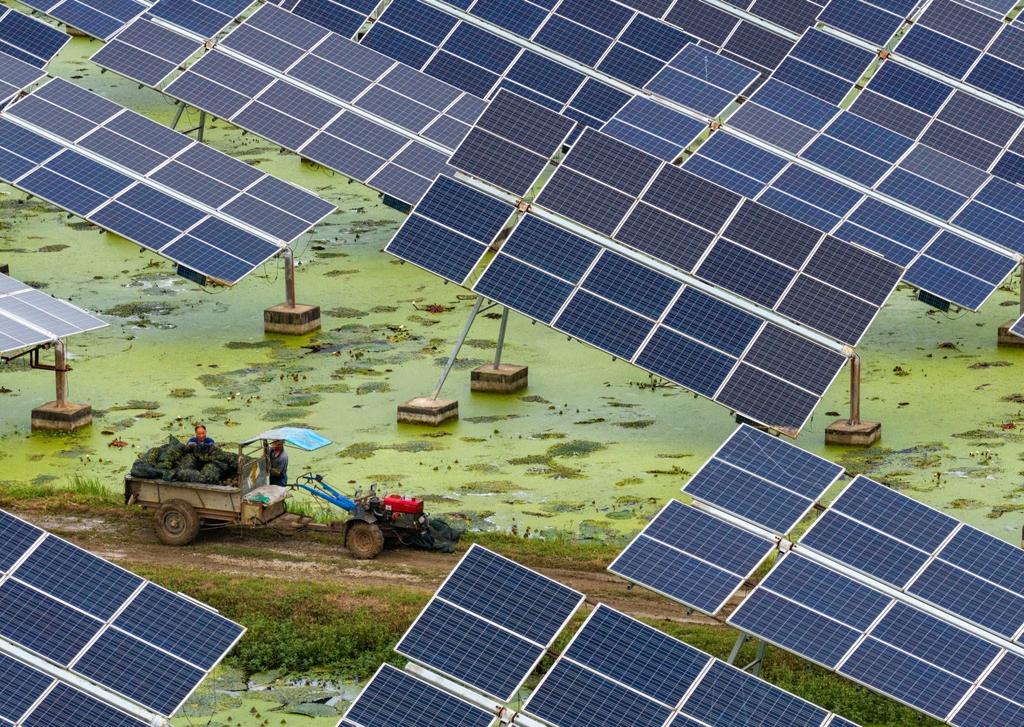
China’s Energy Landscape: A Shift Towards Renewables Amid Declining Fossil Fuel Production
Amid an evolving energy landscape, China has witnessed a third consecutive month of decline in coal and gas production as solar, wind, and nuclear energy have risen to meet new electricity demands. Despite a decrease in fossil fuel imports and domestic coal production, there has been a notable acceleration in the addition of thermal power capacity. The rise in electric vehicle exports continues to bolster the production of new energy vehicles, even as the domestic automobile market faces challenges.
Key Highlights
- Decline in Coal and Gas Generation: September marked a 1.4% year-on-year decrease in coal and gas power generation, continuing a three-month trend. This comes as solar, wind, and nuclear energy have successfully offset the shortfall in hydropower.
- Fossil Fuel Imports Drop: Both fossil fuel imports and domestic coal production fell in September, reflecting reduced consumption levels.
- Thermal Power Capacity Surge: Thermal power capacity increased to a record 58.7 GW in the first eight months of the year, with solar and wind installations also seeing growth.
- NEV Export Boom: New energy vehicle exports reached 4 million units over the first nine months of 2026, a 130% increase from the previous year, counterbalancing weak domestic sales.
- Stagnation in Carbon-Intensive Industries: Industries such as crude steel and cement production have seen significant declines, reaching multi-year lows.
Renewable Energy Gains Ground
Driven by the rise of wind, solar, and nuclear power, large-scale power production saw a 1.2% increase in September despite a 1.2% decline in coal power generation. The contribution from gas power rose by 8.5%, yet its minor role in the power mix meant it had a limited effect on overall electricity generation. Solar and wind power grew by 21.6% and 16.6% year-on-year, respectively, while nuclear power saw a significant increase of 22.4%, hitting a multi-year high.
Imports and Production Trends
September saw a 5.7% drop in coal imports, marking the second consecutive monthly decline. Crude oil imports fell by 21.5% due to disruptions through the Strait of Hormuz, with a 15.3% decrease in import volumes reported for the year’s first nine months. Natural gas imports similarly decreased by 1.7% year-on-year.
Domestic Coal and Industry Output
Domestic coal output contracted by 6.8% year-on-year in September, contributing to a 3.5% decrease over the first nine months compared to 2025. Natural gas production dipped by 1%, while crude oil production increased by 2.2%. Carbon-intensive industries continued to stagnate, with crude steel output flatlining and cement production dropping by 5.3% in August, the lowest since 2020.
Thermal Power and Renewable Capacity Additions
The first eight months of 2026 saw the addition of 97.2 GW of solar power capacity, a 58% decrease from 2025. Wind power capacity grew by 53.3 GW, slightly down from last year but still above pre-2025 levels. Notably, thermal power capacity grew by 18% from last year, the highest in 15 years. August alone saw 11.1 GW of solar and 6.2 GW of wind power added, reflecting a recovery from a 2025 slump.
Regional Leaders in Clean Energy
Jiangsu, Henan, Yunnan, and Xinjiang lead the way in solar installations, while Xinjiang, Inner Mongolia, and Shandong dominate wind power development. Anhui, Hubei, Guangdong, and Hebei saw the most significant increases in thermal power capacity.
Solar and Battery Production
While solar cell production fell by 5.1% year-on-year in September, battery production rose significantly by 57.3%, driven by strong energy storage demand and export markets.
NEV Market Dynamics
New Energy Vehicle production grew by 16.9% in September, with 61% of all vehicles produced being NEVs. Despite a 9.4% fall in domestic NEV sales, exports surged by 160% year-on-year. Over nine months, NEV exports reached 4 million units, marking a 130% increase from the previous year.
Further Reading:
Beyond the headline targets: What China’s 15th Five-Year Plans mean for its green transition
Five years on: China seeds overseas renewables growth but coal ban gaps persist
Analysis: China’s CO2 emissions fall in Q2 2026 due to plummeting oil use
Built for backup, contracted to run: China’s coal support system risks crowding out clean power
China’s new energy plan leaves emissions loose
China’s CO2 climbs 2% in early 2026 due to ‘wasted’ wind and solar
What drove China’s historic drop in power-sector emissions?
China’s new carbon metric leaves Germany-sized gap in its emissions
Reclaiming credibility in China’s steel industry: Climate ambition, financial resilience, and market trust
China’s 15th Five-Year Plan — Implications for climate and energy transition
Original Story at energyandcleanair.org