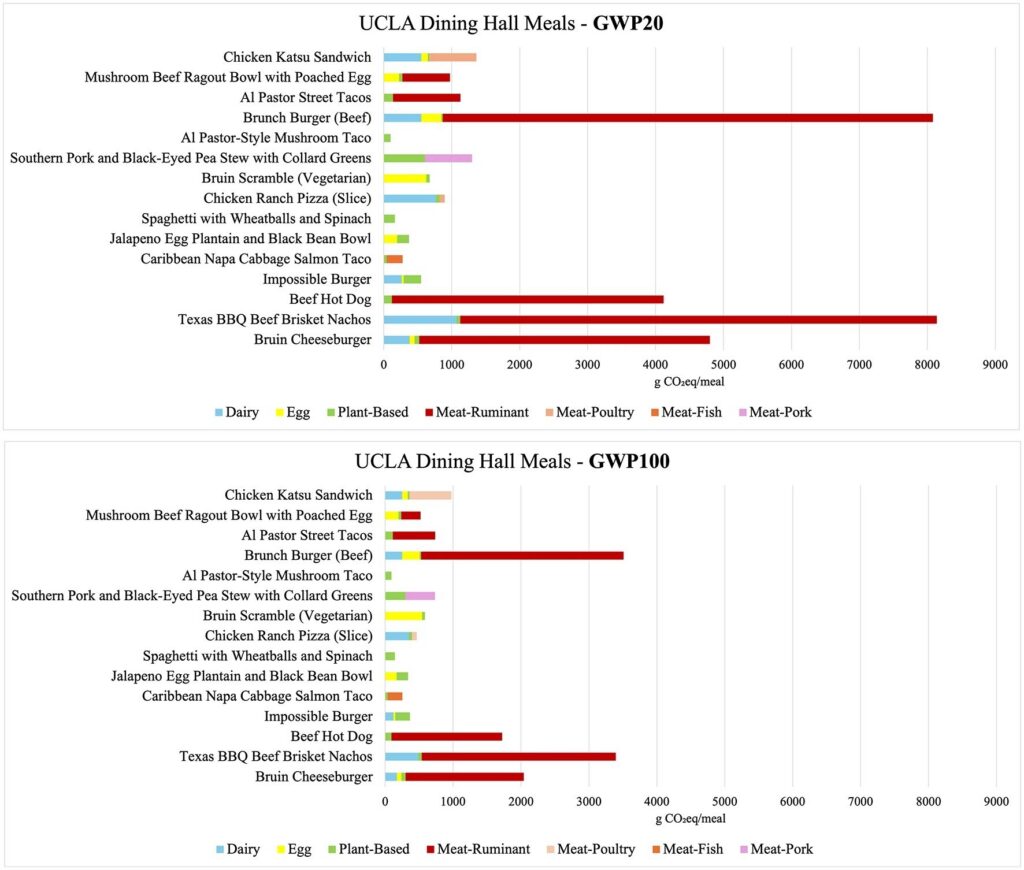
As the world grapples with climate change, the role of beef and dairy in greenhouse gas emissions is under renewed scrutiny. A recent study from the University of California, Los Angeles, in collaboration with the Center for Biological Diversity, highlights how traditional methods may underestimate the environmental impact of these food products.
“This analysis shows how beef-heavy menus are pushing us farther from the emissions reductions needed to slow climate change,” stated Jennifer Molidor, senior food campaigner at the Center for Biological Diversity. The study suggests that more accurate assessments of food emissions could help institutions and policymakers set better-targeted goals.
The research evaluated the greenhouse gas emissions, particularly methane, for 16 food categories and 222 specific foods served at UCLA cafeterias, utilizing both short-term (20-year) and long-term (100-year) perspectives. It revealed that the climate impact of beef and dairy is more than double when assessed over a shorter, 20-year period.
Jennifer Jay, Ph.D., senior author and professor at UCLA’s Department of Civil and Environmental Engineering, noted, “The 100-year timeframe that’s been in use was chosen arbitrarily, and it undercounts the contribution of methane compared to calculations using shorter timeframes of interest. This work allows us to better understand the benefits to be gained through changes in personal food choices and institutional food systems.”
The study’s unique approach uses the Global Warming Potential metric over 20 years (GWP20) alongside the standard 100-year metric (GWP100) to demonstrate how dietary impacts fluctuate with timeframes. Methane’s short-term potency—over 80 times that of carbon over 20 years—draws significant attention to beef, lamb, and dairy’s true impact on global warming.
Applying GWP20 in conjunction with GWP100 for food emissions calculations could influence carbon footprint labels, consumer decisions, and broader food policies. It might also affect agricultural production, commodity purchasing, subsidies, and institutional procurement practices.
In addition to their findings, UCLA and the Center for Biological Diversity have introduced a Planetary Calculator to evaluate the climate, land, and water impacts of various foods. This tool employs both GWP metrics to provide a clearer environmental assessment of meals.
Background
The food and agriculture sector is responsible for over one-third of greenhouse gas emissions contributing to climate change. The U.N. Food and Agriculture Organization reports that the United States is among a few nations where meat consumption exceeds 220 pounds per person annually. Americans, in particular, consume beef at four times the global average, significantly raising methane emissions.
Research indicates that cutting beef consumption by 90% might be crucial in mitigating the climate crisis.
The Intergovernmental Panel on Climate Change’s Sixth Assessment stresses the need to reduce methane emissions and address the immediate effects of greenhouse gases on the climate, environment, and human health.
Additional resources: Cows and Climate Change Factsheet.
Original Story at biologicaldiversity.org