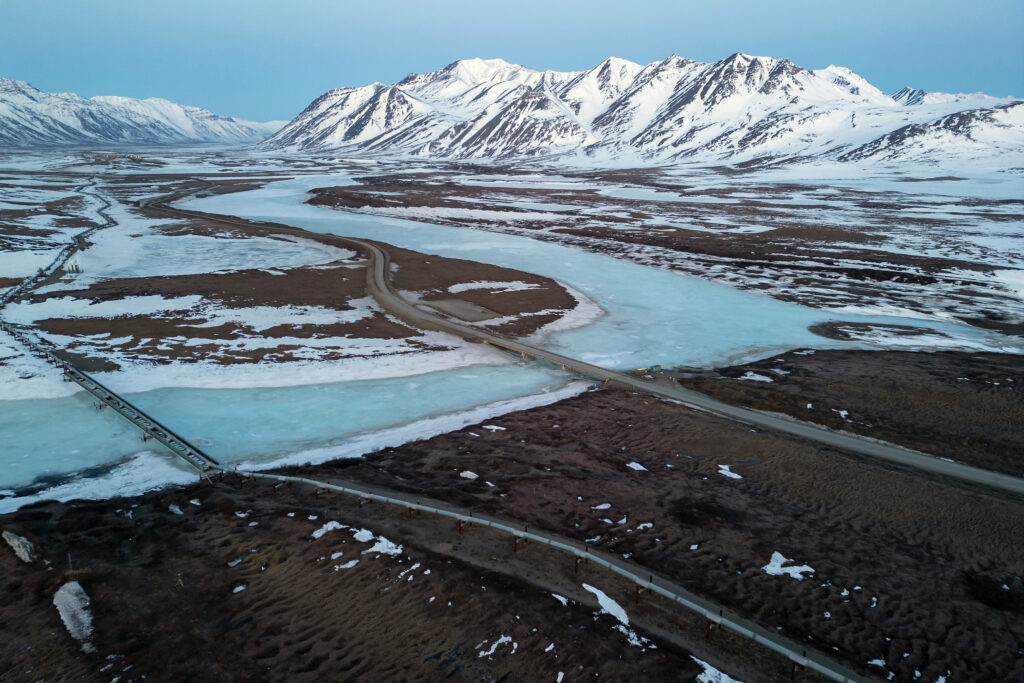
Oil companies are no longer required to conduct environmental reviews before exploring for fossil fuels in the Western Arctic, the largest federally managed public land in the U.S.
The Bureau of Land Management announced a categorical exclusion under the National Environmental Policy Act for winter oil and gas exploration in the National Petroleum Reserve-Alaska. Published in the Federal Register, the exemption aligns with the Trump administration’s efforts to accelerate Arctic drilling in Alaska.
This exclusion allows developers to efficiently locate energy resources, potentially increasing domestic energy supply and reducing public costs, according to Kevin Pendergast, Alaska State Director for the Bureau of Land Management. The agency cites a history of exploration without “significant or lasting environmental impact.”
During Arctic exploration, oil firms construct temporary roads, drill test wells, and conduct seismic surveys using “thumper trucks” to detect oil deposits. These operations are typically conducted in winter to avoid damaging the delicate tundra and permafrost.
However, these activities pose risks to residents and the ecosystem. The Western Arctic, home to the Iñupiat people, is a critical habitat for caribou, whose numbers have dwindled significantly since the 1990s, as noted in the National Oceanic and Atmospheric Administration’s 2024 Arctic Report Card.
Arctic development disrupts caribou migration and calving areas. Research by the United States Geological Survey has documented behavioral changes in caribou due to vehicle traffic.
The reserve also houses millions of migratory birds, polar bears, and seals, all affected by habitat loss due to melting sea ice. Warming at two to four times the global rate, the Arctic faces a feedback loop of increasing temperatures and ice melt.
Critics argue the exclusion exacerbates environmental harm. “The Trump administration will ignore impacts to public lands if it benefits resource extraction corporations,” said Andy Moderow of the Alaska Wilderness League. “This approach risks Arctic lands, waters, and wildlife.”
Opponents also question the exclusion’s legality. “The administration finalized this new approach without public input,” said Janet Bering, an attorney with Earthjustice. “It’s unlawful.”
The Bureau of Land Management proposed a rule to expedite Arctic drilling by reducing environmental review and public input. This rule follows a petition from the Alaska Oil and Gas Association, which represents firms in Alaska. The association has not commented on the decision.
The push for Arctic oil extraction has elicited varied responses from Alaska Natives. Some Iñupiat communities expect economic benefits, while others fear the impact on lands vital for subsistence hunting and cultural preservation.
Rosemary Ahtuangaruak, a former mayor of Nuiqsut, noted that caribou have moved farther from the community due to ConocoPhillips’ expanding operations. Situated near the petroleum reserve, Nuiqsut residents have long advocated for stronger environmental measures.
“We should not let profiteering dictate decisions at the expense of people and future generations,” Ahtuangaruak said.
Designated as a petroleum reserve in 1923, the area was largely preserved until the late 20th century. In 1998, 87% of the reserve was opened to leases, but few acres were developed. The Biden administration later approved the Willow Project but restricted leasing areas. Subsequently, the Trump administration reopened 82% of the region to leasing.
Original Story at insideclimatenews.org