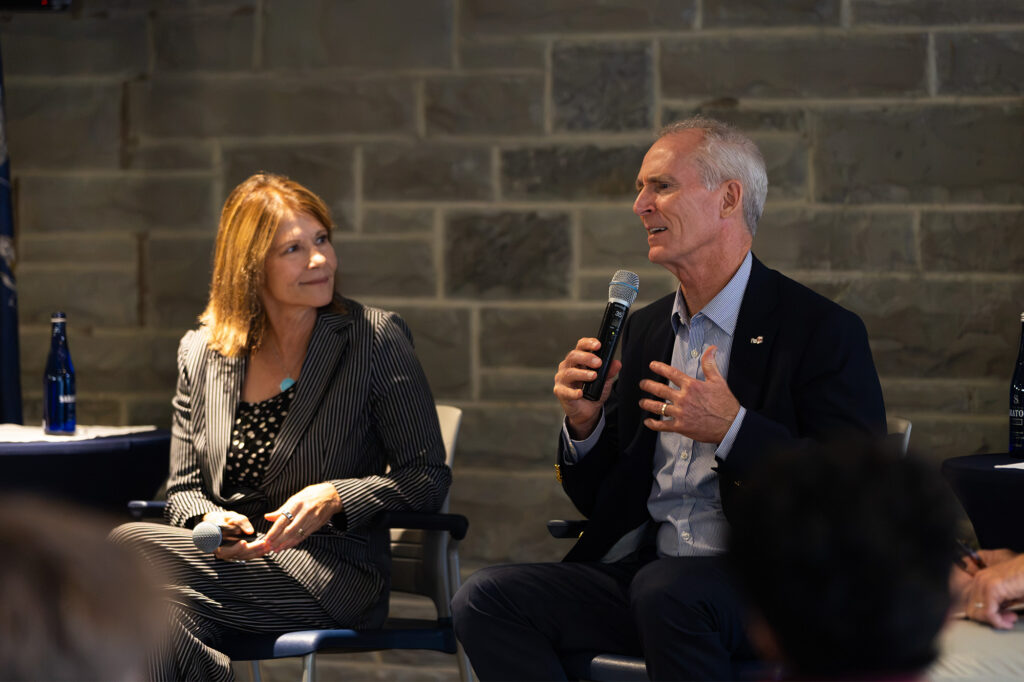
In a time when political divisions often make headlines, Ithaca College provided a platform for civil dialogue on critical issues like climate change during the visit of former U.S. congressional representatives. As part of the Association of Former Members of Congress’s Congress to Campus program, two ex-lawmakers shared insights and experiences on navigating bipartisan cooperation and policymaking.
On September 29 and 30, the Ithaca College community hosted Cheri Bustos, a former Democratic representative from Illinois, and Bob Inglis, a former Republican representative from South Carolina. Their visit included discussions, campus tours, and classroom interactions, focusing on the theme of civil dialogue in the face of climate change challenges.
The Rooms Where it Happened
During a conversation titled “The Rooms Where it Happened,” Bustos and Inglis discussed their experiences working on climate and environmental legislation. Inglis recounted his transformation from a climate change skeptic during his initial congressional term from 1993 to 1999 to an advocate for environmental issues, influenced by family discussions and a revealing trip to Antarctica.
After returning to Congress from 2005 to 2011, Inglis introduced the Raise Wages, Cut Carbon Act of 2009, a carbon tax proposal. Currently, he leads republicEn.org, promoting climate change awareness among conservatives. “The wonderful thing about being in Congress … is just this mission and purpose that you have every day,” Inglis said. He noted that framing climate change as a business opportunity and a national security concern has helped engage conservative audiences.
Bustos, who served from 2013 to 2023, highlighted her role in passing the Inflation Reduction Act under President Joe Biden. The legislation aimed to invest $375 billion over a decade to combat climate change, yet faced obstacles due to its partisan nature. “There was a lot of great policy in there,” Bustos said, emphasizing the political challenges in implementing policy effectively.
Both representatives acknowledged the difficulty of navigating partisanship in Congress. Inglis pointed out the challenges of passing climate legislation that is often burdened with additional policies. “Maybe if we could just get a simple price on carbon dioxide across the finish line, we could begin solving the climate problem,” he stated.
Bustos encouraged students to register and vote, highlighting low voter turnout among young people. “You have so much power in your hands if you vote,” she said, urging students to actively participate in political processes beyond protests.
Senior Isa Hernandez, a facilitator of the discussion, appreciated the focus on individual actions leading to structural change. “That cross-section between law, advocacy, public policy and getting the young population excited about change is really crucial at a time that is really volatile and really unstable,” Hernandez remarked.
Governing Technology in a Changing Climate
On September 30, a discussion titled “Governing Technology in a Changing Climate” featured Bustos, Inglis, and local Tompkins County officials. The conversation centered on community sustainability projects and the implications of data centers on local environments.
Dan Lamb, deputy supervisor of the town of Dryden, highlighted the town’s achievements in expanding sustainable energy initiatives. “We added more solar capacity than any town in New York,” Lamb stated, emphasizing the benefits of community solar options.
Irene Weiser, a Tompkins County legislator and coordinator of Fossil Free Tompkins, discussed the group’s success in closing a coal plant in Lansing and opposing natural gas infrastructure expansion. “We shouldn’t be building more gas infrastructure,” Weiser argued, advocating for a transition to renewable energy sources like heat pumps.
Dr. Anna Kelles, a Tompkins County representative, shared concerns over potential proliferation of data centers in upstate New York. She played a role in passing the Responsible Data Center Development Act, which temporarily halts permits for data centers while assessing environmental impacts.
The discussion underscored the importance of local initiatives in addressing climate challenges and highlighted the respect and cooperation among officials despite political differences. “I think that that’s where some of the best policy comes from, when it is rooted in the actual needs of the community,” Weiser concluded.
Original Story at theithacan.org