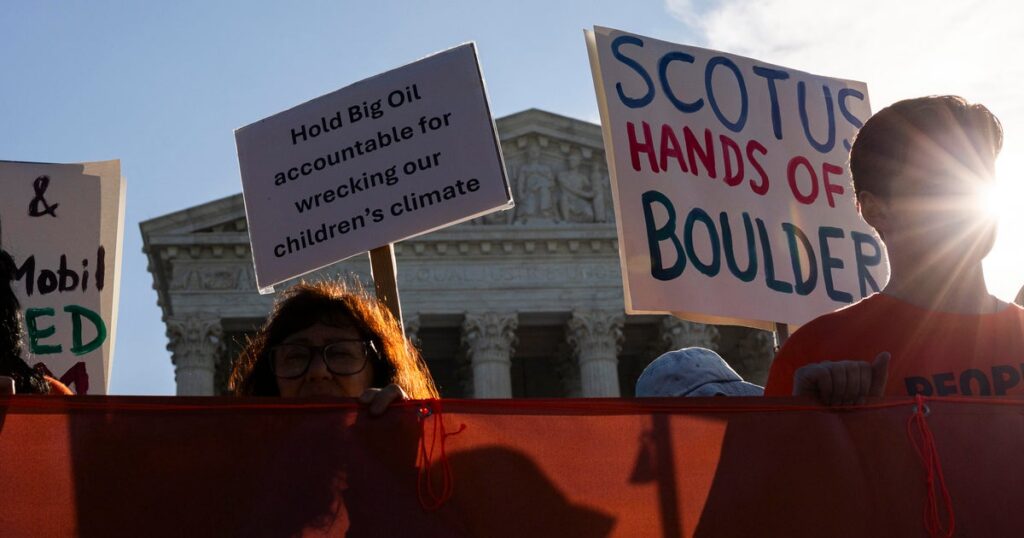
Washington — A pivotal legal battle unfolded in the Supreme Court on Monday as justices deliberated the responsibilities of energy companies like Exxon Mobil and Suncor Energy in global climate change. This high-profile case, brought by the city and county of Boulder, Colorado, seeks to address the financial consequences of climate-related damages.
Eight justices, absent Justice Samuel Alito who recused himself, engaged in nearly two hours of oral arguments. Alito’s decision to step aside, reportedly due to his financial interests in energy companies like ConocoPhillips and Phillips 66, raises the possibility of a 4-4 deadlock, which would uphold the Colorado Supreme Court’s ruling allowing Boulder’s lawsuit to proceed.
The Supreme Court’s task is to determine if Boulder’s lawsuit can move forward or if federal law prevents it. Additionally, the justices are evaluating whether they possess the jurisdiction to overrule the Colorado Supreme Court’s decision.
Justice Brett Kavanaugh highlighted precedents indicating that interstate air and water pollution issues fall under federal law, referencing four Supreme Court decisions since 1972. “We don’t have to reinvent the wheel,” he remarked, noting that Congress has historically aligned with these precedents, notably in the Clean Air Act.
The Trump administration has thrown its support behind Exxon and Suncor, with arguments suggesting Boulder’s lawsuit “egregiously exceeds” state authority limits. Sarah Harris, representing the energy companies, argued that “interstate air pollution is an inherently federal area,” and the Clean Air Act does not authorize such suits.
Boulder’s Legal Challenge to Energy Companies
Boulder’s lawsuit is part of a broader initiative by states and local governments to hold energy companies accountable for the environmental impacts of greenhouse gases. The city and county allege that the actions of Exxon and Suncor have exacerbated climate change, leading to extreme weather events and ecological harm.
The case entails several state law claims against the energy companies, accusing them of facilitating unchecked fossil fuel use through deceptive marketing, thus increasing greenhouse gas concentrations. Despite attempts by Exxon and Suncor to transfer the case to federal court, the Colorado Supreme Court sided with Boulder, prompting the companies’ appeal to the U.S. Supreme Court.
Supreme Court Deliberations
Exxon and Suncor’s representative, Kannon Shanmugam, argued that the Constitution and the Clean Air Act preclude state claims addressing interstate emissions, warning that Boulder’s lawsuit could disrupt national energy policy governance. “A state does not have the power to regulate out-of-state conduct based solely on attenuated effects on the state,” he stated.
Shanmugam cautioned that a ruling in Boulder’s favor might open the floodgates for 90,000 municipalities to file similar lawsuits, potentially reshaping energy policy. Chief Justice John Roberts expressed concern about the potential for widespread litigation, asking Boulder’s attorney, Kevin Russell, about the implications of a favorable ruling for Boulder.
Despite these concerns, Roberts acknowledged that the Supreme Court has permitted state-court lawsuits with broad impacts in the past. Justice Elena Kagan likened the case to historical lawsuits against tobacco and pharmaceutical companies, observing that state claims have been allowed to proceed in similar contexts.
Justice Ketanji Brown Jackson, however, suggested the Court’s review might be “premature,” indicating uncertainty about the applicability of the proposed legal theories to the case at hand.
Russell contended that Boulder’s lawsuit does not aim to regulate emissions but addresses alleged deceptive practices in marketing and production, areas not covered by the Clean Air Act. “This litigation is not an attempt to solve climate change; it merely asks that petitioners bear their fair share of local costs incurred in part because of their tortious conduct,” he wrote.
The Supreme Court is expected to deliver its decision by summer 2027.
Original Story at www.cbsnews.com