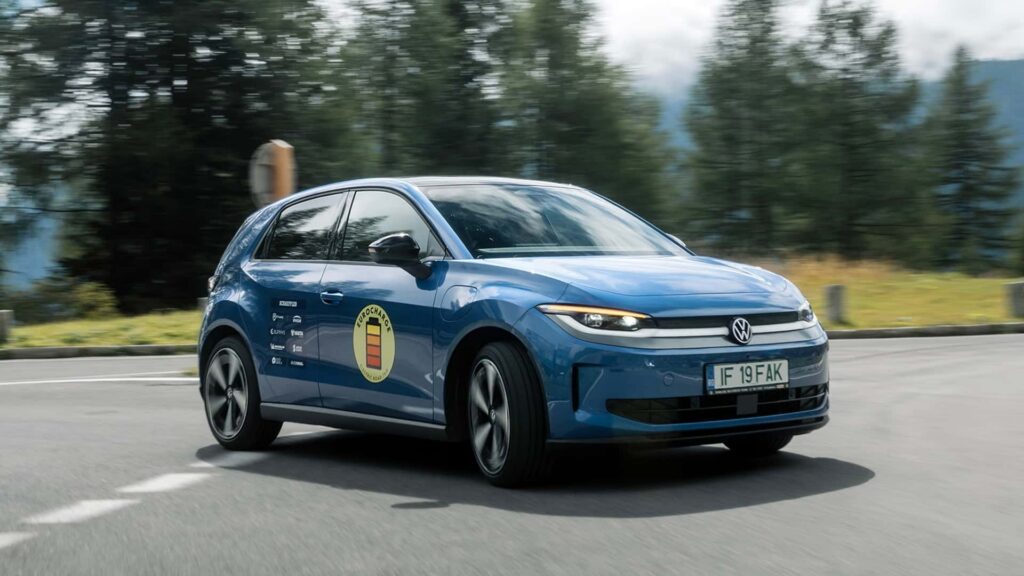
Exploring the VW ID. Polo: A Pricey Yet Compelling Electric Hatchback
With a price tag nearing €40,000, the Volkswagen ID. Polo demands justification for its cost. This electric hatchback was put to the test during the Eurocharge by Schaeffler EV grand tour, a pan-European road trip designed to evaluate electric vehicles. Despite its small stature, the ID. Polo proved to be a compelling case for those seeking efficiency and comfort in a compact package.
During the tour, the ID. Polo journeyed from Romania across Europe, reaching the Danube’s sources and returning, tackling mountainous paths and extensive motorways. The car covered an impressive 4,468 kilometers (approximately 2,776 miles) in total. On one particular day, the ID. Polo traveled 507 kilometers (315 miles) from Enzklösterle, Germany, to Hohe Salve, Austria.
Photo by: Autocritica
Accompanying the ID. Polo was the Renault 5 E-Tech, providing a direct comparison in terms of driving experience and efficiency over varied terrains. While the Renault 5 impressed with its retro design and efficiency, especially reaching its WLTP range under real-world conditions, the ID. Polo stood out for its modern aesthetics and premium feel.
Inside, the ID. Polo surprises with features uncommon in its size category. The Style variant tested came equipped with electric front seats with memory, offering armchair-like comfort for the driver. The cabin is adorned with pleasant materials, and Volkswagen has reintroduced physical buttons, enhancing user experience with real steering wheel controls and climate buttons.

Photo by: Ciprian Mihai/Autocritica
The retro-inspired instrument display is a charming nod to classic Volkswagens, with a power gauge needle that mimics the behavior of older car rev counters. This nostalgic touch extends to a retro theme for the central screen, transforming the media player icon into a cassette player.
On the road, the ID. Polo exhibited impressive composure. It smoothly handled long stretches at 130 km/h (81 mph), absorbing road imperfections quietly and effectively. This refinement contributes to the perception of it being a class above its size.
Photo by: Autocritica
Despite its excellent ride quality, the steering feedback was less confidence-inspiring. In a twisty descent through Austria’s Hochtannbergpass, the front tires lost grip without much indication through the steering wheel. Conversely, the Renault offers more thrilling handling with better grip and feel.
Photo by: Autocritica
Efficiency-wise, the ID. Polo outperformed the Renault 5, except on one occasion where they tied. The Volkswagen’s motor delivers 208 bhp and 290 Nm (214 lb-ft) of torque, surpassing the Renault’s 148 bhp and 245 Nm (181 lb-ft). This power advantage results in a quicker acceleration to 100 km/h (62 mph) in 7.1 seconds, nearly a second faster than the Renault.
Over the tour, the ID. Polo achieved an average efficiency of 15.2 kWh/100 km, compared to the Renault’s 16.6 kWh/100 km, equating to about 4.1 miles per kWh versus 3.7 miles per kWh. These findings, though not lab-based, offer insights into the vehicles’ real-world energy usage.
Photo by: Autocritica
During a 507-kilometer journey, the ID. Polo required just a single 17-minute charging stop, boosting the battery from 30% to 81%. Starting almost fully charged at 99% and ending the day with 10% remaining, the Polo’s modest battery capacity did not hinder the trip.
Ultimately, the ID. Polo’s success hinges on consumer willingness to pay the premium for its advantages. Priced at €39,500, it is €5,300 more expensive than the Renault 5 Roland-Garros. While the cost difference may not be offset quickly by efficiency gains, the Polo’s comfort and long-distance capability make it a compelling choice for those seeking a small electric car capable of handling major journeys.
Original Story at insideevs.com