The following transcript was generated using automated transcription software for the accessibility and convenience of our audience. While we strive for accuracy, the automated process may introduce errors, omissions, or misinterpretations. This transcript is intended as a helpful companion to the original audio and should not be considered a verbatim record. For the most accurate representation, please refer to the audio recording.
Iconic Gray Whales of Oregon: A Struggle Against Climate Change
In the picturesque state of Oregon, where salmon often steal the spotlight, the gray whale holds a special place in the hearts of many locals. These majestic creatures, featured on countless Oregon license plates, are now facing a dire threat from climate change. Leigh Torres, a professor at Oregon State University, sheds light on the concerning situation facing these whales along the Pacific Northwest coast.
The Unique Pacific Coast Feeding Group
According to Torres, the Pacific Coast Feeding Group (PCFG) consists of about 200 gray whales that have chosen the coastal waters of Northern California, Oregon, Washington, and British Columbia as their feeding grounds for over six decades. Unlike their Arctic-bound counterparts, these whales feed primarily on mysids, zooplankton thriving in the region’s kelp and reef habitats.
However, recent environmental shifts have disrupted this delicate ecosystem. The changing ocean conditions, attributed to climate change, have altered the nutrient availability that supports mysid populations. “Environmental change is certainly impacting these whales,” Torres stated, highlighting the significant challenges these creatures face.
Studying the Giants of the Ocean
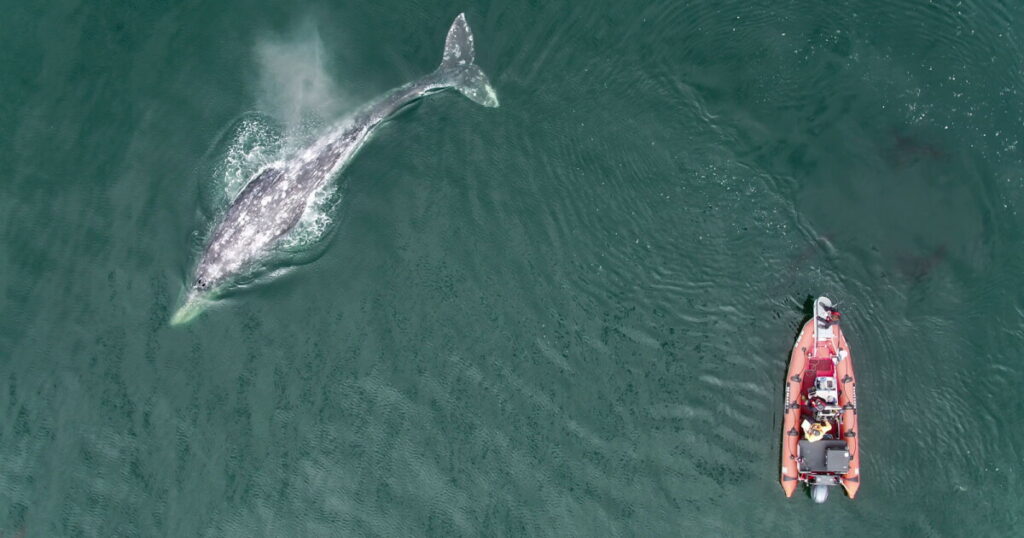
Researching these elusive giants is no small feat. Torres and her team employ various methods, such as drone technology and photography, to monitor the whales. By capturing images of their unique pigmentation patterns, researchers can track individual whales over time. Drones provide insights into whale size and body condition, essential indicators of their health and prey availability.
The findings are concerning: PCFG whales are notably skinnier and shorter compared to their Arctic-feeding relatives. Torres notes that since the year 2000, these whales have decreased in length by about 1.3 meters. “If they’re skinny, they really can’t do those other things very well,” Torres explained, emphasizing the critical role of feeding in whale survival.
Adapting to a Changing World
Despite these challenges, gray whales exhibit remarkable adaptability. Torres describes how these whales have developed unique feeding behaviors, such as head-standing and upside-down swimming, to exploit new prey sources. In regions like Sitka Sound, Alaska, gray whales have been observed feeding on herring spawn, maintaining better body condition compared to their Oregon counterparts.
As climate change continues to alter feeding grounds, Torres suggests that PCFG whales may eventually migrate to more bountiful areas. “Gray whales will not just keep doing the same thing over and over again if it’s not working out for them,” she said, underscoring the whales’ ability to innovate and explore.
Protecting Oregon’s Iconic Whales
While global efforts to combat climate change are crucial, immediate actions can help protect gray whales in Oregon. Reducing ship strikes and preventing fisheries entanglements are vital to preserving these creatures. “Paying more attention as a boat driver and slowing down when you’re in gray whale habitat would be a great way to avoid adding a significant injury to these animals,” Torres advised.
The recent gray whale symposium in Newport brought together scientists from across the Pacific to discuss the challenges facing these whales. Collaborative efforts are essential to understanding and safeguarding gray whales as they adapt to a rapidly changing environment.
Corvallis Tax Debate: A Community in Discussion
Meanwhile, in Corvallis, a different issue unfolds as the city council debates the implementation of new taxes to address a $4 million budget deficit and a $14 million civic campus project. Reporter Macy Moore explains that the decision has been delayed to gather more community input and await the election of a new council.
With potential service cuts looming, the city must balance its budget to maintain its status as a full-service city. The outcome of this debate will significantly impact the community’s future.
For more details, read the full story on the Corvallis tax issue here.
Original Story at www.klcc.org