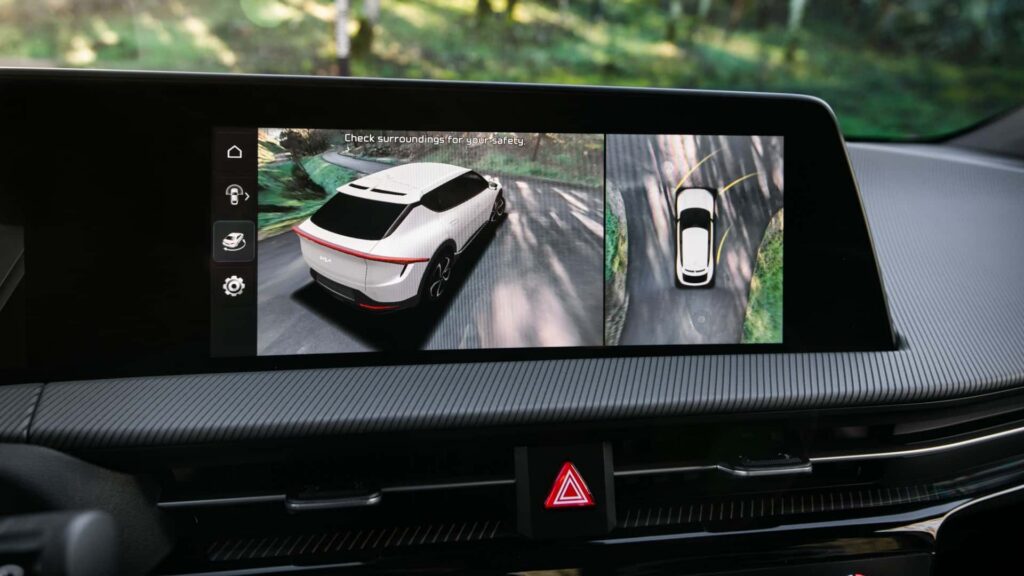
Imagine having a bird’s-eye view of your car, effortlessly displayed on your vehicle’s infotainment screen. It’s as if a drone is hovering above, giving you a perfect overhead shot. But how is this possible without a camera physically floating in the sky?
It’s not magic—it’s technology.
This impressive view is a result of combining images from multiple wide-angle cameras installed around your vehicle. Advanced software corrects distortion, aligns the images into a common perspective, and stitches them together to create that seamless overhead view.
No, Your Car Isn’t Filmed from Above
Camera placement is key. A typical surround-view system uses several strategically positioned cameras—usually at the front, rear, and beneath the side mirrors. These cameras have wide-angle lenses that capture a vast area around the vehicle.
Toyota explains that each camera feed is processed by a computer, which stitches the images into a single panoramic view.
Audi’s documentation details how four surround cameras work together, feeding their images to a control module that builds the desired view of the vehicle. Similarly, Renault describes a bird’s-eye view from cameras placed in the front bumper, door mirrors, and tailgate.
What may seem like a centered view of your car is actually a computer-generated perspective, pieced together from several lower-positioned cameras.
The Software Works Its Magic
A simple setup of four cameras wouldn’t immediately produce the seamless image you see. Each camera provides a different angle and perspective, with wide-angle lenses causing distortion. This is where image processing becomes crucial.
The system precisely knows each camera’s position and orientation, allowing it to transform and correct image distortion. Overlapping sections are aligned, and the images are stitched to form a continuous display.
GM explains its camera systems utilize camera calibration, computer vision, 3D geometry, and real-time processing to achieve this. The Top-Down View projects live data into a shared coordinate system before stitching and blending the images.
This process can sometimes cause edges to appear strange, as the system is mathematically transforming multiple perspectives into a single top-down view.
Here’s How Your Car Does It
The bird’s-eye view may look straightforward, but here’s what’s happening:
- Wide-angle cameras capture overlapping views around the vehicle.
- The system corrects fisheye distortion for clean image merging.
- Camera positions are calibrated for accurate image orientation.
- Feeds are transformed into a common perspective for spatial alignment.
- Images are stitched into a seamless panorama.
- The vehicle’s image is added to the display to simulate an overhead view.
- Additional graphics like parking lines and warnings can be overlayed.
Toyota’s Bird’s Eye View system even offers alternative views, such as a backup-camera perspective and a curb view to help avoid wheel scrapes.
It’s Not Perfect
Despite its impressive appearance, the bird’s-eye view isn’t flawless. Blind spots exist, and perspective transformations can distort objects. Anything outside the cameras’ view won’t appear on the screen. Renault warns that objects above the cameras or appearing farther than they are may not be displayed accurately.
The NHTSA has highlighted these systems’ limitations, advising they serve as aids rather than replacements for the driver’s own observation.
Owners Are Intrigued by the 360-Degree View
Drivers often wonder how cars can show an overhead view without a roof camera. On Reddit’s r/explainlikeimfive, users explain that cameras under mirrors, and at the front and rear, provide overlapping views, which software stitches into a complete image.
A detailed discussion in r/computervision highlights the complexities of stitching, involving lens distortion, calibration, and image transformation before clean merging.
Your Car is Reconstructing a Virtual View
The innovation of a 360-degree camera system lies in its ability to reconstruct a new viewpoint from multiple feeds. Imagine taking photographs from each corner of a room and digitally combining them into an overhead map. Your vehicle continuously processes live images while in motion to achieve this effect.
Advanced systems, like those from GM, create top-down views using a shared geometric model, while Audi offers systems with selectable angles and 3D representations.
The next time you see that seemingly impossible view from above, remember: it’s not an actual camera on the roof but clever geometry and image processing at work.
Original Story at www.motor1.com