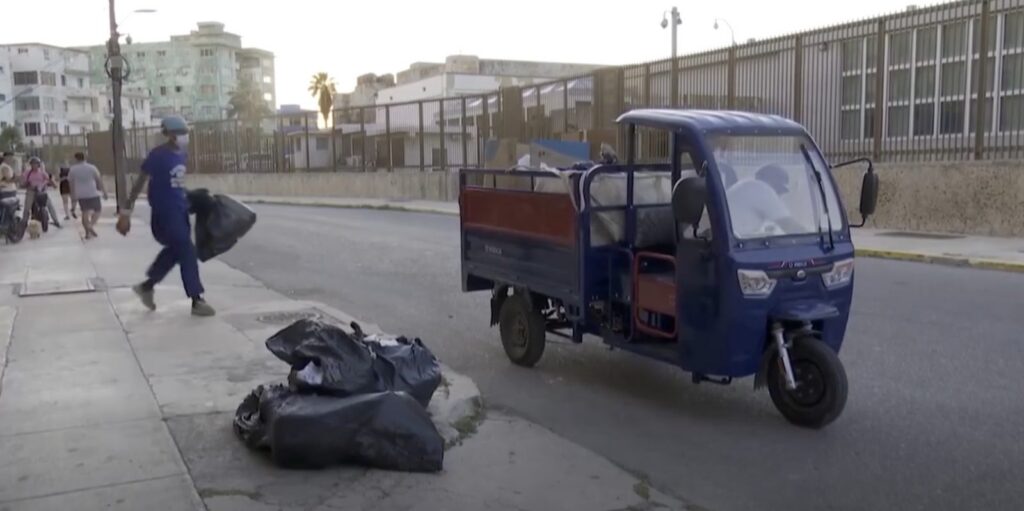
Cuba, grappling with a stringent U.S. fuel blockade, faces multiple crises, including a halt in waste management services in Havana. Innovatively, a local initiative is deploying solar-charged electric tricycles to alleviate this issue.
Amid escalating tensions with the U.S. administration, Cuba is enduring a severe fuel blockade, affecting not only fuel imports from the U.S. but also from other nations. In response, Cuba has accelerated its shift to solar energy, largely thanks to Chinese assistance, as part of its broader strategy to counter the blockade’s impacts.
This blockade has exacerbated existing challenges in Cuba, such as food shortages and electrical outages, and has posed significant obstacles to its well-regarded healthcare system. One of the most visible manifestations of the blockade’s impact is the accumulation of waste on Havana’s streets, as the majority of the city’s garbage trucks remain idle due to fuel shortages.
New Initiative Tackles Waste Crisis with Private Enterprise
In a novel approach for Cuba, the “El Rampeño” project is tackling waste collection in the Vedado neighborhood of Havana. Named after the area’s main street, La Rampa, this initiative departs from the traditional state-provided service model by functioning as a private entity, albeit with governmental support.
El Rampeño imposes a modest fee of 100 pesos monthly for residential waste collection, while businesses are charged 15,000 pesos. Notably, the service is offered without charge to those deemed vulnerable.
Harnessing Solar Power for Sustainability
Central to El Rampeño’s operations is the “Solinera,” a solar-equipped parking facility where electric tricycles are charged. These vehicles are acquired from VEDCA, a collaborative venture between Cuban state-owned Minerva and Tianjin Dongxing Industrial and Commercial Group. Constructed in a factory just outside Havana, each tricycle is equipped with a 5.4kWh lithium iron phosphate battery, capable of carrying up to 600kg of waste over a range of 50 to 70 kilometers.
The project’s fleet has grown from an initial five tricycles to 30, with 10 currently active. The impact is already noticeable; streets within the service area are significantly cleaner compared to surrounding neighborhoods.
This initiative echoes previous Cuban efforts to mitigate fuel shortages through electric vehicles, such as the rise of electric motorcycles in 2019. The increasing adoption of electric transportation is evident in Havana, as electric motorcycles continue to gain popularity.
Electric garbage trucks are increasingly viewed as efficient alternatives in waste management due to their environmental benefits and operational efficiencies. This trend is seen in places like the U.S. and Europe, and now, Havana is also experiencing these advantages through localized solutions.
Original Story at electrek.co