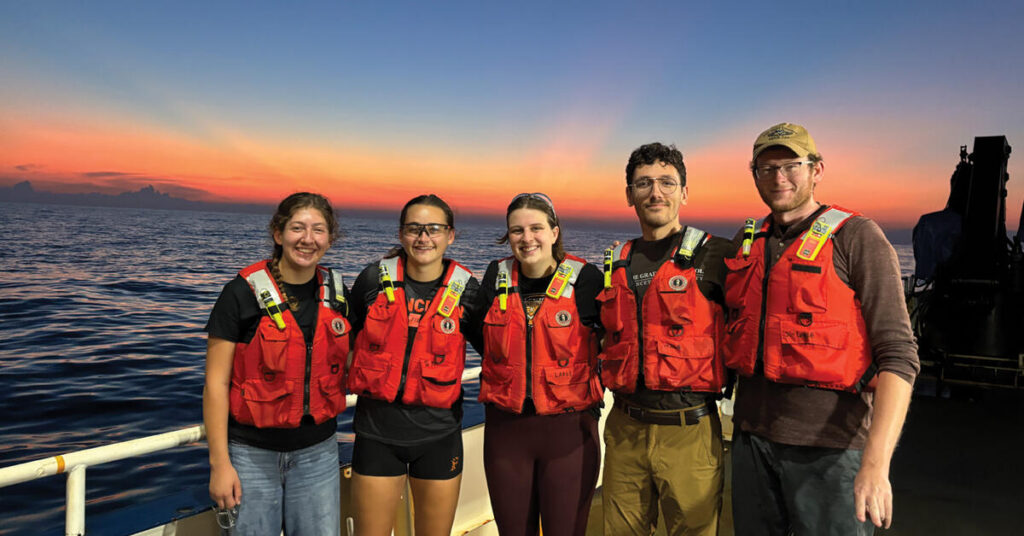
This summer, the High Meadows Environmental Institute’s internship program celebrated its 20th anniversary by offering 122 undergraduates the chance to engage in hands-on research across more than a dozen countries worldwide. Students found themselves working in diverse locations, from the laboratories at Princeton University to distant field sites in Costa Rica, Australia, and Mozambique.
Partnering primarily with Princeton faculty from the fields of environmental studies and engineering, these students tackled some of the world’s most pressing scientific issues. Their projects ranged from climate modeling and renewable energy to water quality and the study of “forever chemicals,” equipping them with skills applicable both during their time at Princeton and in their future careers.
The daily routine of a lab scientist involves balancing various tasks such as conducting experiments, preparing cultures, and analyzing samples using advanced equipment like mass spectrometers. This multifaceted experience is what geosciences professor Bess Ward aims to provide for her summer interns, as well as the postdoctoral researchers and graduate students who mentor them.
“You’re doing three things at once, which is really fun,” Ward stated. “I really enjoy that sort of thing, and I think they do, too.”
Ottilie Sykes ’27, a participant in the HMEI internship program for two summers, worked with Ward focusing on the nitrogen cycle in oceans. In 2025, she spent the last four weeks of her internship on a sea expedition from Rhode Island to Bermuda, collecting water samples and conducting experiments. This summer, Sykes continued her research at Briger Hall, examining the effects of ultraviolet radiation on seawater, a project she intends to expand for her senior thesis in geosciences.
“I got to collect all the water, and now I’m running the analysis,” Sykes mentioned. “So I can see the full story, and I think that’s really rewarding.”
Assistant Professor Elizabeth Niespolo, who studies the interaction between Earth’s geology and human evolution, emphasized the unique opportunities the program provides. Last year, an intern in her lab worked with shells of the extinct elephant bird. “So the students are getting access to really cool samples,” she explained. “But they’re also getting really important data that’s critical for the first steps of a lot of our research programs.”
The internships also offer students uninterrupted lab experiences, preparing them for future independent work. “They get a chance to really learn the skills by being around every day,” according to Jonathan Conway, an assistant professor of chemical and biological engineering. “They have a head start.”
Engaging in summer research can be instrumental for students in determining their future paths. Celia Murphy-Braunstein ’25 participated in two HMEI internships, one with geoscientist Daniel Sigman and another in Ward’s lab. Her work ranged from mastering basic lab techniques to presenting research findings at a symposium. These experiences guided her toward oceanographic research for her senior thesis and eventually to a Ph.D. program in earth and environmental sciences at Boston College.
“Both internships were really good experiences for me and sort of pointed me in the direction I am going down right now,” Murphy-Braunstein reflected. “Without them, I probably would be in a different position and maybe not even in a graduate program.”
Original Story at paw.princeton.edu