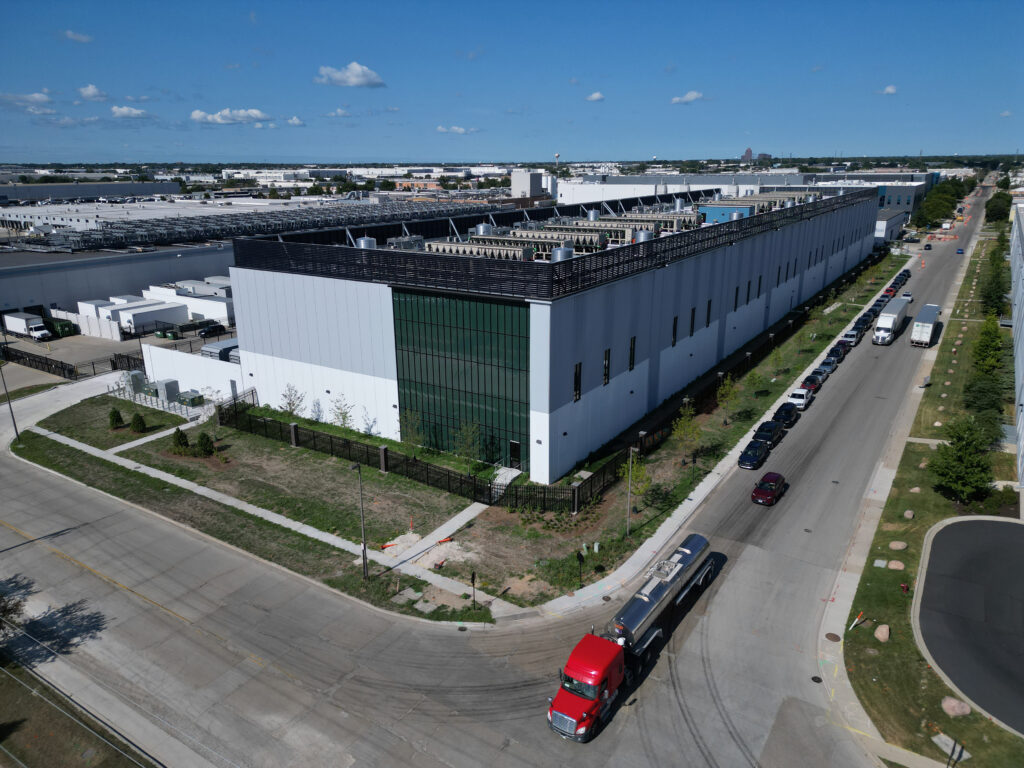
Data Centers, Not Illinois Clean Energy Law, Drive Power Price Surge
Amidst rising electricity costs within the PJM Interconnection’s 13-state region, a discourse has emerged regarding the primary contributors to these increases. Contrary to some arguments, it appears that the proliferation of data centers, rather than Illinois’ clean energy legislation, is the more significant factor behind the surge in power prices.
A recent editorial discussing PJM’s power auction misattributes the cause and solution to Illinois’ clean energy law (“Alarm bells are ringing loudly in electricity markets for Illinois’ clean-energy law,” Aug. 4). It suggests maintaining older power plants as a remedy, but this overlooks data presented by PJM’s market monitor Joe Bowring, which highlights more pertinent issues.
Bowring’s analysis revealed that data centers were responsible for $6.3 billion, or 38%, of this year’s auction costs, and $29.4 billion, or 46% of the last four auctions combined. The latest auction, which only added 525 megawatts of new power plants and upgrades, fell short by 6,831 megawatts of the grid’s needs, despite reaching the highest legal price.
The narrative here is less about retiring coal plants and more about the challenges of gas infrastructure overshadowing existing clean energy resources in Illinois.
Commonwealth Edison (ComEd) alone is dealing with over 75 data center projects, which are seeking a total of 28,000 megawatts in capacity—far exceeding the 11.6 gigawatts of coal capacity slated for retirement under Illinois’ clean energy law by 2030.
Proposals are underway to address these challenges by encouraging data centers to “bring your own new clean energy,” or BYONCE, and bear the associated costs. This approach is encapsulated in the POWER Act (HB5513/SB4016). Additionally, Illinois’ new storage law and a ComEd program incentivizing battery-equipped homes and businesses aim to alleviate power shortages.
PJM’s reopening of its waiting list for new power projects has already garnered proposals for over 67 gigawatts of battery storage and 14 gigawatts of solar power, demonstrating the availability of solutions that simply require swift integration into the grid.
The looming affordability issues faced by Illinois residents cannot be resolved by reversing climate legislation or prolonging the life of outdated power plants. Instead, empowering policies like BYONCE could shield consumers and facilitate the connection of existing clean energy solutions.
— Nick Wallace, senior associate attorney, Environmental Law & Policy Center, Chicago
Downtown Chicago’s Office Space Dilemma
In response to the editorial “Data centers occupying Loop landmark buildings is a bad idea” (Aug. 10), it seems the Tribune Editorial Board is concerned that data centers may negatively affect the city’s image.
With a 28% vacancy rate in downtown office spaces, the declining property values and consequent drop in property tax revenue is a pressing issue. While the mayor’s plan to convert these spaces into residences is underway, the lack of jobs and safety concerns in downtown areas raise questions about its viability.
Data centers could offer a viable alternative, revitalizing downtown properties by generating tax revenue and utilizing the region’s abundant water resources for cooling. Concerns about noise seem minimal when compared to existing urban sounds like the “L” train, which is generally accepted as a green solution.
— Terry Nugent, Chicago
Advocating for Data Centers in the Loop
Contrary to the editorial’s stance against repurposing the 300 W. Adams St. building into a data center, it is possible to adapt the landmarked property while preserving its historic character.
The Tribune Editorial Board acknowledges the surplus of office space in the Loop, emphasizing the need for creative reuse. Establishing a data center could provide employment opportunities and revitalize the area.
— David Andersen, Chicago
Envisioning Chicago’s Future
Addressing the editorial “Climate migration could be big boost for Chicago” (Aug. 10), the Tribune Editorial Board speculates on potential climate migration to the Midwest.
The Chicago Metropolitan Agency for Planning (CMAP) emphasizes a broad approach, considering diverse factors such as economics, demographics, and technology in planning for the future. Despite uncertainties in migration patterns, Chicago’s strengths, including a robust economy, access to fresh water, and a central location, make it a desirable place to live.
CMAP is collaborating with various sectors to develop The Century Plan, a roadmap to sustain the region’s quality of life and prosperity through coordinated infrastructure and system improvements.
— Erin Aleman, executive director, Chicago Metropolitan Agency for Planning
Addressing Legislative Double-Dipping
Illinois law permits members of the General Assembly to hold multiple elected positions simultaneously, raising ethical concerns. Notable examples include state Sen. Napoleon Harris III and former state Rep. Harry Benton, both of whom have held additional public offices.
House Speaker Emanuel “Chris” Welch supported Benton, contributing significantly to his reelection campaign. The practice of “double-dipping” is criticized for being unethical, prompting calls for legislation to prohibit it.
— Bob Anderson, Wonder Lake
Security at Governor Pritzker’s Residence
It is reassuring to know that the residence of SAFE-T Act supporter and Gov. JB Pritzker is guarded by Illinois State Police troopers, ensuring safety at the expense of taxpayers (“Trespassing suspect allegedly didn’t know he’d jumped into Pritzker’s yard,” Aug. 6).
— Bruce R. Hovanec, Chicago
Submit a letter, of no more than 400 words, to the editor here or email letters@chicagotribune.com.
Original Story at www.chicagotribune.com