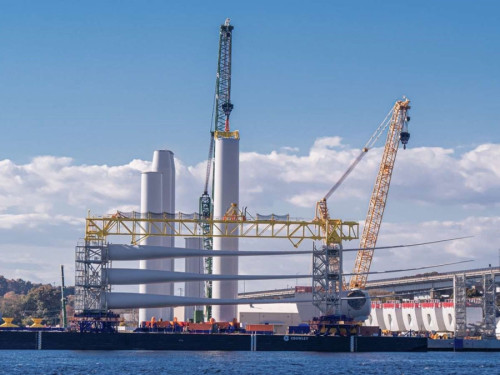
Amidst an evolving energy landscape, the BlueGreen Alliance (BGA), a coalition of environmental and labor groups, has raised alarms over the significant impacts of recent U.S. policies on clean energy and job growth. Their report highlights the effects of the One Big Beautiful Bill Act (OBBBA) and decisions by the Trump administration on offshore wind projects, which could threaten substantial investments and employment opportunities.
The BGA report indicates that the OBBBA has led to the cancellation or delay of 223 projects, translating into a potential loss of $82.8 billion in investments and risking 111,765 jobs. This includes a mix of manufacturing, clean energy, and industrial projects across the nation.
Furthermore, the report points to a critical decision by the Trump administration on August 6, which resulted in developer RWE pulling out from U.S. offshore wind projects. These actions have reportedly endangered at least 57,000 jobs projected from such developments.
U.S. maritime industries, including shipbuilders and vessel operators, face potential setbacks. A report from the American Bureau of Shipping (ABS) anticipates a high demand for vessels in floating offshore wind projects, which could be undermined by reduced offshore wind development.
The continuation of a Jones Act waiver by the Trump administration, allowing foreign-flagged vessels to transport certain cargo between U.S. ports, has met with strong opposition from the maritime industry.
More Than One Million U.S. Jobs at Risk
Jason Walsh, Executive Director of BGA, emphasized the coalition’s commitment to balancing job creation with environmental goals. He criticized the Trump administration’s policies, stating they have severely weakened the Inflation Reduction Act, thereby raiding $500 billion meant for clean energy investment to fund tax cuts for wealthier Americans.
The BGA report, titled Bait and Switch: The Impacts of Trump Administration Policies at the Intersection of Clean Energy, Manufacturing, and Labor, underscores the potential loss of over 1 million jobs due to tax restrictions imposed by the OBBBA.
- 84 manufacturing projects affected, risking $52 billion in investments.
- 139 clean energy and industrial projects impacted, with $30.8 billion at stake.
The report further details the risk to 3,034 sites expected to create significant employment opportunities in manufacturing and construction, jeopardizing over $695.2 billion in investments.
- 750 manufacturing sites potentially creating 160,325 jobs are at risk.
- 2,284 clean energy and industrial sites potentially offering 36,132 jobs face similar threats.
BGA criticizes the Trump administration for decisions that compromise worker rights and safety, impacting union and equity efforts.
Offshore Wind Actions Put U.S. Jobs at Risk
The BGA has launched a webpage to document the financial and job-related impacts of the Trump administration’s stance on offshore wind, estimating a cost of $3.9 billion in taxpayer money and at least 57,000 lost jobs.
RWE U.S. Offshore’s recent $1.22 billion settlement with the U.S. Department of the Interior highlights the fallout from these policies. Despite investing over $1 billion in U.S. offshore wind leases, RWE cited a lack of viable options to permit these projects in the foreseeable future.
Jobs Impact
California officials warn that delays in offshore wind projects could cost the state up to 10,000 jobs. Plans in Humboldt County and the Port of Long Beach are particularly affected, with expected job creation in the thousands now uncertain.
Energy Impact
Hillary Bright from Turn Forward has criticized the redirection of energy projects, noting that they fail to address regional energy needs effectively. She argued that substituting offshore wind with other energy sources in different regions does not resolve power supply challenges in the Northeast and mid-Atlantic.
Offshore Wind’s Shipbuilding Potential
The ABS report Floating Offshore Wind anticipates a surge in demand for offshore vessels due to floating wind projects. This includes requirements for large anchor handling, tug supply vessels, and support for mooring and cable installation, potentially benefiting the U.S. maritime industry.
California Harbor-Craft Emission Waivers Under Attack
Recent Congressional efforts to revoke California’s strict emissions standards for commercial harbor craft have sparked controversy. Critics argue that this move undermines investments in cleaner maritime technologies and threatens the competitiveness of the U.S. shipbuilding industry.
According to the BGA analysis, the Trump administration’s policies endanger over 1 million potential American jobs, impacting renewable energy production, job creation, and vessel demand. These actions also challenge efforts to implement cleaner maritime technologies, such as battery-powered harbor craft.
Original Story at www.ajot.com