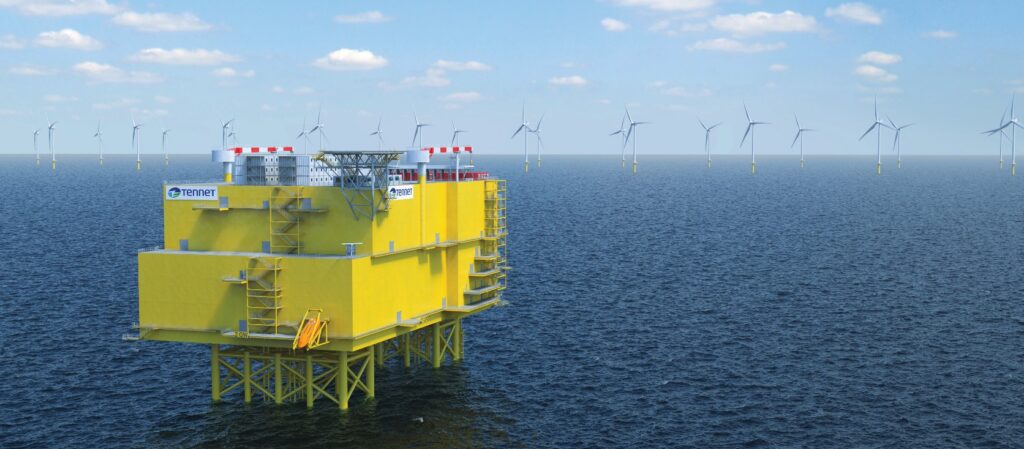
South Korean offshore wind foundation manufacturer SK oceanplant has secured a contract from Seatrium to manufacture and supply the jacket foundation and piles for TenneT’s BalWin5 high-voltage direct current (HVDC) offshore converter platform in the German North Sea.
The contract, valued at approximately USD 110.7 million (around EUR 96 million), involves construction engineering, procurement, fabrication, and load-out of one jacket and 20 piles for the offshore substation.
The jacket substructure provided by SK oceanplant will weigh about 15,000 tonnes. This marks the first time a Korean supplier has secured a full jacket supply agreement for a European HVDC offshore substation.
“While Korean companies have previously supplied certain structural components, this is the first case of delivering a complete jacket for a large-scale HVDC OSS connected to the European power grid”, the company noted in a press release on July 31.
SK oceanplant entered the European offshore wind market through the DolWin4 and BorWin4 projects, for which contracts were signed in April 2025, with key components delivered in May 2026.
BalWin5 is planned as a 2.2 GW-class HVDC offshore converter platform and is part of TenneT’s next-generation offshore transmission infrastructure in Germany. It will support the connection of large-scale offshore wind farms in the North Sea to the German electricity grid.
The GE Vernova-Seatrium consortium received a contract to deliver the offshore converter platform in December 2025.
Under this contract, GE Vernova’s Electrification Systems business will provide the full HVDC technology and the onshore and offshore converter stations. Seatrium will design, build, transport, and install the offshore converter platform.
Planned for commissioning in 2033, BalWin5 will consist of an offshore converter platform in the North Sea and an onshore converter in Bremen, connected by approximately 210 kilometers of subsea cable and around 115 kilometers of land cable.
At the offshore converter, the alternating current generated by the offshore wind farms is converted into direct current and transported via the cable system, passing under the island of Langeoog, to the mainland. From the Lower Saxon coast, the underground cable runs to the onshore converter in the state of Bremen, where the direct current is converted back into alternating current and fed into the high-voltage grid via the adjacent substation.
Reach the offshore wind industry in one go!
offshoreWIND.biz is read by thousands of offshore wind professionals every day.
—
Increase your visibility with banners, tell your story with a branded article, and showcase your expertise with a full-page company profile in our offshore wind business directory.
Follow offshoreWIND.biz on:
Original Story at www.offshorewind.biz