Exploring the Reality of Long-Distance EV Travel: A Tale of Two Trucks
Electric vehicles (EVs) are often critiqued for their perceived lack of infrastructure, especially when contemplating cross-country journeys. Yet, the experience of a recent trip from Central Florida to South Florida offers fresh insights into the capabilities of EVs versus traditional vehicles, challenging common perceptions.
Comparing Two Vehicles for the Journey
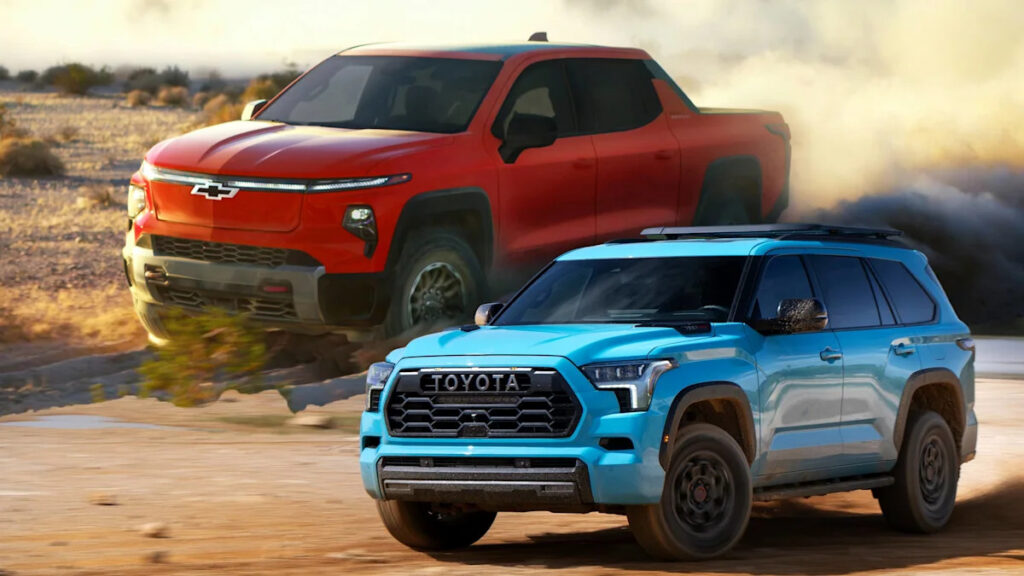
In July, two trips were taken to South Florida, approximately 200 miles each way. The first journey was made with a 2026 Toyota Sequoia TRD Pro, a hybrid SUV, while the second trip utilized a 2026 Chevrolet Silverado EV Trail Boss, an electric truck equipped with a 205 kWh battery.
Surprisingly, it was not the electric vehicle that induced range anxiety, but rather the hybrid. The Toyota Sequoia, despite its hybrid status, showed signs of inefficiency.
The Hybrid’s Performance and Fuel Usage
The Toyota Sequoia boasts a powerful i-Force Max powertrain, producing 437 horsepower and 583 lb-ft of torque. Enhanced with a TRD Performance Package, the vehicle’s power reaches 466 hp. Despite its impressive acceleration, reaching 60 mph in 6.14 seconds, the Sequoia fell short in fuel economy.
During the trip, the Sequoia averaged just 18.5 mpg, significantly below the EPA’s 20 mpg combined estimate. The fuel tank was nearly depleted after the journey, highlighting the irony of a hybrid vehicle requiring a refuel after only 200 miles.
The Electric Truck’s Efficient Journey
Conversely, the Chevrolet Silverado EV Trail Boss required only 45% of its battery capacity for the same trip. Chevrolet estimates that the Trail Boss version can travel 478 miles on a full charge. The EV arrived at its destination with ample battery life, sufficient for potential return trips without recharging.
A brief stop at a Tesla Supercharger restored 80% of the battery in just 20 minutes, showcasing the practicality of EVs in terms of charging time and cost efficiency.
Cost Comparison Between Hybrid and EV
Price-wise, both vehicles are comparable, with the Sequoia starting at $82,465 and the Silverado EV at $89,195. The Sequoia’s fuel stop cost $65.26, while the EV’s charging session was significantly cheaper at $34.12.
Future of Electric SUVs and EREVs
The Silverado EV’s performance shines a light on the potential of future electric SUVs such as the Cadillac Escalade IQ, which offers an impressive range of up to 500 miles. Meanwhile, extended-range electric vehicles (EREVs) emerge as a viable middle ground between hybrids and full EVs, combining electric motors with gasoline generators for increased range.
Upcoming models like the Ram 1500 REV and Ford F-150 Lightning promise extensive ranges of up to 700 miles, making them formidable contenders in the long-distance travel segment.
Original Story at autos.yahoo.com