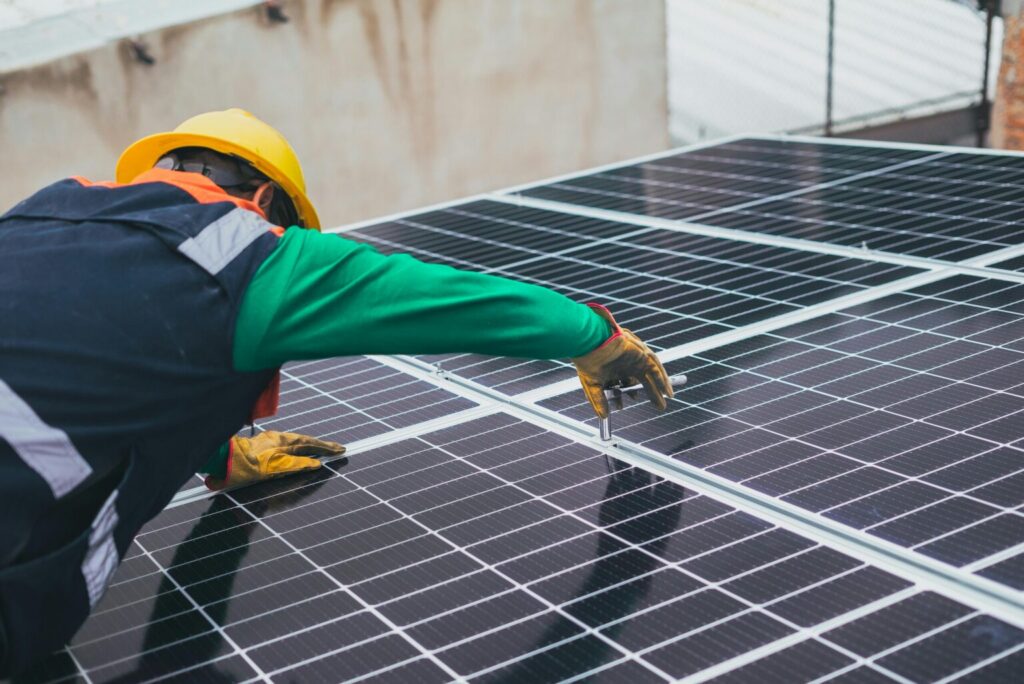
The U.S. solar industry is witnessing significant growth, currently employing over 280,000 individuals. Despite this expansion, the industry is grappling with a shortage of skilled workers to meet its ambitious project timelines. According to the 2025 U.S. Energy & Employment Report (USEER) and the IREC National Solar Jobs Census, approximately 355,000 workers will be needed by the end of 2026 to achieve installation targets of 60 GW to 70 GW, revealing a shortfall of 53,000 positions.
As the solar sector seeks to bridge this employment gap, other industries are also vying for the same skilled individuals. The United States Energy & Employment Report (USEER) highlights that the electric power generator (EPG) sector employed 933,800 workers in 2024, with nearly 40% working in solar.
The USEER report further illustrates that construction is the largest employer within the solar EPG workforce, with 181,700 employees, making up 49.0%. This is followed by professional and business services, including engineering, financial services, and consulting, which employ 58,500 workers, accounting for 15.8%.
While construction continues to employ a large segment of the solar workforce, the industry itself has evolved, now requiring expertise in areas such as high-voltage engineering, SCADA systems, asset performance, cybersecurity, and supply chain analysis.
This growth in solar expertise is attracting attention from other sectors like battery storage, data centers, nuclear, and AI. Jack Roberts, an energy workforce specialist at Ecotal, a recruitment firm focusing on the energy sector, explained this trend to pv magazine USA.
Roberts noted, “People are drawn to renewable energy careers because they can find a mix of technically challenging positions in companies with purpose-driven missions.” He further explained that skills such as SCADA systems can easily transition from solar to battery systems, while sectors like nuclear and data centers are in need of commissioning specialists, engineers, and land acquisition experts.
Roberts also observed a growing demand for specialized roles including grid interconnection, transmission planning, and construction management, driven by the maturity of the solar industry.
Innovative training methods are emerging as a solution to meet skill demands. For instance, Cypress Creek Renewables has partnered with Piedmont Community College in Roxboro, North Carolina, providing $25,000 to enhance electrical training programs and fund marketing efforts to attract students.
Organizations are also developing resources to bolster workforce readiness. The Interstate Renewable Energy Council (IREC) offers a free online course to prepare job seekers for clean energy careers through Registered Apprenticeship pathways.
The Center for Energy Workforce Development (CEWD), a consortium of over 140 energy entities, has a Consulting Network aimed at enriching workforce development and expanding talent pipelines. These apprenticeship initiatives are poised to address workforce needs across various power sectors as electricity demand rises.
Original Story at pv-magazine-usa.com