Shifting Political Landscapes: Indigenous Diplomacy in the Arctic and Beyond
In an era marked by changing global dynamics, the systems governing both the Arctic and the world are undergoing significant transformations. Originally crafted in a time characterized by cooperation and mutual scientific exchange, these frameworks now face challenges posed by strategic competition, reduced institutional trust, and weakening multilateral consensus.
The Arctic Council’s operations are heavily influenced by geopolitical upheavals following Russia’s full-scale invasion of Ukraine. Concurrently, mechanisms supporting Indigenous rights within the United Nations are grappling with financial constraints, increasing political polarization, and uncertain prospects for continued multilateral cooperation.
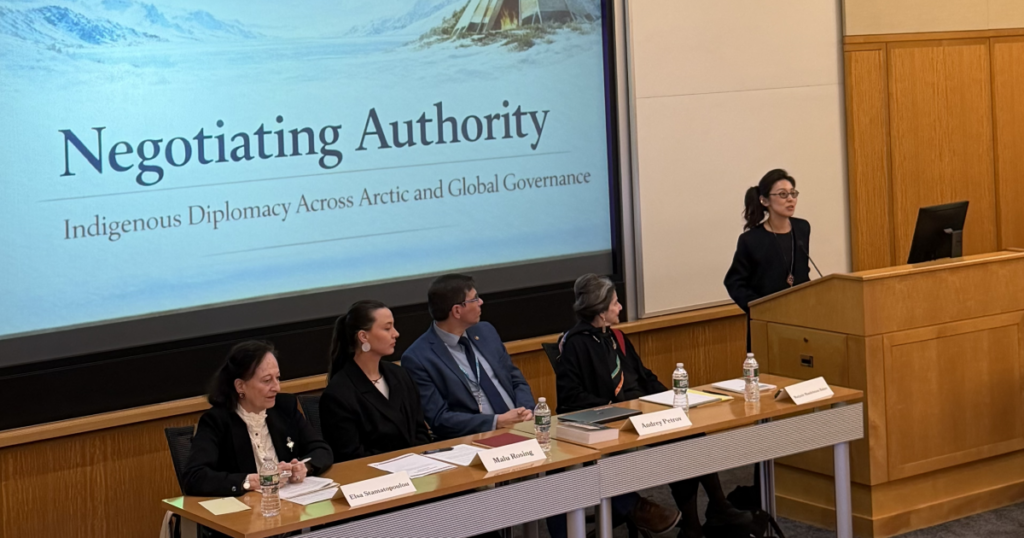
On April 27, the Davis Center for Russian and Eurasian Studies at Harvard University, in collaboration with Harvard’s Arctic Initiative, hosted a panel discussion. This event gathered experts, Indigenous advocates, and practitioners to discuss the evolution of Indigenous diplomacy amidst geopolitical fragmentation, institutional pressures, and shifting governance priorities.
The panel featured notable speakers including Malu Rosing from the International Work Group for Indigenous Affairs, Marjorie Mandelstam Balzer from Georgetown University, Elsa Stamatopoulou, former Chief of the Secretariat of the UN Permanent Forum on Indigenous Issues, Andrey N. Petrov from the University of Northern Iowa, and Mariana Katzarova, UN Special Rapporteur on Human Rights in the Russian Federation.
Today, Indigenous peoples hold a more prominent role within global governance systems than ever before. However, the political context surrounding these institutions is increasingly unequal and polarized, raising critical questions about representation and authority.
This discussion coincided with the twenty-fifth session of the United Nations Permanent Forum on Indigenous Issues (UNPFII) in New York, linking ongoing institutional debates with broader changes impacting Indigenous governance.
Redefining Indigenous Authority in Global Governance
One central theme of the panel was the recognition of Indigenous diplomacy as a fundamental component of global governance. Participants argued that Indigenous authority has been integral to shaping governance structures through decades of political mobilization and advocacy for self-determination.
Speakers noted that Indigenous peoples have not only participated in existing governance frameworks but have actively influenced international norms through sustained diplomatic efforts. From the 1970s’ development of Indigenous participation within the United Nations to the Arctic Council’s Permanent Participant model, Indigenous actors have redefined institutional practices and political authority.
Indigenous diplomacy was described as a mechanism for negotiating legitimacy and authority across political arenas. Participants highlighted how Indigenous organizations have contributed to the development of governance models that define international and Arctic cooperation, including within the Arctic Council.
The panelists also warned against equating institutional participation with political autonomy, noting that while participation mechanisms may remain, the conditions for independent representation are becoming fragile. This raises significant questions about representation, accountability, and legitimacy in Indigenous diplomacy.
Navigating Geopolitical Fragmentation
Another theme was the impact of the changing geopolitical landscape on Indigenous governance. Participants emphasized that governance frameworks from the post-Cold War era are now strained by financial challenges, political polarization, and geopolitical tensions.
Indigenous organizations find themselves navigating complex environments involving states, NGOs, scientific institutions, businesses, and security-driven agendas. These overlapping systems present both opportunities and constraints for engagement.
While Indigenous rights are not being removed, they are increasingly framed in terms of strategic necessity, territorial security, and competing claims to authority. Formal mechanisms intended for inclusion are gaining geopolitical value for states seeking legitimacy and cooperative governance.
As geopolitical tensions rise, the challenge extends beyond securing participation to sustaining the political conditions necessary for independent representation and collective action.
Historical Context and Activism
The panelists underscored the importance of historical context in understanding contemporary Indigenous governance. Indigenous communities have long navigated political exclusion, state restructuring, and territorial transformation while maintaining forms of organization and transnational cooperation that continue to influence governance debates.
Speakers argued that Indigenous authority’s legitimacy stems from representatives’ ongoing relationships with their communities. Activism, documentation, and community-based advocacy are essential for ensuring representation remains connected to lived realities and maintaining political accountability.
Participants challenged the separation of activism from governance, arguing that Indigenous diplomacy begins within communities through local experiences and political claims. Strengthening ties between Indigenous activism, research, and international institutions is crucial, especially as many communities face shrinking political space and increasing pressures.
Challenges of Political Space and Criminalization
Mariana Katzarova, the UN Special Rapporteur, highlighted the shrinking political space for Indigenous participation, particularly focusing on the criminalization of activism in Russia. The panel discussed the risks associated with engaging international Indigenous rights mechanisms under authoritarian regimes.
Recent arrests of Indigenous activists and the misuse of extremism and terrorism laws against civil society were cited as evidence of a shrinking civic space. This reflects a growing state influence in defining Indigenous governance internationally.
These issues were also prominent at the UN Permanent Forum on Indigenous Issues, where delegates from conflict regions discussed militarization, displacement, and environmental destruction. Russian representatives emphasized state policies for preserving Indigenous cultures, while independent rights defenders highlighted arrests and political pressures on activists.
The discussions revealed tensions within international institutions, with competing claims to representation and legitimacy becoming increasingly central. The ability of governance institutions to address these issues will be critical for Arctic and international institutions moving forward.
Original Story at www.belfercenter.org