A Glimpse into Mars: Garnet Discovery Raises Questions About Martian Geology
In a fascinating twist of cosmic events, scientists have unearthed a tiny garnet within a meteorite that originated from Mars. This finding has piqued the curiosity of researchers, as garnets, which are common on Earth, have never been identified on the Martian surface before.
The meteorite, known as NWA 8171, was initially discovered in 2013. However, it wasn’t until June 2026 that the presence of garnet inside this extraterrestrial rock was confirmed. This revelation has sparked numerous questions within the scientific community about the mineral’s formation and the conditions on Mars that might have allowed it.
David Turner, Ph.D., a Professor of Environmental Science at St. Mary’s University, shared insights with Gold & Blue regarding the significance of this discovery. He also highlighted how this revelation is integrated into his classroom discussions about the similarities and differences among terrestrial planets.
Understanding Garnets
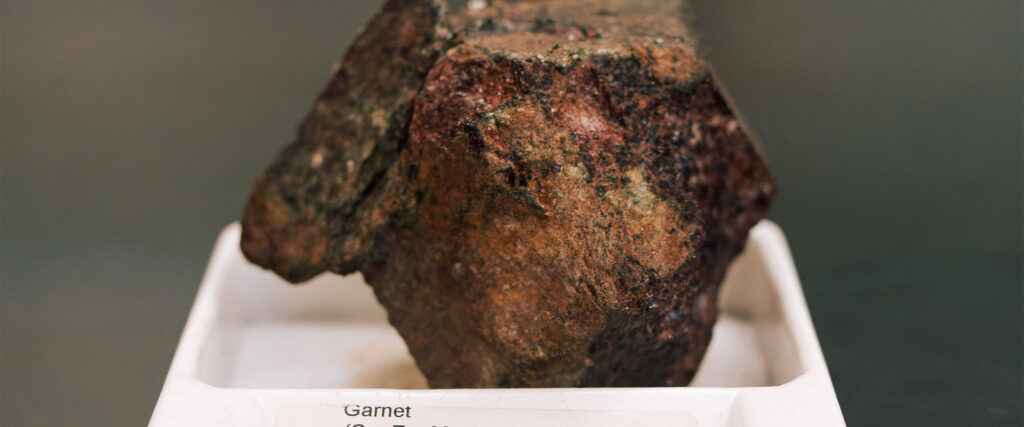
Garnets are silicon and oxygen-based minerals, often combined with other elements. They are semi-precious and exhibit a distinctive dodecahedral crystal shape. While garnets on Earth can range from small sizes to as large as bowling balls, the Martian garnet’s discovery is particularly notable for its uniqueness.
Why Is This Discovery Significant?
According to Turner, “this is the first time a garnet has been found on any rocks that are believed to come from Mars.” Most garnets on Earth are metamorphic, formed under specific conditions like high heat and pressure. The existence of a garnet on Mars suggests possible metamorphic processes on the planet, opening up possibilities about Mars’ geological history.
Comparing Earth and Mars Garnets
On Earth, garnets are prevalent in metamorphic rocks. In contrast, the Martian garnet is currently a solitary sample, marking a stark difference in abundance. This solitary discovery raises intriguing questions about geological processes on Mars compared to Earth.
Potential Geological Similarities Between Earth and Mars
Turner notes the significance of the discovery in understanding Mars’ past. “What this garnet might point us to is not necessarily how Mars is today, but how Mars might have been in the past.” The presence of garnet may hint at past water presence on Mars, a crucial element for life and exploration.
The Role of Rocks and Minerals in Planetary History
Rocks are crucial to understanding a planet’s history. They reveal insights into mineral formation and the evolution of planetary bodies over time. At St. Mary’s University, Turner’s geology classes explore the geology of neighboring planets, emphasizing their importance in understanding Earth’s place in the solar system.
Exhibits at the David J. Fitzgerald Museum of Earth Sciences
The David J. Fitzgerald Museum of Earth Sciences houses meteorites, including one found in Namibia in the 1830s. These samples help unravel the history of our solar system, offering insights into planetary evolution.
Incorporating Extraterrestrial Geology into Education
Turner’s geology curriculum at St. Mary’s includes planetary geology, highlighting the importance of understanding Earth-like planets such as Mars, Mercury, and Venus. These studies serve as analogs for Earth, providing context for atmospheric and environmental changes.
Original Story at www.stmarytx.edu