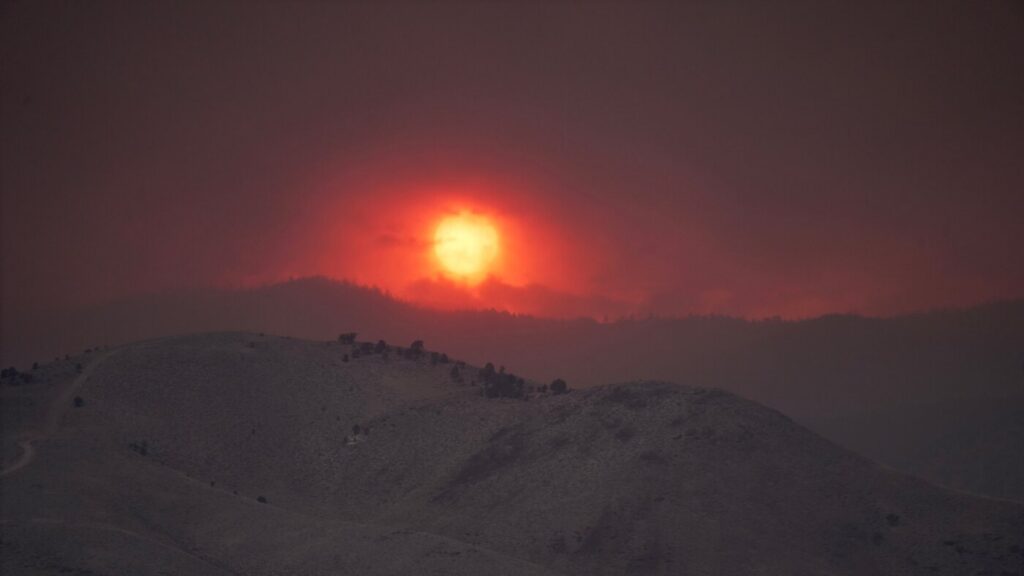
The sun sets over the Cottonwood Fire near Marysvale, Utah, on Friday, June 26, 2026.
Ty ONeil/AP
hide caption
toggle caption
Ty ONeil/AP
As wildfires rage across the Great Basin and Southwest, residents and emergency teams are on high alert for severe fire conditions anticipated this weekend.
In a historic move, the National Weather Service in Salt Lake City has issued its first “particularly dangerous situation” red flag warning for parts of Utah, driven by a dangerous mix of high winds, scorching temperatures, and low humidity. More details here.
The challenging weather is predicted to persist into Sunday, complicating efforts to manage the Cottonwood Fire in southern Utah, currently the largest blaze in the U.S. Alyssa Mason, a spokesperson for the fire, noted, “Our biggest challenge right now is that we have single digit humidities and the wind gusts are around 45 miles per hour. That’s on top of fuel moistures between 2 and 8 percent.”
Utah, alongside Nevada, Colorado, and other states in the Intermountain West, is grappling with drought conditions following a dry winter. The Rocky Mountains reported record low snow levels. Utah’s snowpack peaked three weeks earlier than normal and hit a new low, posing challenges for water resources.
On Friday afternoon, fierce winds forced a temporary halt in firefighting efforts at the Cottonwood Fire, grounding helicopters and pulling personnel off the line, according to Mason. Despite efforts, the fire remains completely uncontained, covering an area larger than Salt Lake City.
While the National Weather Service forecasts relief next week with cooler temperatures and higher humidity, the ongoing drought and multiple fires prompted Utah Governor Spencer Cox to restrict fireworks through the Fourth of July. “When people who’ve dedicated their lives to protecting Utah tell us this year is different, we desperately need to listen,” he emphasized at a press conference.
Human activities are behind the majority of U.S. wildfires, according to the U.S. Forest Service. These fires are becoming larger and more destructive as human-induced climate changes alter weather patterns. Recent research published in the Proceedings of the National Academy of Sciences shows forest fires now burn ten times more acreage annually than in 1985.
Fire plays a crucial ecological role, supporting forest regeneration. However, a century of aggressive wildfire suppression has left U.S. forests overgrown. Combined with climate change, this legacy has made severe fires more common than beneficial ones, particularly in California, as noted by a recent study. “The loss of these forests isn’t just, ‘I can’t take a pretty picture,'” said Mitchell Hung, a UCLA researcher. “There are profound socioeconomic impacts. Real dollars are being lost each year due to high severity forest fire.”
Original Story at www.npr.org