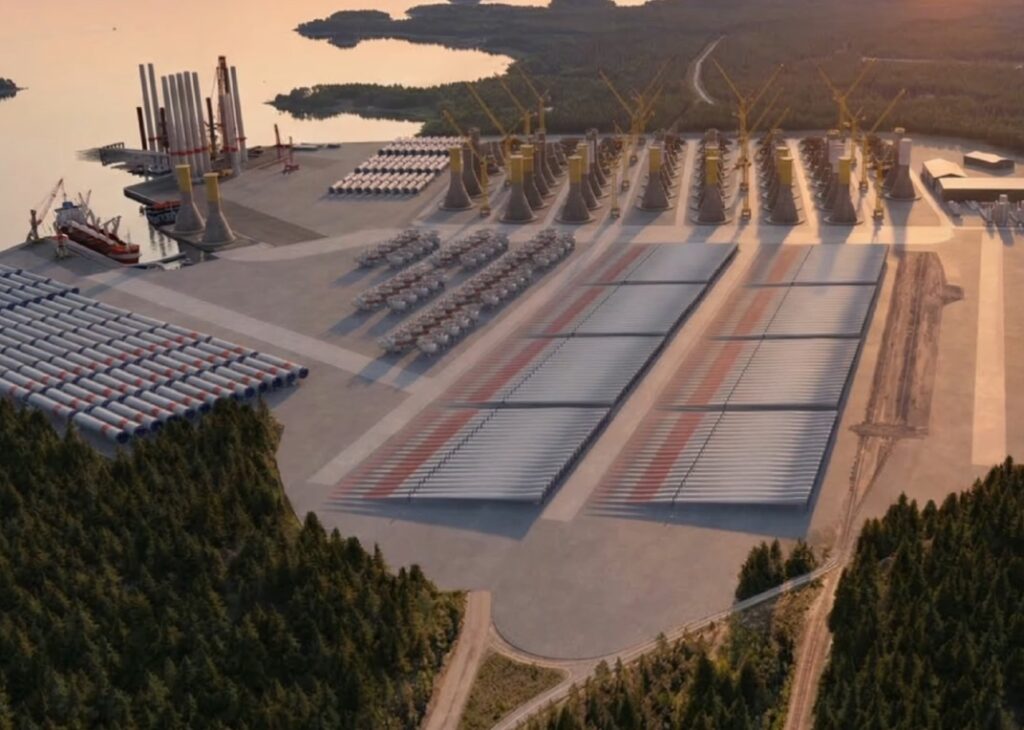
Euroports has revealed advanced plans for Koverhar, a significant offshore wind industrial hub in Finland, aimed at enhancing supply chain capacity in the Baltic Sea.
The plan for the Finnish offshore wind hub emerged last year when Euroports signed a Letter of Intent (LoI) with partners of the Noatun offshore wind project to develop Koverhar Harbour in the Port of Hanko as a logistics hub for constructing the Noatun North offshore wind farm, with an option to extend to Noatun South.
The detailed proposal for the offshore wind port was recently showcased at the Wind Offshore Helsinki conference.
Koverhar is being promoted as a marshalling and industrial platform designed to transition from project-specific logistics to a standardized offshore wind supply chain.
The site will offer approximately 90 hectares of terminal space, expandable to around 500 hectares of industrial reserve. Infrastructure includes heavy-duty quays with a load-bearing capacity of at least 20 tonnes per square meter and deep-water berths, enabling the facility to manage multiple offshore wind projects simultaneously.
The concept supports both gravity-based foundations (GBS) and monopile supply chains. For GBS, Koverhar will feature on-site fabrication, including concrete production, casting, curing, and storage, directly linked to the quays. Units measuring approximately 40 meters in diameter and weighing between 10,000 and 12,000 tonnes can be moved without intermediate transport.
For monopiles, the hub offers facilities for storage, handling, pre-assembly, and sequencing, suitable for large-scale projects.
The design streamlines industrial flows with direct transfer of components via self-propelled modular transporters (SPMTs) from fabrication or storage areas to the quay. The facility also supports flexible load-out configurations, such as side and back loading, based on installation strategies.
Euroports emphasizes that the integrated setup aims to reduce congestion, minimize double handling, and enhance execution reliability. Koverhar is positioned as a de-risking solution for offshore wind developers, providing a ready-to-operate platform, shared infrastructure to decrease capital expenditure, and improved schedule certainty through early port access.
Original Story at www.offshorewind.biz