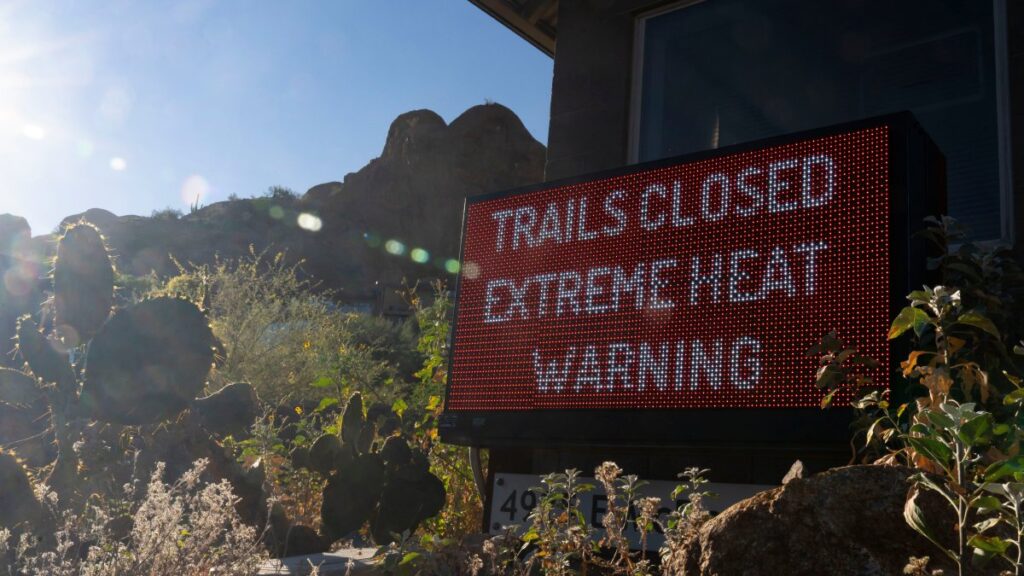
The U.S. Southwest recently experienced an extraordinary heat wave in March, setting unprecedented records and underscoring the increasing frequency of extreme weather due to global warming. This event, characterized by temperatures reaching 112 degrees Fahrenheit in multiple Arizona and Southern California communities, highlights the escalating nature of climate change-driven weather phenomena.
Weather experts emphasize that such unpredictable and hazardous weather patterns are emerging more often, posing significant risks to populations. Traditionally accustomed to high temperatures, the Southwest is encountering these extreme conditions much earlier in the year, illustrating a shift in weather patterns. On March 20th, two locations in Arizona and two in Southern California, all within a 50-mile radius, reported record-breaking temperatures.
“This is what climate change looks like in real time: extremes pushing beyond the bounds we once thought possible,” remarked Andrew Weaver, a climate scientist at the University of Victoria. “What used to be unprecedented events are now recurring features of a warming world.”
According to World Weather Attribution, a coalition of scientists dedicated to analyzing extreme weather, March’s extreme heat would have been almost impossible without the influence of human-induced climate change. Their report highlights the role of climate change in amplifying such heat events.
An assembly of over a dozen experts, including scientists and meteorologists consulted by The Associated Press, categorize the March heat wave with other ultra-extreme weather events like the Pacific Northwest heat wave in 2021 and the catastrophic floods in Pakistan in 2022.
The National Oceanic and Atmospheric Administration’s Climate Extremes Index reveals that the areas in the U.S. affected by extreme weather have doubled in the past two decades. Record-breaking hot weather occurrences have surged by 77% since the 1970s, and the frequency and cost of billion-dollar weather disasters have significantly increased, highlighting the growing impact of climate change.
Trying to Keep Up With Extremes and Failing
“It’s really hard to even keep up with how extreme our extremes are becoming,” stated Bernadette Woods Placky, Chief Meteorologist at Climate Central. “It’s changing our risk, it’s change our relationship with weather, it’s putting more people in risky situations and at times we’re not used to. So yes, we are pushing extremes to new levels across all different types of weather.”
Government officials face increasing challenges in managing these disasters. Former FEMA Director Craig Fugate noted the growing frequency of extremes, stating, “We were operating outside the historical playbook more and more. Flood maps, surge models, heat records — events kept showing up outside the envelope we built systems around. That’s just what we saw.” He also pointed out that the assumption of relying on historical weather patterns is becoming unreliable, as evidenced by insurers withdrawing from high-risk areas.
‘Virtually Impossible’ Without Climate Change
In a preliminary analysis, climate scientists at World Weather Attribution examined the role of climate change in the recent Southwest heat wave. By comparing historical temperature data with projections of a climate-impacted world, they concluded that the extreme warmth experienced in March was nearly impossible without human-induced climate change.
The study identified that burning fossil fuels has added 4.7 to 7.2 degrees Fahrenheit to the observed temperatures, as noted in the report. Co-author Clair Barnes, an attribution scientist at Imperial College London, explained, “What we can very confidently say is that human-caused warming has increased the temperatures that we’re seeing as a result of this heat dome, and it’s going to be pushing those temperatures from what would have been very uncomfortable into potentially dangerous.”
Examples Abound of High Heat and Extreme Weather
This Southwest heat wave joins a list of recent “giant events,” with temperatures soaring up to 30 degrees Fahrenheit above normal, according to Stanford University climate scientist Chris Field. He cited several other significant weather phenomena over the past six years, including the 2020 Siberia heat wave and the 2023 South Asian heat wave.
Other historical anomalies, like the 2022 East Antarctica heat wave, further illustrate the scale of these events. Weather historian Chris Burt remarked on the unprecedented nature of this anomaly in his book “Extreme Weather.”
Scientists also highlight that climate change’s influence extends beyond extreme heat to include hurricanes, droughts, and intense rainfall. For instance, West Africa faced devastating floods in 2022 and 2024, while Iran experiences a prolonged drought. Superstorm Sandy in 2012 exemplifies the extensive reach of such extreme weather, as it affected a vast area and caused significant destruction.
The link between climate change and increasing weather extremes is clear, as stated by Friederike Otto of Imperial College London and World Weather Attribution coordinator: “This is due to climate change, that we see more extreme events, and more intense ones and have so many records being broken.”
___
Associated Press reporter Hallie Golden contributed from Seattle.
Original Story at www.nbcbayarea.com