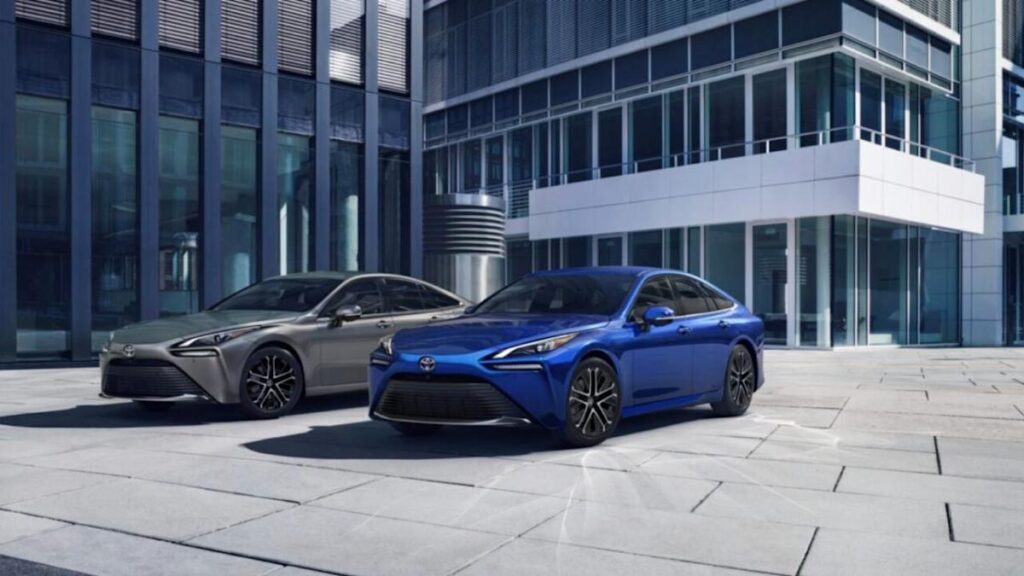
Toyota’s dedication to hydrogen technology challenges the industry status quo, drawing parallels with its early venture into hybrid vehicles. While competitors have leaned towards battery-electric solutions, Toyota’s unwavering commitment to hydrogen fuel cells reflects a potential game-changer in the realm of clean energy.
Despite infrastructure challenges and skepticism from rivals, Toyota introduced the Mirai, a hydrogen fuel cell sedan, in 2014, followed by an updated model in 2020. This move marks their continuous investment in hydrogen technology across various sectors, including racing and trucking.
Understanding Hydrogen Vehicles
Image credit: Shutterstock.
Hydrogen vehicles function by storing compressed hydrogen in tanks, which then reacts with oxygen in a fuel cell to generate electricity, powering an electric motor. The emission? Pure water vapor.
The driving dynamics of hydrogen cars mirror those of electric vehicles: quiet, smooth, and lacking gear shifts. However, hydrogen cars can refuel in about five minutes, akin to gasoline refueling, contrasting the lengthy charging times of electric cars.
With the Mirai, Toyota offers a range of roughly 400 miles per tank, though actual performance can vary.
Infrastructure: A Significant Hurdle

Image Credit: Toyota.
The primary challenge for hydrogen cars is not in the vehicle’s technology but in its infrastructure. In the U.S., hydrogen refueling stations are clustered in California, especially near Los Angeles and the San Francisco Bay Area, with sparse availability elsewhere.
This limited infrastructure restricts the practicality of hydrogen vehicles for many potential users. Despite investments from Toyota and its partners to expand this network, progress has been sluggish.
Creating a comprehensive nationwide hydrogen refueling network is a demanding, costly, and lengthy endeavor.
Toyota’s Hydrogen Ambitions

Image Credit: Toyota.
The latest Mirai offers a sophisticated design with rear-wheel drive and a premium interior. Toyota is also exploring hydrogen combustion engines, which burn hydrogen directly, albeit less efficiently than fuel cells.
Further, Toyota is investigating hydrogen-powered trucks, which could better address the limitations of batteries in long-haul transportation, such as weight and charging delays.
Challenges and Skepticism

Image Credit: Toyota.
Critics highlight hydrogen’s efficiency issues, with energy losses occurring at various stages from production to consumption, unlike direct electricity use in battery vehicles.
Cost remains a hurdle, with hydrogen vehicles like the Mirai positioned in the premium market segment, and their production often limited to experimental rather than mass-market scales.
The Case for Hydrogen’s Future

Image Credit: Toyota.
Hydrogen’s potential lies in its application, particularly in heavy-duty transport where it may outshine batteries due to issues like weight and charging times.
While battery-electric vehicles now dominate the passenger car market thanks to improvements in range and infrastructure, hydrogen’s role in commercial sectors could be crucial in cutting emissions.
Current Perspectives

Image Credit: Toyota.
Toyota’s investment in hydrogen dates back decades, underlying a strategic commitment rather than a fleeting interest. Yet, the challenges of infrastructure and cost continue to loom over hydrogen’s future in passenger vehicles. The potential for hydrogen in commercial transport, however, remains a topic of ongoing exploration.
Read More
- 13 Muscle Cars So Overlooked Most People Forgot Them
- 15 Car Features That Should Have Never Been Phased Out
Original Story at autos.yahoo.com