Lucid Group Charts Path to Profitability Amid Expansive Growth Plans
Amidst a challenging market landscape, Lucid Group has unveiled ambitious plans to achieve positive cash flow by the end of this decade. The electric vehicle manufacturer outlined its strategy during its first investor day in nearly five years, emphasizing the expansion of its vehicle lineup and significant advancements in software and technology.
Lucid aims to realize its financial goals through ventures into midsize vehicles, robotaxis, and international markets, including Europe and Saudi Arabia. The company plans to leverage enhanced driver assistance systems and introduce a new artificial intelligence assistant to boost efficiency and drive software revenue growth.
Despite these promising announcements, Lucid’s stock closed at $9.84 on Thursday, marking a 7.9% decline. This reflects the broader challenges faced by EV companies in the current market environment. Analyst Ben Kallo from Baird noted, “We view the midterm and late decade targets as an important benchmark against which investors can measure LCID’s progress which will improve transparency.”
Lucid’s financial targets are ambitious, considering the company’s recent performance. In 2025, Lucid reported a $2.7 billion loss on $1.35 billion in revenue, with negative free cash flow reaching $3.8 billion, a 31% increase from the previous year.
Expansion into Autonomy and New Markets
Interim CEO Marc Winterhoff emphasized the company’s focus on “accelerating to profitability,” although a specific timeline for reaching positive cash flow remains undisclosed. Lucid plans to introduce a new midsize vehicle at the year’s end, while its largest shareholder, Saudi Arabia’s Public Investment Fund, has adjusted its investment approach to revolving credit.
On March 12, 2026, Lucid previewed plans for a two-seat robotaxi based on its upcoming midsize platform. This venture is part of a broader strategy to achieve $1 billion in annual non-vehicle revenue through services like software subscriptions. The robotaxi initiative is considered a “mid-term” goal, with a subscription service slated to launch by early 2027.
Kay Stepper, Lucid’s vice president of advanced driving systems, stated, “Autonomy plays an outside role in the future of Lucid,” with plans to offer self-driving vehicles by 2029. The company is also expanding its partnership with Uber to include midsize vehicles in their robotaxi collaboration.
New Midsize Vehicles on the Horizon
Lucid announced plans to produce three midsize vehicles, starting with the Cosmos this year, followed by the Earth model and another unnamed vehicle. Derek Jenkins, senior vice president of design and brand, highlighted the goal of reaching a broader audience with these offerings.
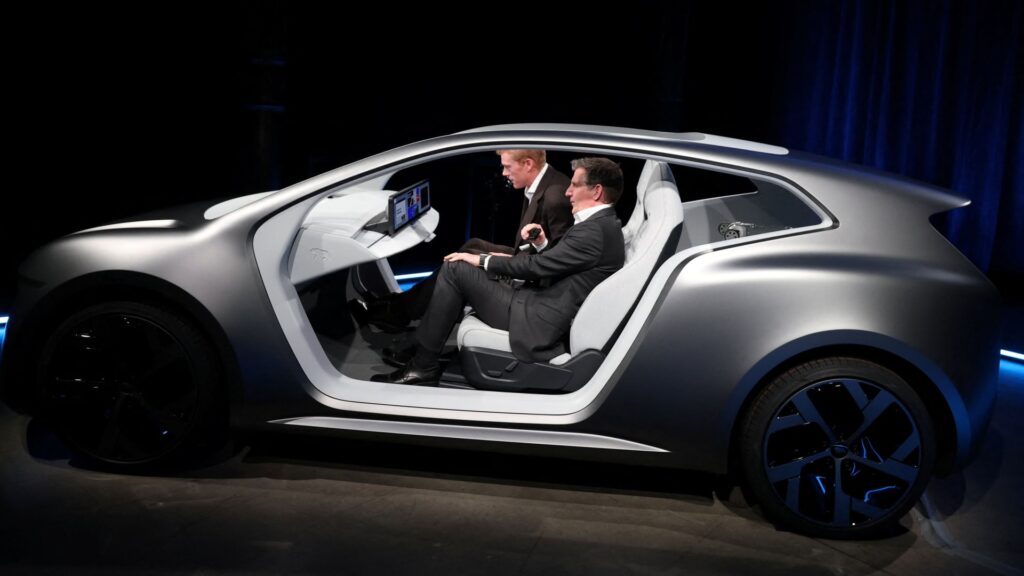
The Cosmos, previewed during the event, features a design reminiscent of Lucid’s Gravity SUV but scaled down. The vehicle targets upscale buyers, younger achievers, and outdoor enthusiasts, competing directly with Rivian’s upcoming R2 midsize vehicle. Lucid’s midsize EVs are expected to start at approximately $50,000, aligning with average U.S. vehicle transaction prices.
Both Lucid and Rivian are striving to reassure investors of their competitive edge in the EV market, emphasizing new vehicles and technologies to rival Tesla. Lucid aims for its midsize platform to lead in efficiency, a hallmark of its vehicle lineup.
Lucid reports $5.5 billion in total liquidity, including a $2 billion credit facility from Saudi’s PIF, sufficient until mid-2027. Meanwhile, Rivian ended the fourth quarter with $6.59 billion in liquidity, as it scales up production of its midsize vehicle and autonomy technologies.
— CNBC’s Michael Bloom contributed to this report.
Original Story at www.cnbc.com