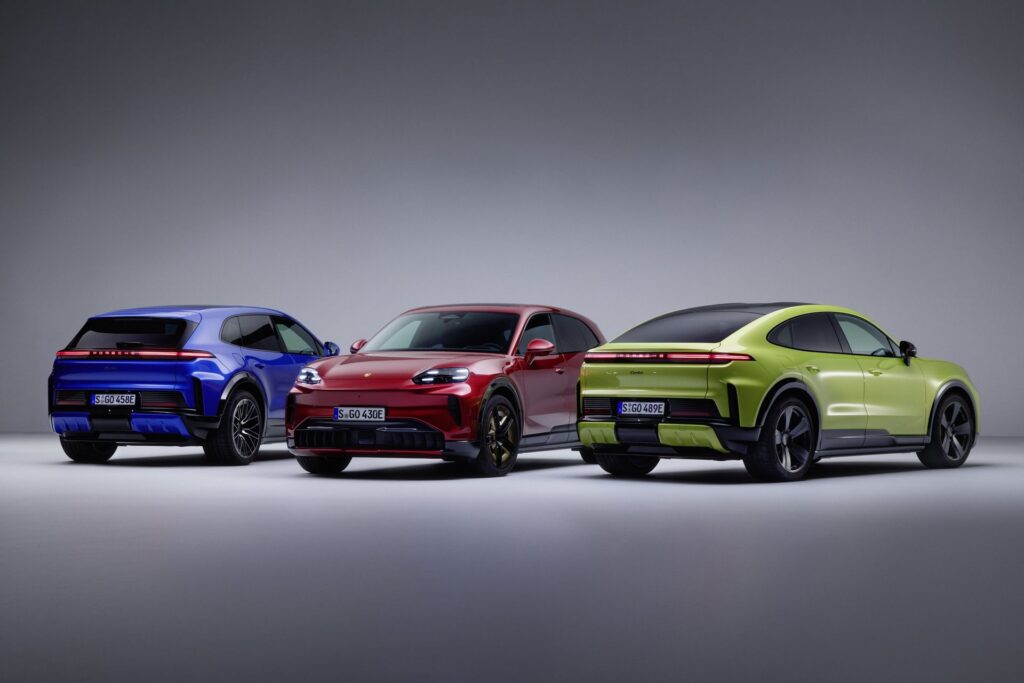
The Porsche Cayenne Electric, a noteworthy entrant in the electric vehicle market, has been updated for the 2027 model year, despite its recent debut in the U.S. The latest version offers subtle enhancements aimed at amplifying the luxury SUV experience.
Porsche has made the configurator for the 2027 Cayenne Electric available, with customer deliveries slated for the first quarter of 2027.
This iteration introduces several customization options, including:
- automatic electric doors for seamless entry and exit
- a massage function paired with 4D audio for an immersive experience
- a Paint to Sample program offering 92 additional paint colors
Key specifications, such as the powertrain, battery, range, performance, and pricing, remain unchanged from the 2026 model.
- 2026 Porsche Cayenne Electric (Image credit: Porsche)
-

- 2026 Porsche Cayenne Coupe Turbo Electric (Image credit: Porsche)

The 2027 Porsche Cayenne Electric
Model Variants
As Porsche’s third fully electric vehicle, following the Taycan and Macan Electric, the Cayenne Electric is built on Volkswagen Group’s Premium Platform Electric (PPE). Initially released as an SUV, the model expanded to include a coupe variant. Both body styles are available in three versions:
- Cayenne Electric: 325 kW; accelerates from 0 to 60 mph in 4.5 seconds
- Cayenne S Electric: 490 kW; reaches 0 to 60 mph in 3.6 seconds
- Cayenne Turbo Electric: 850 kW; hits 0 to 60 mph in just 2.4 seconds
- Cayenne Coupe Electric: 325 kW; accelerates from 0 to 60 mph in 4.5 seconds
- Cayenne S Coupe Electric: 490 kW; accelerates from 0 to 60 mph in 3.6 seconds
- Cayenne Turbo Coupe Electric: 850 kW; achieves 0 to 60 mph in 2.4 seconds
These variants feature a dual-motor, all-wheel-drive system with varying peak power outputs. The Turbo version, the most powerful, can tow up to 7,716 lbs.
Battery Details
This model carries over the 113-kWh battery from the previous year, providing a usable capacity of 107.8 kWh. Comprising 192 large pouch cells across six modules, the battery is integral to the vehicle’s structure, eliminating the need for a conventional battery box.
For comparison, the Porsche Macan Electric sports a 100-kWh battery, while the 2027 Porsche Taycan features a 105-kWh battery.
The high-voltage (800-volt class) battery can be split into two parts for compatibility with 400-volt class DC fast chargers. It also boasts an advanced thermal management system with dual-sided cooling: “two cooling plates cool or heat the high-voltage battery from above and below as required. This allows the optimal temperature window to be achieved more effectively.”

Porsche Cayenne Electric: Battery (Image credit: Porsche)
Estimated Range
While the EPA has not yet published range estimates for the 2027 Cayenne Electric, Porsche indicates that the figures should mirror those of the 2026 model. Depending on the version, the SUV offers an EPA range of 298 to 325 miles, whereas the Coupe variant ranges from 302 to 339 miles.
The Range Setup option, which optimizes the powertrain for efficiency and includes smaller 20-inch wheels, is available at no additional cost and helps achieve the higher range numbers.

In late 2025, State Of Charge tested a pre-production Porsche Cayenne Electric. The car achieved 353 miles of range at 70 mph (likely 69 mph, as the speed was not GPS-corrected) with 2% state of charge (SOC) remaining.
Energy Consumption
The EPA has not yet released official energy consumption ratings. During a test conducted by State Of Charge, a pre-production model achieved an average of 3.3 miles per kWh while maintaining a speed of 69-70 mph.

2026 Porsche Cayenne S Coupe Electric (Image credit: Porsche)
Charging Options
Charging Ports
The Cayenne Electric comes with two charging ports: an NACS (SAE J3400) for DC fast charging, and a separate SAE J1772 for AC charging. These ports are strategically placed on opposite sides of the vehicle: the SAE J1772 is on the right rear, while the NACS is on the left rear.
The vehicle can directly access SAE J1772 AC charging points and NACS DC fast chargers, including Superchargers (Porsche EVs gained access to the Tesla Supercharging network in late 2025/early 2026).
Access to CCS1 DC fast chargers is possible via a CCS1-to-NACS adapter. Similarly, the car can use NACS AC charging points with an AC adapter (NACS-to-J1772).
We assume the NACS (SAE J3400) charging port for both AC and DC charging will be implemented in the future.

Porsche Cayenne Electric (Image credit: Porsche)
AC Charging
The Cayenne Electric includes a 9.6-kW onboard charger, which can fully recharge the vehicle in 13 hours. For faster charging, a 19.2-kW onboard charger is available for an additional $1,780, reducing the charging time to 6.5 hours.
To use the 9.6-kW charger effectively, a 50-amp circuit and a 9.6-kW home charging station are recommended. A 100-amp circuit and a 19.2-kW charging station are necessary to unlock the full potential of the 19.2-kW charger.

2026 Porsche Cayenne Turbo Electric (Image credit: Porsche)
DC Fast Charging
As one of the fastest-charging electric vehicles available in the U.S., the Cayenne Electric can charge from 10% to 80% in just 16 minutes using a high-power charger. The peak charging power is 390 kW, potentially reaching 400 kW under optimal conditions, such as starting at a higher state of charge.
With an estimated range of 298-339 miles, the vehicle can replenish 13.0-14.8 miles per minute in the 10-80% SOC window, adding 210-237 miles of range in 16 minutes. This performance is among the best on the market, although it doesn’t match the top Lucid EVs.
When using low-voltage chargers (400-500 V class), the battery pack splits into two parts, allowing charging at a reduced power level. A 150-kW charger can complete a 10-80% SOC session in 26 minutes.

2027 Porsche Cayenne Electric: Range replenishment rate during DC fast charging from 10% to 80% SOC. (Image credit: State Of Charge)
Wireless Charging
Currently unavailable in the U.S., the Cayenne Electric offers a wireless charging option expected to launch in the latter half of 2026. The 11-kW wireless system, announced by Porsche in 2025, boasts 90% efficiency. Initial European reports suggest a cost of approximately €7,000, potentially translating to $7,000-$8,000 in the U.S.
In Europe, the wireless charging option was launched in September 2026. Electrive reports that, according to the German configurator, the system costs €6,961.49 (€1,844.50 for the vehicle and €5,116.99 for the ground charging pad).
In the U.S., buyers can opt for the $250 preparation package for Porsche Wireless Charging, essential for the later installation of the receiver plate.
“Preparation for Porsche Wireless Charging (1) is required during configuration to retrofit a vehicle with Vehicle Charging Receiver Plate (2) when it becomes available. Preparation for Porsche Wireless Charging is available as a stand-alone option and within Premium Package. Vehicle charging receiver plate (2) and ground charging pad (3) are planned to be available in late 2026.”

2026 Porsche Cayenne Electric: wireless charging (Image credit: Porsche)
Power Export
The Porsche Cayenne Electric comes equipped with a 115-volt AC outlet located in the trunk.

2026 Porsche Cayenne Electric (Image credit: Porsche)
Pricing Structure
The base price for the 2027 Porsche Cayenne Electric is set at $109,000, or $111,350 when including the $2,350 destination fee. Higher trims like the Cayenne S Electric and Cayenne Turbo Electric start at $126,300 and $163,000, respectively.
Coupe variants are priced approximately $4,800 to $5,000 higher than their SUV counterparts. Overall, pricing mirrors the previous model year.
2027 Porsche Cayenne Electric MSRP:
- Cayenne Electric: $109,000
- Cayenne S Electric: $126,300
- Cayenne Turbo Electric: $163,000
- Cayenne Coupe Electric: $113,800
- Cayenne S Coupe Electric: $131,200
- Cayenne Turbo Coupe Electric: $168,000

2027 Porsche Cayenne Electric: Prices and expected EPA range. (Image credit: State Of Charge)
Original Story at evchargingstations.com