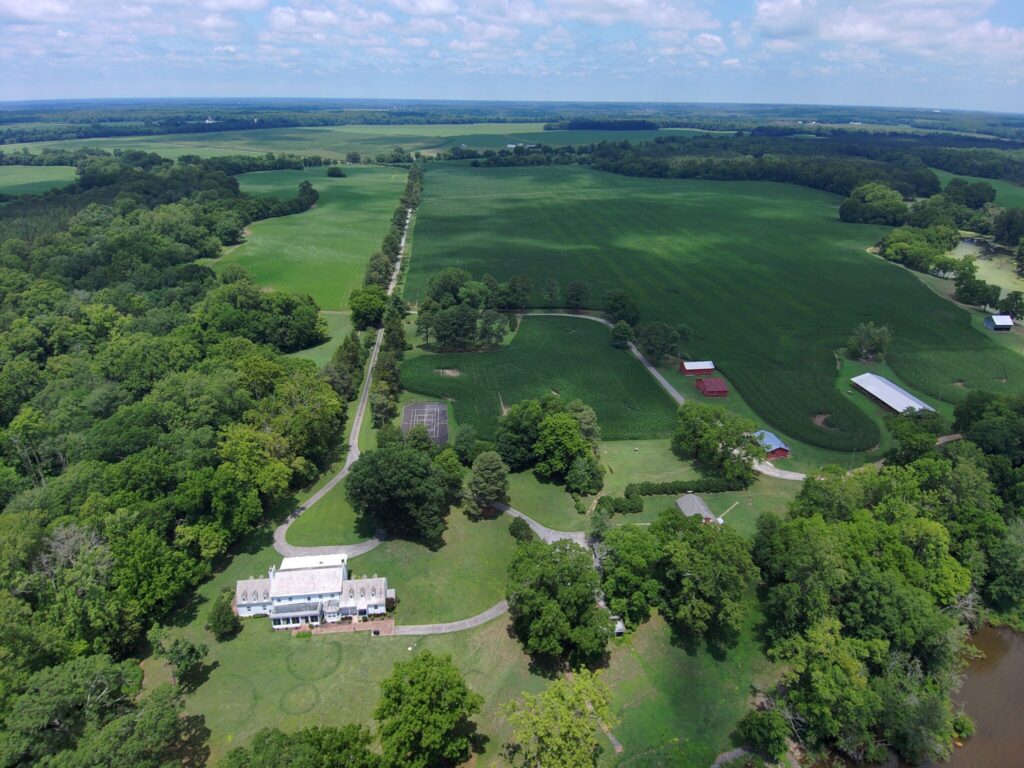
A stretch of Virginia farmland that has been continuously cultivated for nearly four centuries will now be protected from future development — a milestone that connects colonial-era history to present-day conservation. The Capital Region Land Conservancy (CRLC) announced Monday that 1,145 acres along the Pamunkey River have been placed under a permanent conservation easement, the largest in the organization’s history.
Retreat Farm sits near the Hanover and New Kent County line along Piping Tree Ferry Road. Its roots run deep: in the 1600s, colonists patented more than 1,000 acres at a bend in the Pamunkey River, a site described as a place where early Indigenous councils and colonists came together to negotiate peace. The ferry that gave the road its name operated from 1720 until the early 1900s, carrying travelers across the same water that borders the property today.
The land changed hands over centuries, often within family lines. Historical records show the Blackwell family held the farm until 1772, when it passed to Carter Braxton — a figure who signed the Declaration of Independence and reportedly financed substantial resources in support of the Revolutionary War. The farm has remained in family ownership through the generations, and it was that same family who chose to grant the easement now.
What makes the land especially notable is its agricultural richness. Beneath the surface lie large deposits of marl — a calcium carbonate-rich clay historically used as a natural fertilizer. Those deposits played a significant role in restoring tobacco fields that had been depleted by intensive farming in earlier eras. Today, 452 of the farm’s 1,145 acres remain in active crop production, continuing a farming tradition stretching back more than 375 years.
The easement was made possible in part through funding from the U.S. Department of Agriculture’s Natural Resources Conservation Service. Dr. Edwin Martinez of that agency emphasized the broader stakes of protecting land like this:
“Protecting agricultural land is essential to sustaining farming and supporting our rural communities because thousands of acres of farmland are being converted to other uses every day.”
Eric Randolph, who currently farms the land, underscored what the conservation means at a local level.
“Keeping 450 acres of fertile farmland in production is so important to our business and Hanover’s cultural identity,”
he said.
The conservation easement permanently blocks future development while permitting continued agricultural activity and limited forestry. CRLC notes that the arrangement also reduces the property’s assessed value and local land use taxes in perpetuity — a financial benefit that helps make long-term family ownership more viable, even when economic pressures arise.
Beyond the fields, the property supports thriving habitats of plants and wildlife. The protected acreage connects to an additional 500 acres on the opposite bank of the Pamunkey River, which is also under a separate conservation easement — creating a larger protected corridor along this historic stretch of waterway.