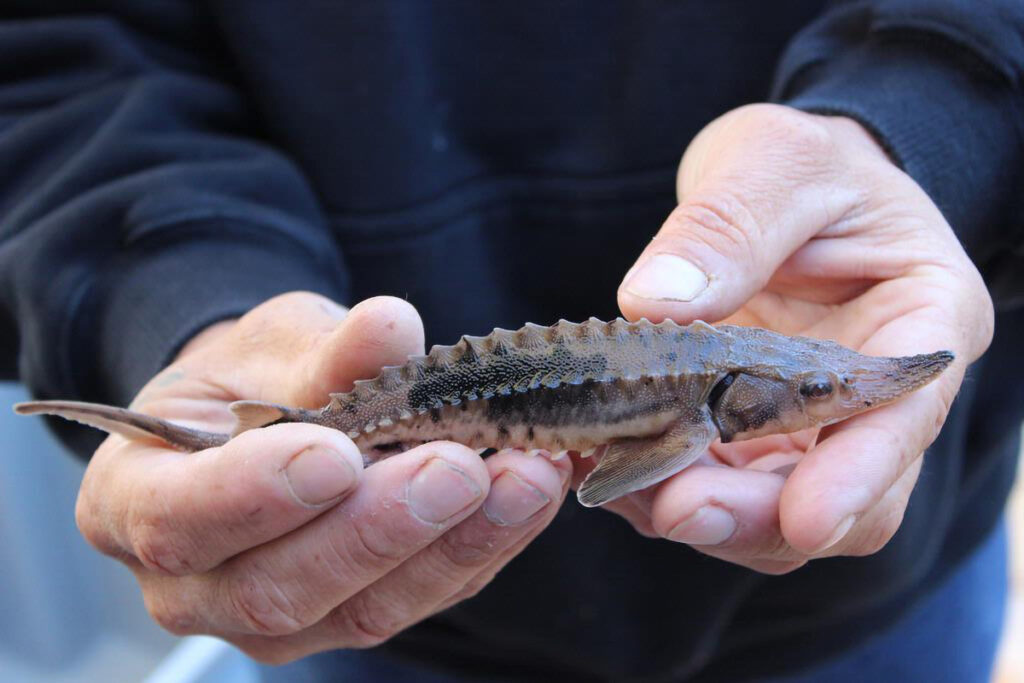
On a brisk October day, the St. Croix Chippewa Tribe initiated a significant step in conservation efforts at the Clam Lake boat landing in northern Wisconsin. Armed with buckets of young lake sturgeon, they released the fish into the lake after a ceremonial prayer. This event marked the tribe’s first sturgeon release, symbolizing a new chapter in freshwater conservation across North America.
Lake sturgeon, notable for their prehistoric appearance with bony plates and a shark-like tail, can grow up to six feet and live beyond a century. Historically, they were prevalent in the Great Lakes and Mississippi River basins. However, by the 1900s, overfishing, pollution, and dam construction had nearly driven them to extinction. Wisconsin stood out as a refuge for the species, particularly in the Lake Winnebago watershed.
Thanks to strict protections and active community engagement, Wisconsin has successfully rebuilt its sturgeon populations. These restored populations are now aiding in river restoration efforts from Milwaukee to the Saint Louis River, demonstrating the broader impact of Wisconsin’s conservation success.
Wisconsin’s identity is closely tied to the lake sturgeon’s revival. “The fact that we’ve got multiple locations throughout the state where you actually have a chance to harvest lake sturgeon sustainably is just incredible,” stated Margaret Stadig, a fisheries biologist with the Wisconsin Department of Natural Resources.
Despite their resilience, lake sturgeon face uncertainties due to climate change. Warmer winters and unpredictable spring flows could affect their spawning and survival. Scientists are still trying to understand how these changes might impact sturgeon, which have thrived for 150 million years.
Ancient Survivors and Conservation Challenges
Sturgeon belong to one of the most endangered animal groups globally. Their long lifespan and infrequent spawning, once advantageous, now make them susceptible to human-induced pressures like overharvest and habitat loss. Of the 27 recognized sturgeon species, most are threatened, and some have vanished completely.
In North America, the decline of lake sturgeon mirrored other species, falling to small, scattered populations by the 1950s. Unlike other migratory sturgeon, lake sturgeon live entirely in freshwater, with females spawning only every few years. “Being a slow growing, slow-reproducing species [makes them] particularly vulnerable to” human pressures, explained John Lyons, fish curator at the University of Wisconsin-Madison Zoological Museum.
Wisconsin’s early restrictions, dating back to 1915, were crucial. Regulations such as harvest limits and bans on commercial fishing helped stabilize the species, laying the groundwork for its recovery.
Lake Winnebago, fed by the Fox and Wolf rivers, is central to this recovery. Each February, it hosts a unique spearing season, where participants wait in shanties on the ice, spear in hand, hoping to catch a sturgeon. This tradition, rooted in native practices, has become integral to the species’ protection, fostering a community of both fishers and stewards.
The Sturgeon Guard program, initiated in the 1970s, also plays a vital role. Volunteers protect spawning fish during their vulnerable migrations, deterring poaching and aiding biologists.
Local schools, families, and visitors gather to witness the spectacle of spawning sturgeon, turning riverbanks into hubs of community engagement and conservation.
“Public support is absolutely key in that this support is critical to get the public funding necessary to effectively manage a sturgeon resource,” Ron Bruch, a retired sturgeon biologist, noted. Successful management relies on public participation in the fishery.
Wisconsin’s robust sturgeon population enables the state to assist in species restoration elsewhere. Eggs from the Winnebago system now support initiatives in several rivers and states, showing promising signs of adult fish returning to previously uninhabited waters.
Cultural Revival and Tribal Leadership
Among Wisconsin’s Indigenous communities, the Menominee have led sturgeon stewardship. This role is now expanding to other Tribes, such as the St. Croix Chippewa, who are reviving culturally significant foods, including sturgeon.
For the St. Croix Chippewa, the restoration at Clam Lake is culturally significant. Their reservation lies across the St. Croix watershed, an area once rich with sturgeon. Tribal Chairman Conrad St. John emphasizes that the fish are “knowledge holders and knowledge passers.”
Restoring sturgeon is about cultural reconnection. “For us, this is cultural,” St. John stated. “We are the protectors of these resources and we’re really going to fight tooth and nail to maintain and preserve them.”
The Tribe has expanded its hatchery, previously focused on walleye, to include lake sturgeon. This spring, biologists collected and fertilized sturgeon eggs from the Yellow River, nurturing them in the hatchery until they were ready for release in October.
The initial cohort of 3,000 young sturgeon, including 400 released on the first day, is part of a 20-year restoration plan. “It was a really nice day to get everybody involved,” said Jeremy Bloomquist, the tribe’s land and water resources manager. “It was a long time coming, something that we have been wanting to do for many years.”
All juveniles were tagged for tracking, aiding future stocking decisions. Studies suggest that continuous annual stocking is essential for population recovery.
Facing Climate Change
Despite Wisconsin’s success, climate change poses new challenges for lake sturgeon. Warmer, unpredictable winters affect spawning cues and habitat conditions.
Winters in Wisconsin are warming faster than other seasons. Ice forms later and melts sooner, impacting activities like spearing seasons.
For sturgeon, changes in seasonal cycles can disrupt spawning and juvenile survival. “Fish in temperate environments are adapted to seasonal cycles,” explained fisheries ecologist Zach Feiner. If these cycles shift, sturgeon reproduction may suffer.
John Lyons, a sturgeon researcher, notes the lack of data on sturgeons’ temperature preferences. Climate projections indicate possible stressful conditions for sturgeon in some river areas.
Whether lake sturgeon can adapt to these rapid changes is uncertain. “You could argue they’ll adapt, and you could make an argument that they might really suffer,” Lyons said, acknowledging the uncertain future even for a species with a long history.
Original Story at insideclimatenews.org