
In Wisconsin, the journey towards harnessing solar energy is encountering turbulence as local communities express dissent over proposed projects. Two significant solar initiatives are currently embroiled in controversy, with local authorities voicing their opposition.
Officials in communities in northeast and central Wisconsin have taken a stand against two large-scale solar projects. Additionally, a smaller solar initiative in south-central Wisconsin saw its decision deferred following an extended public hearing.
This local resistance arises amidst a legislative proposal that would mandate local government approval for significant solar and wind projects prior to state regulatory consent. The bill aims to shift decision-making power to local entities.
Among the projects facing opposition are the Fox Solar Project in Morgan, Oconto County, and the Akron Solar Project in Rome, Adams County, and Saratoga, Wood County. Both are spearheaded by Florida’s NextEra Energy Resources, requiring only state approval.
The Fox Solar Project is poised to produce 100 megawatts, with Akron aiming for 200 megawatts. According to the Solar Energy Industries Association, 100 megawatts can power approximately 15,332 Wisconsin homes.
Both projects incorporate battery storage, with Fox planning for 50 megawatts and Akron 200 megawatts of storage capability.
Community leaders like Morgan Town Board Chair Lori Witthuhn and Rome Town Board Chair Carl Hasdal have lodged objections with the state Public Service Commission.
Rome seeks to intervene in the Akron case, while Morgan intends similar action for Fox Solar.
“We are locked out on the whole thing,” Hasdal remarked. “We don’t have any say in the matter, and that’s just not right.”
Communities in Oconto, Adams Counties Oppose Solar Projects
The Fox Solar Project in Oconto County has sparked controversy, leading to the recall of two town board members in 2022 due to community dissatisfaction. Currently, Morgan’s town board is predominantly opposed, with nearly 70 percent of residents denouncing the project in a 2023 referendum.
Witthuhn expressed concerns, stating, “It’s pretty obvious to me that people in this township do not want it.” Oconto County Board Supervisor David Behrend echoed these sentiments, criticizing NextEra Energy’s approach to community engagement.
Behrend mentioned that while community meetings were held, they appeared to be mere formalities. “They think they can come into any town and do as they wish,” he commented. Concerns about lost farmland, solar reliability, and battery safety are prevalent among opponents.
NextEra, however, remains committed to their projects, emphasizing potential tax benefits. A spokesperson highlighted that Fox Solar could generate $12.5 million in local tax revenue, while Akron is anticipated to contribute $1 million annually.
In Adams and Wood counties, Hasdal noted limited community feedback opportunities, reinforcing the project’s unpopularity. “This is just not what the people want here,” he remarked.
Both Witthuhn and Hasdal advocate for increased local say in renewable energy decisions. “It’s important that people have a voice, whether you’re for it or against it,” Witthuhn stated.

Bill Proposes Local Government Approval for Solar, Wind Projects
Under current Wisconsin law, large-scale energy projects require Public Service Commission approval, bypassing municipal consent. However, a Republican bill proposes that solar or wind projects generating at least 15 megawatts secure local government approval.
State Sen. Eric Wimberger, R-Oconto, advocates for local governance, stating, “It remains my hope that we pass (the bill), and put power back into the hands of those who have been elected to lead.”
Rick Coelho from Clean Wisconsin warns that the bill could impede the state’s response to rising energy demands. He highlights solar’s efficiency, questioning, “Do we want to slow down the approval of fast and cheap energy at a time of growing energy demand?”
Coelho attributes resistance to land use changes, noting, “A solar farm replacing an agricultural field is really a land use change.” He underscores the thoroughness of the Public Service Commission’s approval process, allowing public input.
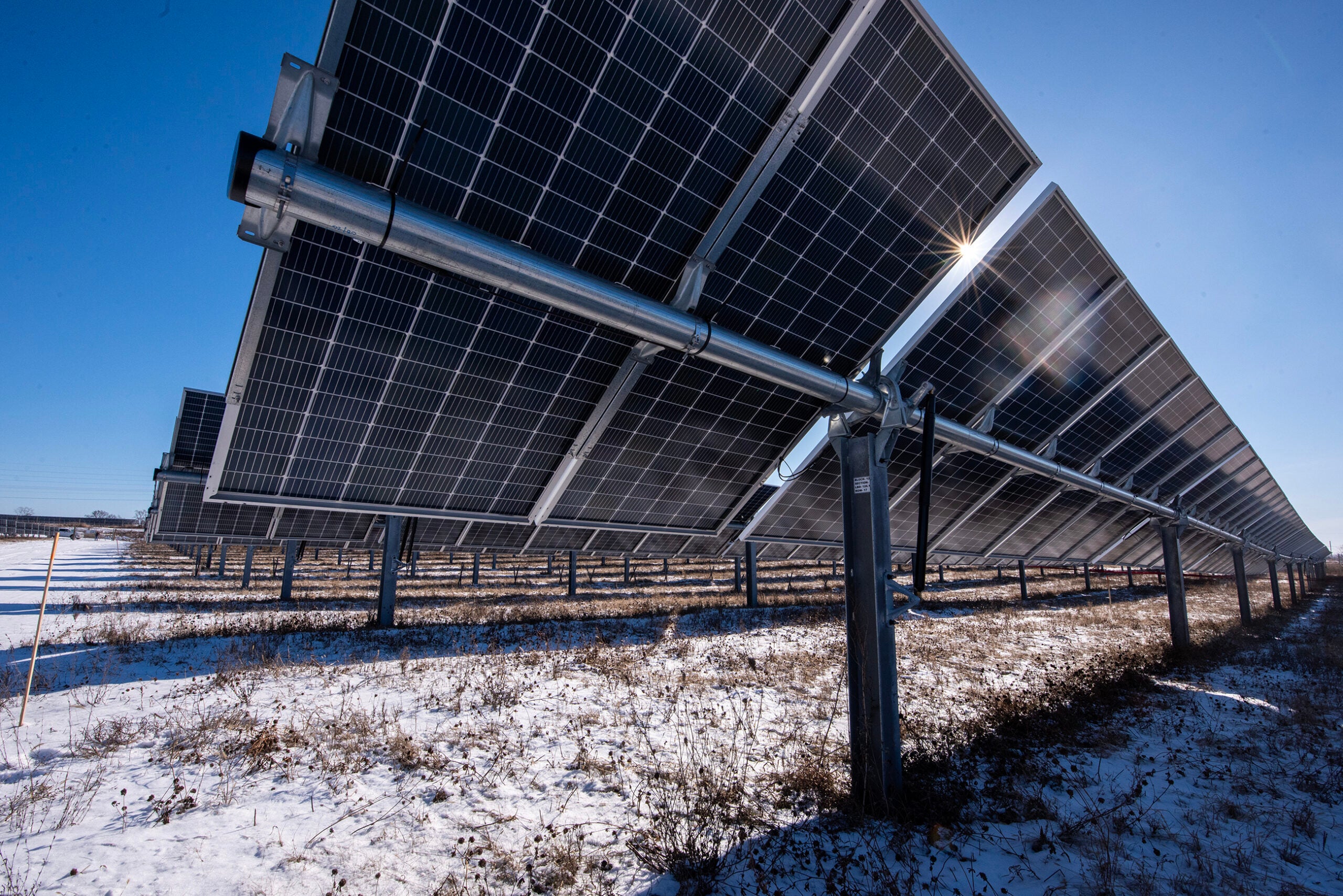
Small Solar Project in Waunakee Faces Delayed Vote
A solar initiative in Waunakee experienced delays after residents voiced concerns during a Village Board meeting. The Six Mile Solar Project, developed by OneEnergy Renewables, would produce 6 megawatts.
The proposed project would be situated on leased land from Madison Gas and Electric. Project Manager Nolan Stumph emphasized the benefits, stating it would stabilize the local energy grid and reduce energy importation.
Opponents fear it may alter the rural character of the area. Waunakee resident John Aronica expressed his concerns, suggesting the project be relocated.
Despite the opposition, some residents support the project, like Linda Ashmore, who emphasized solar energy’s cleanliness and cost-effectiveness.
The Waunakee Village Board has postponed the decision, with no new date announced for reconsideration.
Original Story at www.wpr.org