Innovative Collaboration Transforms Unsold Food into Renewable Resources
In a progressive move towards sustainability, a partnership between food and beverage brands and their logistics partners is redefining waste management practices. With an emphasis on state-level landfill diversion mandates and environmental goals, companies are now treating unsold products not as waste, but as valuable resources.
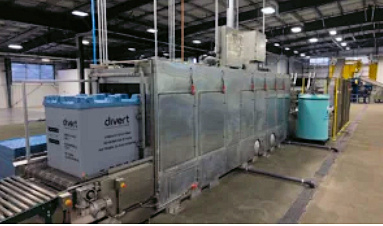
When efforts to sell or donate excess products are exhausted, United States Cold Storage (US Cold) transports them to Divert’s Integrated Diversion & Energy Facility located in Turlock, California. Utilizing advanced High-Recovery Depackaging (HRD) and anaerobic digestion technologies, Divert converts these materials into renewable natural gas (RNG), nutrient-rich fertilizers, and reclaimed water. This innovative process ensures that value is retained locally while providing US Cold and its partners with the environmental benefits and documentation they require.
Brands like Oatly, which depend on US Cold’s distribution network, see this partnership as an extension of their sustainability commitments. Oatly has already eliminated production waste from reaching landfills and aims to completely eradicate waste, including warehouse-generated waste, by 2030. Through collaboration with Divert, US Cold aligns with these goals, ensuring that unsold inventory is handled with stringent environmental care at all stages.
The logistics sector faces challenges with varying destruction volumes based on location, product type, and season. Traditional service models often fail to handle this variability cost-effectively, posing obstacles to sustainable practices. However, Divert’s dynamic pricing and optimized material routing have enabled US Cold to scale its sustainable destruction efforts across multiple sites.
Sara Cook, Sustainable Development Manager at United States Cold Storage, highlighted the importance of trust in brand stewardship: “Our customers trust us to be good stewards of their brand, and that responsibility doesn’t end when products can’t be sold.” She praised Divert’s flexible program, which allows for secure product destruction while maintaining sustainability, providing brands like Oatly with assurance of responsible handling.
According to a recent Divert case study, in the first 15 months of the collaboration, over 2.5 million pounds of unsold food and beverage products from seven US Cold facilities in California were processed, resulting in:
- 8,500 MMBtu of renewable natural gas production
- Avoidance of approximately 450 metric tons of CO2 equivalent emissions, equivalent to 40 vehicle trips around the equator
Specifically for Oatly, the partnership led to the processing of 126,000 pounds of product, generating nearly 80 MMBtu of RNG and preventing around 4 metric tons of CO2e, roughly equal to 10,000 miles driven.
The Turlock facility not only contributes renewable natural gas to the pipeline but also supplies fertilizers and soil amendments to local agricultural partners like Western Milling and Crème Brulee Farming Co., aiding regional farms in food production. When operating at full capacity, the facility can generate enough renewable energy for over 4,000 homes and produce fertilizers to support 112 million pounds of strawberries, among other benefits.
With a presence in over 7,800 customer locations nationwide, Divert is poised for expansion in the food supply chain sector, especially with the USDA estimating 930 refrigerated warehouse locations across the U.S.
Ben Kuethe Oaks, SVP, Commercial at Divert, commented on the impact of their platform: “The impacts we’ve generated with US Cold and its customers in California are a great example of the closed loop our Circularity Platform creates.” He emphasized the platform’s ability to support customers nationwide as they pursue waste reduction and circularity objectives.Read more
Original Story at www.renewableenergymagazine.com