Originally published by Public Health Watch, a nonprofit investigative news organization. Learn more at publichealthwatch.org.
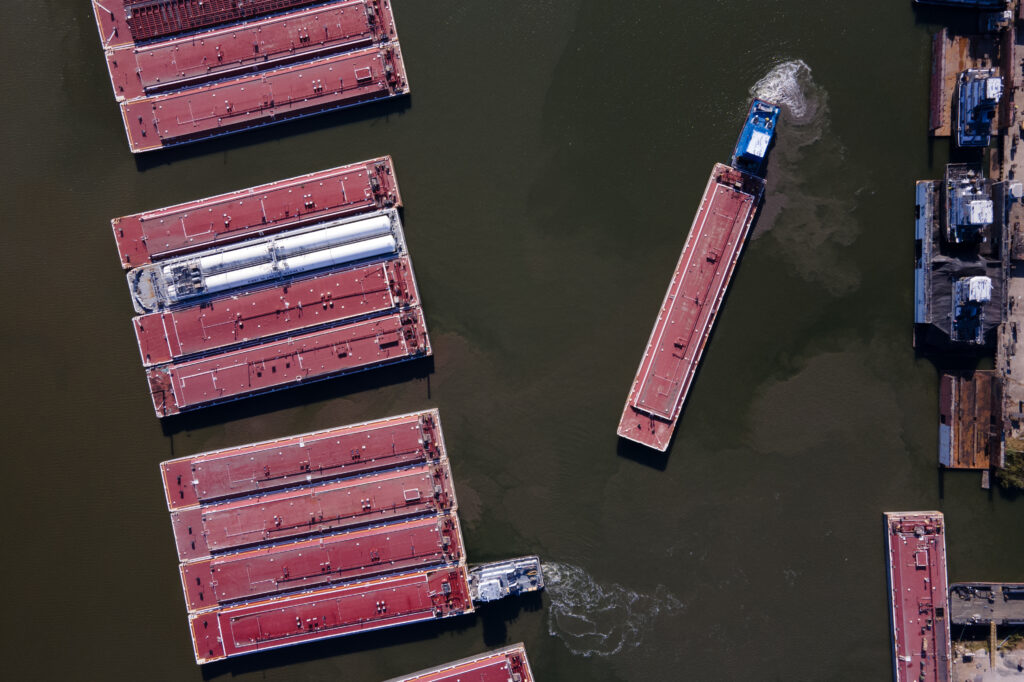
SAN JACINTO RIVER, Texas—Hundreds of oil and chemical barges have accumulated over 30 years in a once-peaceful part of the San Jacinto River, east of Houston, with federal and state approval.
An analysis of archival satellite imagery by Public Health Watch showed the number of barges on this six-mile water stretch soared from about 100 in 1990 to over 600 today.
These cargo ships are crucial for Houston’s refineries, chemical plants, and pipeline terminals, facilitating movement along the Houston Ship Channel, one of the busiest U.S. shipping lanes and a significant chemical distribution hub.
However, for Channelview and Highlands’ 54,000 residents, this industrial growth signifies danger. Their air quality ranks low nationwide, often attributed to industrial facilities along the Ship Channel. Yet, Texas Commission on Environmental Quality (TCEQ) data indicates that in 2023, barge-related pollution surpassed that of a major Exxon Mobil facility.
TCEQ estimated that barges and small vessels released 5.1 million pounds of volatile organic compounds (VOCs) in Harris County in 2023, 28% more than Exxon’s major complex. VOCs, including benzene and toluene, are linked to cancers, with Highlands and Channelview residents facing cancer risks significantly above the national average, according to the U.S. Environmental Protection Agency’s 2020 Air Toxics Screening Assessment.
Despite TCEQ’s claim that barge emissions were just 2.6% of Harris County’s VOCs in 2023, Public Health Watch identified significant gaps in the TCEQ’s emissions inventory, which lacks direct monitoring and omits emissions from barges in transit or moored.
Frank Parker, a retired barge industry consultant, noted the inevitability of leakage during chemical transfers, while Tim Doty, a former TCEQ scientist, highlighted long-standing awareness of barge pollution, criticizing regulatory oversight.
A History of Disasters
The barges pose additional threats. They pass a dioxin-laden Superfund site and navigate tight spaces under the Interstate 10 bridge. Residents fear hurricanes could loosen barges, causing disasters like bridge collapses or toxic spills.
Channelview resident Jennie Ramsey expressed concerns over the industrial encroachment on residential areas. Past incidents, like the 1994 barge collision causing a river fire and the 2019 barge crashes into the I-10 bridge, highlight the risks.
The Texas Department of Transportation acknowledged the danger, planning to rebuild the I-10 bridge by 2027 to accommodate growing barge traffic.
The Multi-Billion-Dollar Shipping Lane
The Houston Ship Channel, managed by the Port of Houston, is crucial to Texas’ economy, generating $439 billion annually. Barges, the “18-wheelers of the water,” are vital for operations, making numerous trips daily. The channel is undergoing expansion to accommodate larger vessels, with multiple petrochemical projects planned along its banks.
Despite the economic benefits, Harris County Commissioner Adrian Garcia acknowledges the need for cleaner barge technology but emphasizes the industry’s importance. Commissioner Tom Ramsey, however, warns of potential disasters from increased barge traffic near sensitive areas.
The Powerful Port of Houston
Residents have limited influence over barge proliferation. Channelview and Highlands lack local government representation, and regulatory agencies often deflect responsibility. The Port of Houston controls much of the barge leasing process, with decisions largely made behind closed doors.
Public engagement is restricted to brief opportunities before decisions are finalized, and residents often struggle to voice concerns effectively.
A Missed Opportunity
In May, the Port of Houston designated seven barge exclusion zones, but none near the I-10 bridge or Superfund site, areas of significant risk. The port justified its decision by citing a lack of nearby residential areas, a claim disputed by local advocates.
Advocates like Jackie Medcalf, founder of the Texas Health and Environment Alliance, criticize the regulatory framework for marginalizing public input, even as ongoing legal challenges occasionally force agencies to reassess permits.
Despite advocacy efforts, the Port of Houston continues expanding barge capacity, adding to residents’ concerns over safety and environmental impacts.
Original Story at insideclimatenews.org