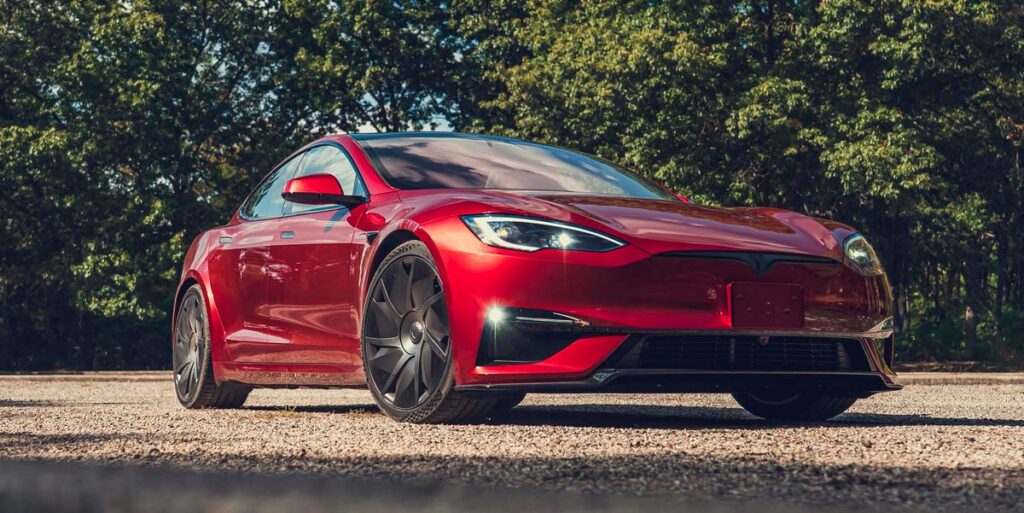
Once perceived as a novelty, electric vehicles have undergone a dramatic transformation. Over a decade ago, the concept of an electric car was often dismissed as unappealing, likened to the original Nissan Leaf’s blending of eco-awareness with the aesthetics of an orthopedic shoe. However, a significant turning point emerged with Tesla’s bold entry into the market.
“The Reality Shift in Electric Vehicles”
Back in 2012, Car and Driver remarked on Tesla’s Model S, stating, “The reality is that most electric cars simply haven’t been very good. The Model S gets the job done. It’s attractive, comfortable, fast, practical, technically fascinating, and not overpriced. Most important, it’s not just a good electric vehicle, it’s a good car.” This assessment set the stage for the Model S to become a game-changer in the automotive industry.
This past weekend marked the end of an era as the final Model S and Model X units rolled off the production line at Tesla’s Fremont, California, facility. Tesla now focuses on its popular Model 3 and Model Y models, while the Fremont plant transitions towards other innovative projects.
Tesla’s unpredictability has always been a topic of interest, but the legacy of the Model S and Model X is clear. These models have left an indelible mark on the automotive landscape, influencing the industry much like the Ford Model T and the Porsche 911.
In 2015, a Model S P85D became the first electric vehicle to undergo a Car and Driver long-term test, impressing despite its $136,720 price tag. Tesla’s expanding charging network played a key role, growing from 188 locations to over 3000 in the continental U.S. during the test period.
Imitation is often the highest form of flattery, and the Model S inspired many. Although Ferdinand Porsche had long been intrigued by electrification, Porsche’s first mass-produced EV, the Taycan, was a response to Tesla’s innovation, not a pioneering venture.
While electric vehicles face challenges such as range limitations and dependency on charging networks, their performance is undeniable. When the 1020-hp Model S Plaid debuted in 2021, its acceleration was brutally effective. However, its claimed 200 mph top speed was restricted to 163 mph without the optional Track package.
Meanwhile, the Model X delivered similar performance with family-friendly features. Though its aesthetics and “falcon” doors were polarizing, they captured the imagination of many, particularly younger audiences with features like Fart Mode.
The tenure of the Model S and Model X concluded with an invite-only delivery event, albeit postponed without explanation. Tesla’s strategy often involves ambitious promises, sometimes at the expense of timelines. Nonetheless, these models fundamentally redefined electric vehicles, showcasing their potential for speed and desirability, and changing perceptions of eco-friendly motoring.
Original Story at www.caranddriver.com