Supreme Court Faces Pivotal Climate Lawsuit: Boulder vs. Big Oil
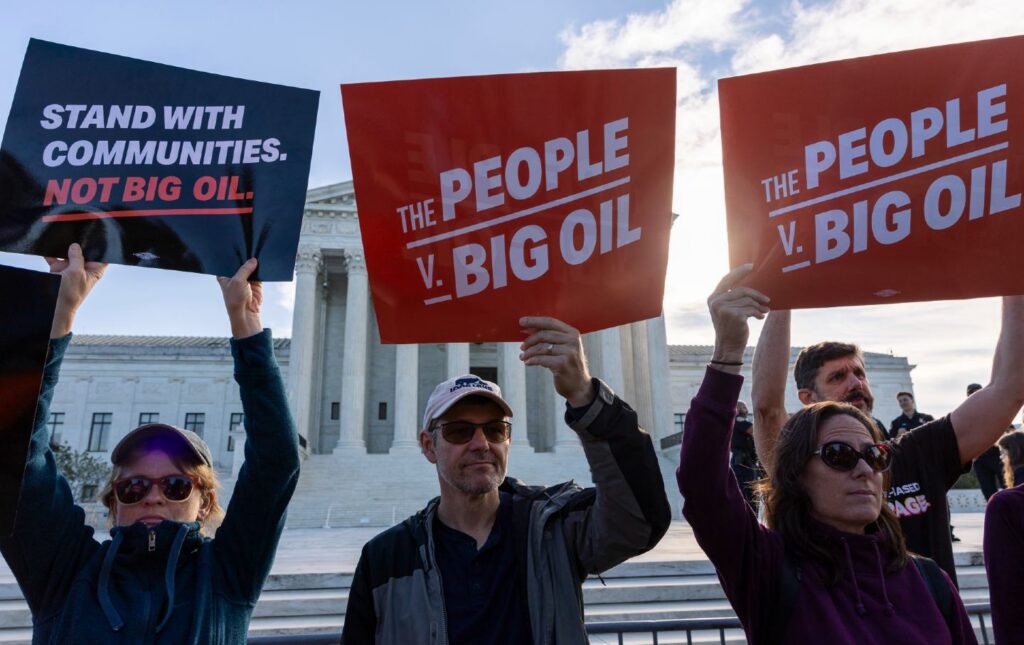
Demonstrators rally outside the Supreme Court against oil corporations involved in Suncor Energy Inc. v. County Commissioners of Boulder County.
(Finn Gomez / Getty Images)
The U.S. Supreme Court has embarked on a new term with a contentious environmental case, Suncor Energy Inc. v. County Commissioners of Boulder County. Originating from Boulder, Colorado, the lawsuit targets Suncor and ExxonMobil, accusing them of misleading marketing tactics that allegedly contributed to climate change-related damages.
The hearing focused on whether the lawsuit should proceed past a dismissal motion. A decision in favor of Boulder could set a precedent, enabling local governments and individuals to sue energy firms for climate-induced damages, potentially transforming the fossil fuel industry’s operations worldwide.
However, the case’s success seems uncertain. Unlike previous mass tort litigations targeting industries like tobacco or opioids, this involves the massively capitalized Big Oil, valued at over $4 trillion. It’s a significant leap to hold these companies accountable for global energy production and consumption impacts.
The justices grappled with the case’s legal complexities. While some prefer to see the case dismissed, others are unsure about the timing and method of dismissal. The Colorado State Supreme Court previously allowed the suit to proceed, posing a jurisdictional question for the Supreme Court: should it intervene now or let the state court handle it first?
Justice Clarence Thomas questioned the energy companies’ legal representation on jurisdiction matters. Liberal justices Elena Kagan and Ketanji Brown Jackson suggested awaiting the state court’s conclusion, although Kagan signaled skepticism about Boulder’s chances.
Energy companies seek to avoid state court battles, with their lawyer suggesting immediate Supreme Court intervention to prevent a deluge of similar lawsuits. They argue for federal preemption, citing the Clean Air Act and constitutional principles as barriers to state-level regulation of air pollution.
Boulder, however, claims their lawsuit targets deceptive marketing, not pollution per se. Kevin Russell, representing Boulder, asserted that the companies could continue their operations as long as consumers are fully informed about the consequences, attempting to circumvent the Clean Air Act’s regulations.
While some justices, like Chief Justice Roberts and Kagan, were skeptical of Boulder’s marketing angle, the case uniquely challenges conservative justices who typically resist expansive federal preemption. This contradiction puts them in a difficult position, as broad federal preemption could impede state autonomy in other contexts.
Justice Neil Gorsuch faces a dilemma, as conservatives generally oppose federal overreach. Yet, supporting Big Oil might require an expansive interpretation of federal law, conflicting with their usual stance on states’ rights.
Justice Alito’s recusal due to potential conflicts of interest leaves the court with an even number of justices, which could result in a tie, leaving the lower court’s decision intact. However, the likelihood of such an outcome remains uncertain.
The court’s decision may hinge on reconciling ideological conflicts with practical implications. While some justices may wish to curb Boulder’s case, the broader implications of federal preemption weigh heavily on their considerations.
Original Story at www.thenation.com