This story has been published in partnership with Intercept Brasil.
Brazil’s popular soap operas have turned into an unexpected platform for promoting fossil fuels, with Shell using this medium to boost its fuel sales by linking itself to clean energy initiatives. The oil giant capitalized on the reach of famous actors and social media influencers to craft a narrative that resonated with millions of viewers.
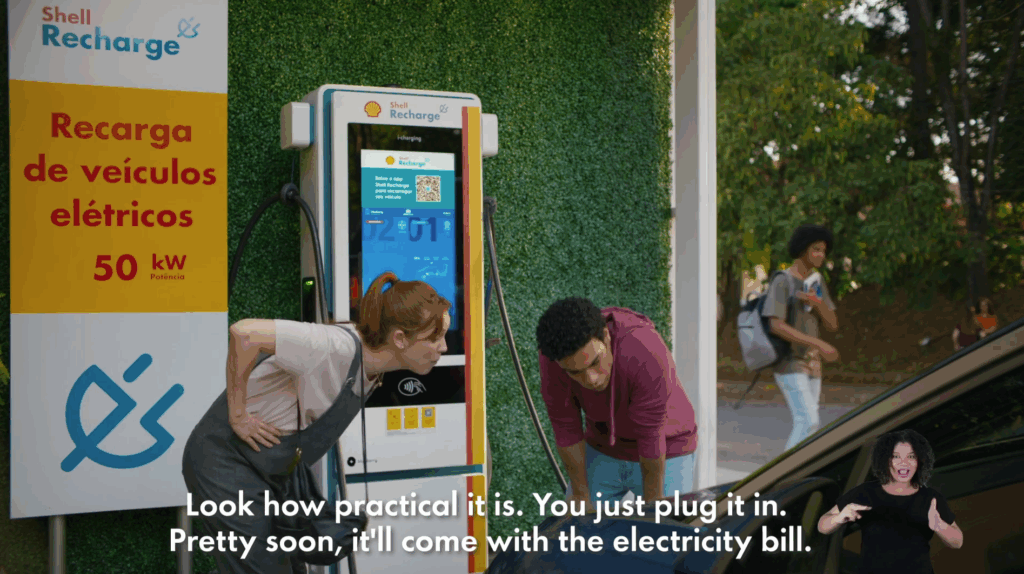
The “Caminhos do Amanhã” (“Paths of Tomorrow”) initiative featured renowned actors Sophia Abrahão and Sérgio Malheiros in its initial phase, showcasing Shell’s electric vehicle charging stations to a massive audience during soap opera ad breaks in 2023. This campaign was later revitalized with social media influencers, aiming to broaden its appeal.
British ad agency VML, responsible for the campaign, sought to leverage the public’s favorable view of clean energy to “strengthen trust in Shell” and subsequently drive up sales of their traditional car fuels, according to documents accessed by DeSmog.
The strategy, leveraging the “halo effect,” resulted in a 13 percent increase in fuel sales. However, details about the specific timeframe or the total sales volume were not disclosed in the documents.
Shell’s campaign contrasts sharply with its actual operations in Brazil. Although the company has run the campaign for two years, electric charging is available at less than 1 percent of its stations. Earlier this year, Shell halted most of its solar and onshore wind projects in Brazil, as reported by Power Technology.
The upcoming COP30 climate talks set to start on November 10 in Belém, Brazil, highlight the country’s pivotal role in global discussions on reducing reliance on fossil fuels. Meanwhile, advertising strategies like those of VML are under scrutiny for potentially hindering these efforts.
Critics argue that campaigns like these enable oil companies to project themselves as clean energy investors while continuing fossil fuel exploitation. Adriano Liziero, a Brazilian environmentalist, commented, “VML is helping turn misleading narratives into perceived truth.”
Shell’s campaign expenditure reached up to $10 million in its first year. The storyline involving Sophia and Sérgio was heavily promoted across TV, cinemas, billboards, and digital platforms, ensuring widespread reach.
Despite regulatory setbacks in the UK, where Shell’s clean energy claims were curtailed by the Advertising Standards Authority, VML’s approach in Brazil continues unabated. Notably, VML’s UK CEO, Pip Hulbert, was recently promoted to international chief client officer, underscoring the company’s strategic focus on such campaigns.
Brazil’s Oil Expansion
Shell ranks as Brazil’s second-largest oil producer behind Petrobras. Together, these companies aim to elevate Brazil from the seventh to the fourth largest oil and gas producer globally.
In March, Shell approved a new offshore project, expected to produce 120,000 barrels of oil per day by 2029, alongside plans for additional projects.
Despite this expansion, Shell continues to emphasize clean energy in its latest campaign iteration. Featuring influencers on platforms like YouTube and Instagram, the campaign focuses on Shell’s technological innovations for sustainability, garnering significant engagement.
While Shell claims to be a leader in clean energy trust in Brazil, the reality is different. Shell’s electric infrastructure is minimal, with only 80 charging stations out of 6,500. The company has paused its electric expansion to reassess its portfolio.
Globally, Shell’s renewable energy production stands at a mere 0.35 percent of its total energy output, according to a recent study published in Nature.
Pressure Growing for Ad Bans
The advertising sector is increasingly criticized for its role in perpetuating fossil fuel dependency through misleading campaigns. Calls for bans on fossil fuel advertising are gaining momentum, led by figures like U.N. Secretary General Antonio Guterres, who advocates for the end of such marketing practices.
Some regions, including parts of Europe, have imposed restrictions on fossil fuel ads. However, no South American countries have implemented similar measures, despite growing advocacy from groups like Clean Creatives, which encourages agencies to reject fossil fuel clients.
“The message is one of transition, but the outcome is growing the status quo,” a former WPP employee noted, emphasizing the disconnect between advertising narratives and environmental realities.
Additional reporting by Juliana Aguilera.
This story has been published in partnership with Intercept Brasil.
Original Story at www.desmog.com