Subscribe to the new Harvest newsletter for our latest reporting on agriculture and the environment, behind-the-scenes exclusives, and more.
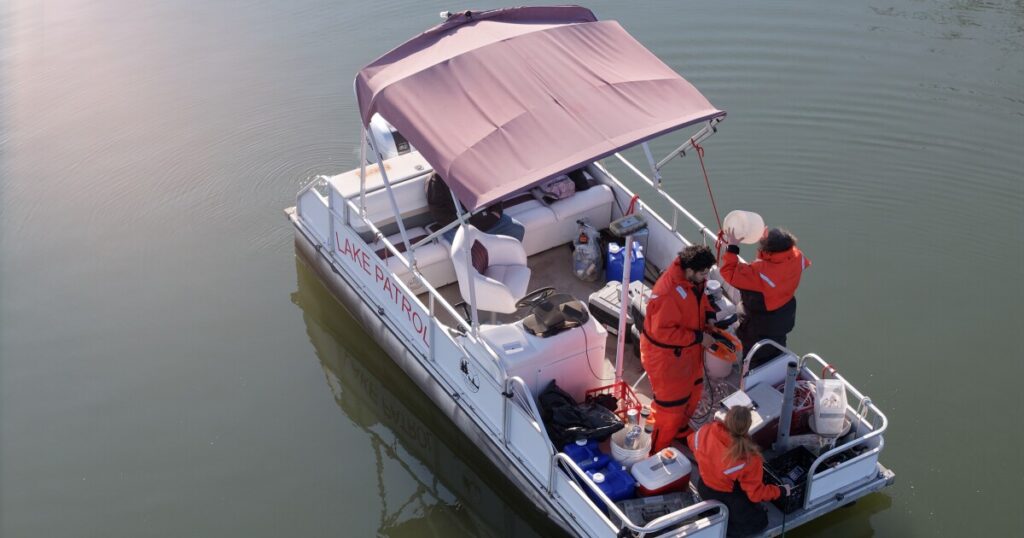
Amidst a serene Missouri lake, a pontoon boat carried a team conducting crucial water quality assessments, helmed by Rebecca North, a scientist from the University of Missouri. Clad in an orange flotation suit, North’s mission was to assess the health of the private lake, a task now funded by a local homeowners association due to recent federal funding cuts.
North, an aquatic ecology expert for over 20 years, now seeks funding through unconventional means, like a GoFundMe campaign. “Currently, for the first time in my scientific career, I have a GoFundMe or donation button on my website,” she admitted. This financial pivot reflects a broader trend affecting scientists across the central U.S. under the second Trump administration.
Interviews with 14 scientists from various states reveal the administration’s impact on American science, marked by workforce reductions, grant cancellations, and restrictions on research topics such as climate change.
White House spokesman Kush Desai defended the administration’s approach: “The United States is home to the largest public-private ecosystem of innovation in the world, and the American government is the largest funder of scientific research.” He added that the administration aims to cut funding for projects perceived as politically biased.
Terminated Research Funding
Over 7,000 research grants from institutions like the NIH and NSF were canceled, as tracked by the watchdog group Grant Witness. This list is incomplete, as several other federal agencies also provide grants. Among the affected scientists is Bonnie Keeler from the University of Minnesota, who lost three major grants totaling over $14 million. “It’s been really, really tough, I’ll be honest,” Keeler expressed, detailing the abruptness of the terminations.
Keeler shared termination letters indicating a shift away from supporting diversity and environmental justice. Other scientists received similar abrupt notices without thorough explanations.
Collaborative projects have also been affected, including the National Climate Assessment and the new National Nature Assessment. Despite these setbacks, Keeler’s coalition continues its work with alternative funding sources. “We are full steam ahead on producing that report,” she noted, predicting future efforts by 2026.
Trent Ford, Illinois State Climatologist, emphasized the regional impact of halting the National Climate Assessment, which hinders localized climate understanding.
Research Topics Under Scrutiny
Some researchers suspect that their work’s content led to funding cuts. Grants listed in Sen. Ted Cruz’s database of “Woke DEI Grants” were particularly vulnerable. Terms like climate change and environmental justice also flagged projects for potential cancellation.
Christopher Tessum from the University of Illinois speculates that his air quality project was cut due to its focus on environmental justice. “I don’t have the inside information about the particular process,” he remarked, noting the lack of clear reasons for the termination.
Keeler described the year as “policy whiplash,” with some grants unexpectedly axed despite being in response to federal calls for research. She observed, “I think it is telling that evidence-based regulatory analysis is no longer a priority of the Trump administration.”
Scientists have reportedly been advised against discussing climate change publicly, as confirmed by an anonymous federal scientist. This directive remains unwritten but influences communication at public events.
In Illinois, Ford adapts his language to avoid contentious terms, stating, “We’re still going to do climate change research, right, but we’re going to call it ‘weather extremes.'”
Federal Workforce Reduction
More than 320,000 federal employees have left positions since January 2025, according to the U.S. Office of Personnel Management. Among them is Doug Kluck, who retired early from NOAA due to fears of losing health benefits for his family. “The spring was full of DOGE, the effort to get rid of federal employees under false pretenses,” Kluck explained.
Kluck’s early retirement has left his previous role and others like it largely unfilled, affecting coordination and communication within federal agencies.
Ford highlighted the impact on collaboration during extreme weather events, noting decreased communication with agencies like FEMA. “The communication is zero now,” he stated.
Adapting to Changes
Despite the challenges, scientists and organizations are finding new ways to continue their work. Kluck hosts climate webinars for Midwest stakeholders, funded by the University of Nebraska. “Although I’ve retired, I haven’t really quit my job,” he shared.
Climate Central, a nonprofit, has stepped in to assume roles once held by the government, hiring former federal scientists and maintaining a database of billion-dollar disasters. Yet, according to Kristina Dahl, Climate Central’s vice president, “Even collectively, all of the U.S.-based climate and environmental nonprofits don’t have the same capacity as the federal government.”
Keeler echoed the sentiment, recognizing the irreplaceable scale of federal support for scientific research. “Philanthropy at any scale is never going to be able to replicate the amount of funding that the federal government can support,” she said.
Despite the setbacks, Rebecca North remains hopeful, drawing parallels to similar periods of funding cuts in Canada. “We know that countries and programs can come back from things like this,” she stated.
This story was produced in partnership with Harvest Public Media, a collaboration of public media newsrooms in the Midwest and Great Plains. It reports on food systems, agriculture, and rural issues.
Original Story at www.kcur.org