
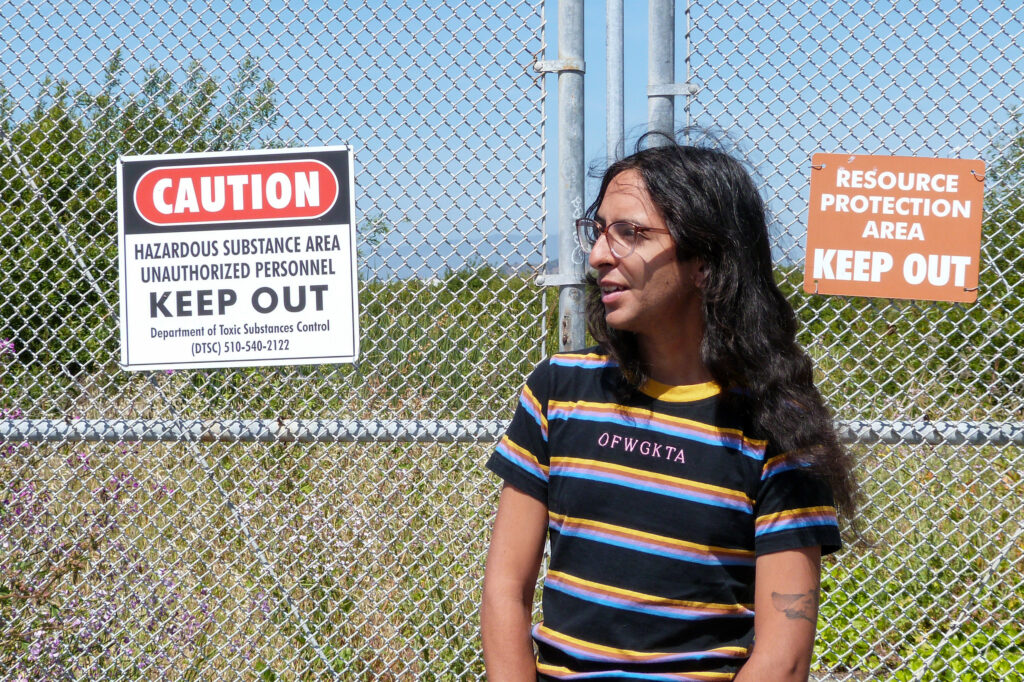
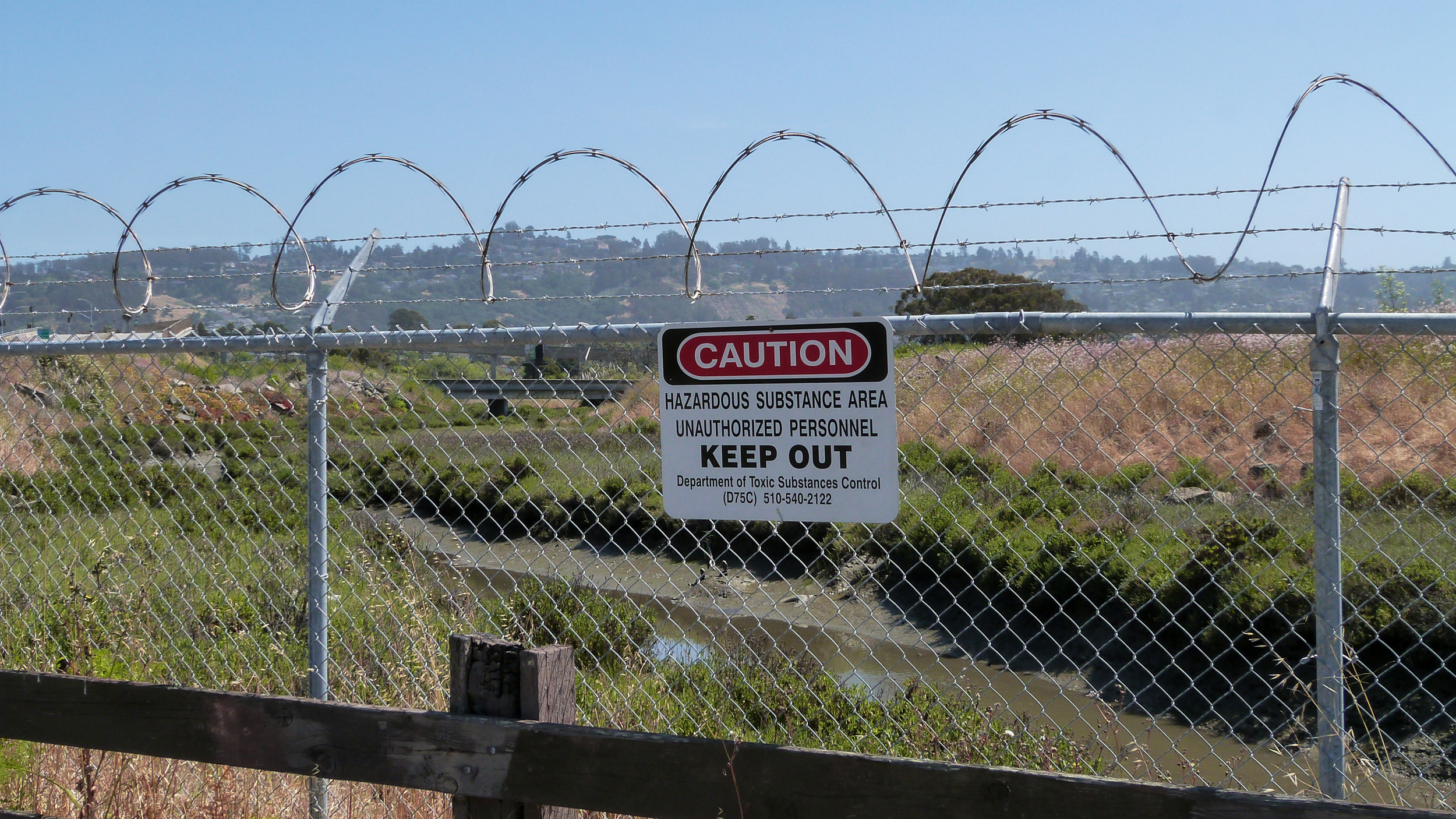
RICHMOND, Calif.—On a sunny May morning, Luna Angulo walked along a chain-link fence topped with razor wire on San Francisco Bay’s eastern shore. She paused near locked gates labeled as a “hazardous substance area,” where long-closed chemical plants had deposited toxic waste on marshlands, recalling the refinery explosion that changed her life.
Angulo was 12 when a massive explosion hit Chevron’s Richmond refinery, four miles away. Towering clouds of black smoke darkened the skies in 2012, forcing 15,000 residents to seek medical care for ailments like chest pain, headaches, and asthma.
The catastrophic fire remains in the memory of this working-class town, where industrial accidents often affect Black and Latino neighborhoods surrounded by polluting railroads and freeways. It also inspired many young people to become climate activists.
“That fire was a major catalyst for us,” said Angulo, now 25, who co-founded Rich City Rays, a climate justice group led by gender-queer activists. They organize non-violent protests against Chevron, the second-largest greenhouse gas emitter in California.
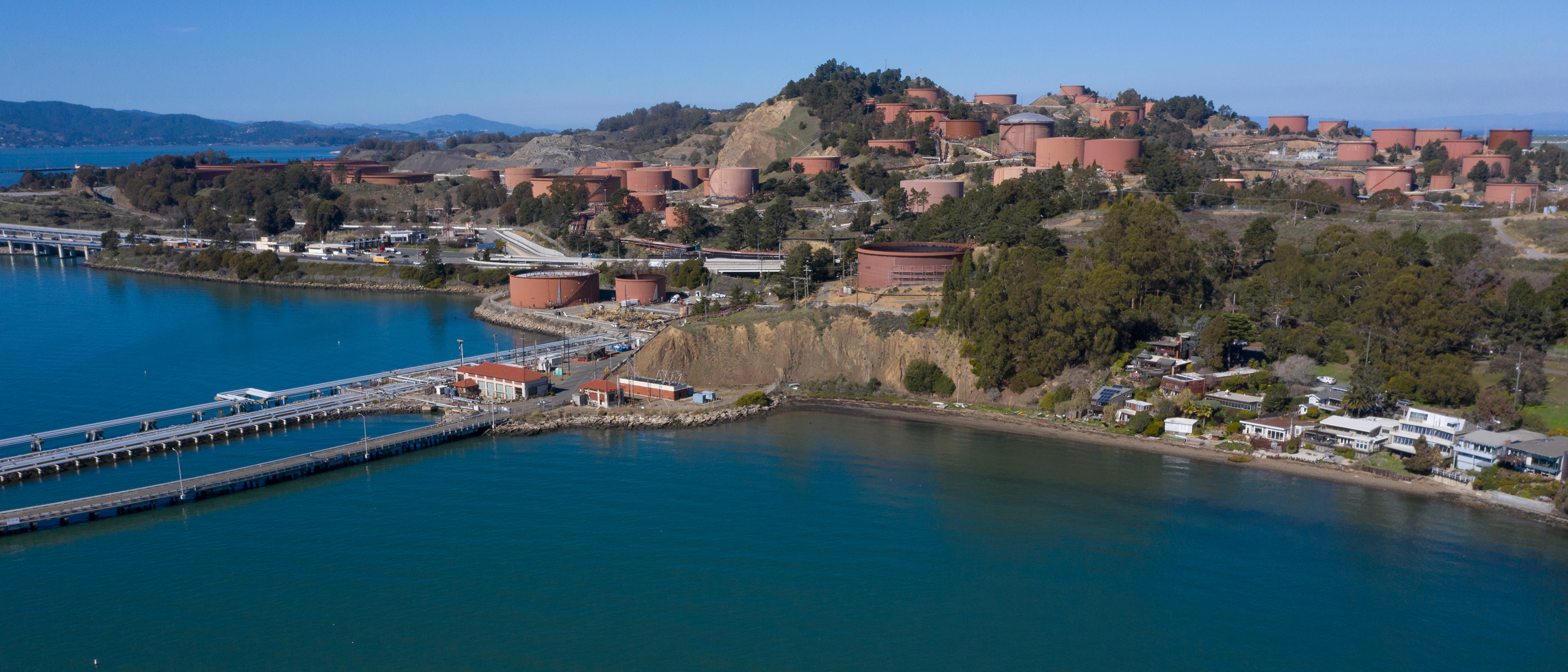
Angulo, a first-generation Mexican-American, grew up with asthma but did not connect it to Richmond’s pollution until the refinery fire. Now she sees the oil-storage tanks beyond her mother’s window as “symbols of harm.”
Experts warn that living in a heavily polluted city could have health impacts for generations if greenhouse gas emissions are not curbed. Rising seas will increase flood risks for sites in Richmond and other coastal cities, according to a study published in Nature Communications by scientists from the University of California and Climate Central.
Low-income neighborhoods and communities of color face a disproportionate share of the risk. Rachel Morello-Frosch, an environmental-health disparities expert, has evaluated climate pollution impacts on low-lying industrial regions.
Burning fossil fuels makes floods more destructive by releasing toxic substances like petroleum. Morello-Frosch worries that toxic floodwaters will increasingly impact low-income communities like Richmond. Decades of discriminatory practices have left residents living near polluting industries without means to mitigate harm.
The research team conducted a national assessment of flood risks from hazardous sites. Of nearly 48,000 U.S. facilities handling harmful substances, 5,500 are likely to face a 1-in-100-year flood event by 2100, and nearly 3,800 by 2050. Curbing emissions could spare a few hundred sites by 2100.
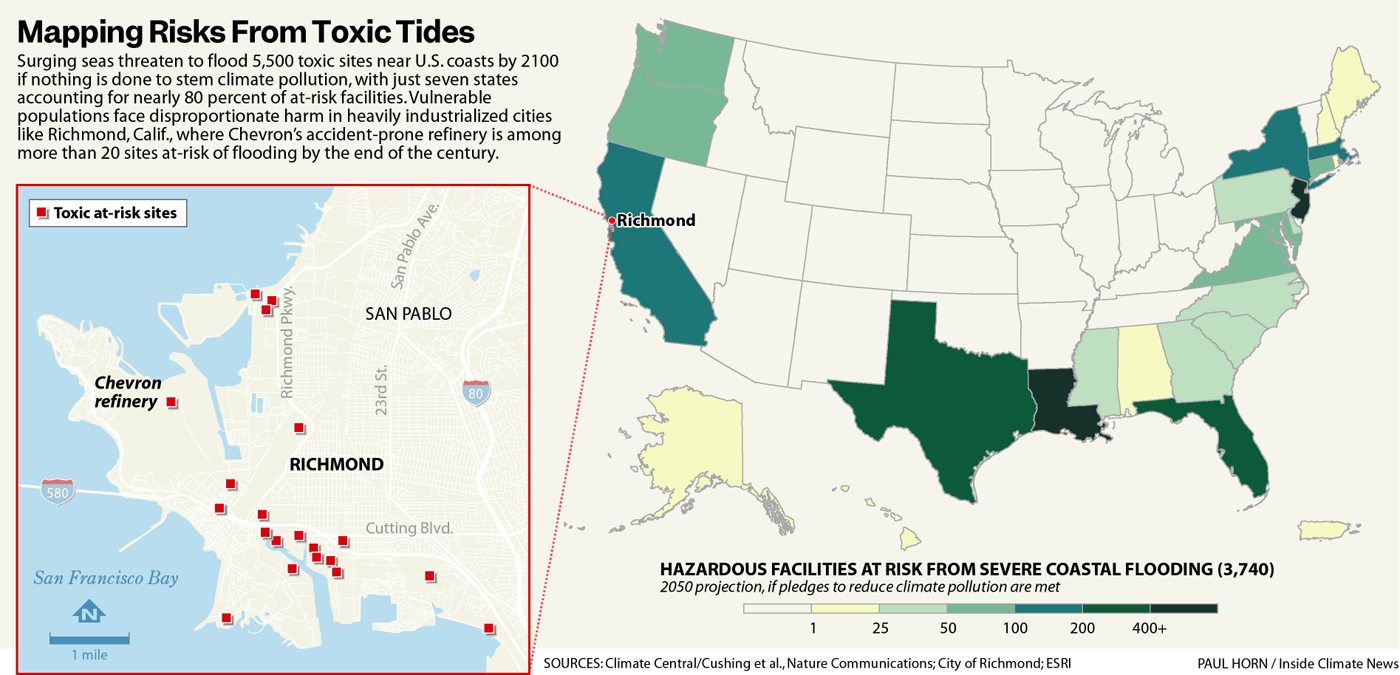
More than 5,000 facilities are at risk of flooding by 2100 if no action is taken, said Morello-Frosch, referring to the Paris Agreement target to avoid irreversible climate change effects. The vast majority of at-risk facilities are in seven states, led by Louisiana with its concentration of oil and gas wells, followed by Florida, New Jersey, Texas, California, New York, and Massachusetts.
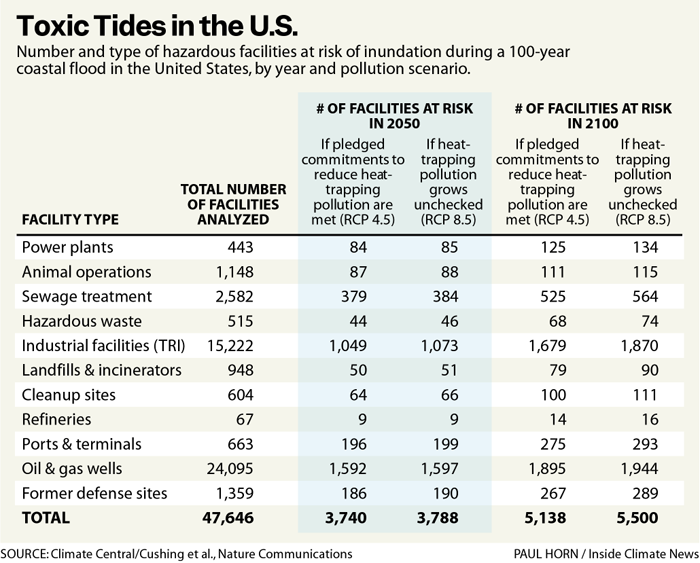
Oil and gas wells and facilities emitting toxic chemicals tracked by the U.S. Environmental Protection Agency’s Toxics Release Inventory make up nearly 70 percent of sites likely to flood. Other facilities include sewage plants, ports, defense sites, and power plants.
Exposure to toxic substances has been linked to numerous health conditions, including heart problems and cancer. Overburdened communities like Richmond are 50 percent more likely to live near a hazardous site at risk of flooding by the century’s end. Hispanic residents, single parents, nonvoters, renters, people over 65, and those in poverty or with limited English skills are up to 41 percent more likely to live near an at-risk site.
“Ideally, we would have a federal government enabling communities to plan and respond to these risks,” Morello-Frosch said, noting the Trump administration’s cuts to federal disaster relief programs. As it becomes harder to access federal resources, states will struggle to address future threats.
“A Legacy of State-Sponsored Racism”
Angulo studied a map showing nearly two dozen hazardous sites likely to flood in her hometown. An elementary school, Peres K-8, lies within half a mile of two chemical plants likely to flood. “A petroleum pipeline runs right under the sidewalk in front of the school,” Angulo said.
The study excludes pipelines despite their vulnerability during floods due to limited national data. Angulo was unsurprised to see at-risk sites around the Iron Triangle, where less than 10 percent of residents are white, and North Richmond, where 96 percent are people of color.
“It’s a legacy of state-sponsored racism and segregation,” Angulo said, referencing federal housing policies that considered people of color threats to property values before the 1968 Fair Housing Act. “Neighborhoods like North Richmond were historically the only places Black and brown folks could own houses.”
Black migrants who helped build Richmond’s shipyards during World War II were denied access to government-insured loans and resorted to makeshift materials. “That’s why Parchester Village was built,” Angulo said.
Parchester Village, promoted as a “community for all Americans,” was surrounded by industry and railways.
Thomasina Horsley grew up in Parchester Village, where heavy rains flooded the neighborhood soon after it was built in 1949. Her mother, one of Parchester’s original residents, remembers floodwaters rushing through the neighborhood.
Engineers warned officials in the 1950s that a “dangerous mixture of oil and water” would pass through Parchester if a storage tank in the Chevron “tank farm” burst during a storm.
Parchester’s flooding worsened after developers removed a eucalyptus grove about five years ago to build million-dollar homes, Horsley said. Without the trees to catch water during rains, “there’s water all over.”
“We’ve had so many bad things happen, people just go into survival mode,” said Horsley.
In 1993, a railroad tank car released a sulfuric acid cloud over homes, sending 24,000 to hospitals and leading to a $180 million settlement.
“There’s always these tanks around with something leaking,” Horsley said. “Then we get the downwinds all the time with all these chemicals coming from Chevron. You smell them all the time.”
Living near some of California’s major pollution sources has worsened residents’ health problems.
Asthma is more common in Richmond, with 25 percent of residents affected, compared to 13 percent in California. Asthma emergency visits in the Iron Triangle are higher than 99 percent of California census tracts, state data shows.
“So many people are already suffering from industry’s noxious releases, Angulo said. How are they supposed to handle more toxic threats from rising seas when they have nowhere else to go?
“Blatant Neglect”
Doria Robinson, a third-generation Richmond native on the city council, runs a community food project called Urban Tilth in North Richmond. The farm, employing local residents for a healthier community, sits near a sewage plant likely to flood.
Two creeks flank the farm, which saw “massive flooding” until the county raised their levees. But climate change and unusual storm events like atmospheric rivers present new challenges.

Robinson helped the city negotiate a deal with Chevron to pay Richmond $500 million over 10 years instead of tens of millions each year in a “polluters pay” refinery tax.
“For us to have a multinational corporation in our backyard with the amount of disinvestment, the amount of deferred investment in our infrastructure, is just,” Robinson paused, “blatant neglect.”
Chevron said in a statement that it contributes over $1 billion in economic activity annually to Richmond and the region. “Our agreement with the city underscores the essential nature of our relationship, and we hope the additional funding will be used responsibly to help our Richmond community flourish.”
Robinson wants the Chevron tax settlement funds to reverse decades of lack of investment. She emphasized the need to focus on climate change threats and allocate resources to address them.
She’s particularly concerned about how rising seas will affect hazardous waste sites “cleaned up” by capping the soil with concrete and asphalt.
Robinson thinks about saltwater pushing groundwater up against caps, inundating toxic soils and carrying contaminants into old sewer pipes under houses, parks, and schools.
“We’ve got an old DDT factory and other sites where supposedly a cap was going to save us,” she said. “Our grand plan to use these massive caps is undermined by water intrusion.”
Threats From Below
Robinson first heard about coastal groundwater rising from UC Berkeley researchers. Emma Lasky and her Ph.D. advisor Kristina Hill study the likelihood of contaminants being dislodged at hazardous sites capped with concrete.
“When we thought of the problem as rain spreading the contaminant, it made sense to cover it with concrete,” Hill said. “It was like putting an umbrella over the contaminant.”
But now, said Hill, “we see that it’s about water rising up from below and even changing flow directions.”
As saltwater moves inland, studies show, it pushes groundwater toward the surface, mobilizing contaminants in groundwater and soil.
Lasky is studying how seasonal precipitation affects the movement of volatile organic compounds (VOCs) at the contaminated Richmond marsh. VOCs, harmful even at low levels, may move through sewer pipes and enter homes through broken seals or cracks.
To understand how rising waters might affect VOCs, Lasky placed sampling devices on sewer laterals to compare chemical concentrations during dry and rainy seasons. So far, she found a chlorinated VOC linked to cancers at higher concentrations during rains. This suggests that VOC-tainted water, from heavy rains or surging seas, could enter sewer systems and seep into buildings.
Lasky hasn’t tested for VOCs in homes yet. She’s concerned that if found, people might not afford repairs. She’s even more worried people are unaware of the problem.
Lasky and Hill aim to raise awareness.
High tides and rains can raise groundwater enough to mobilize contaminants, Hill said. “The impact of sea level rise is a game of inches, not feet.”
This is a concern for coastal sites like Richmond. The marsh floods with heavy rains, said Angulo. “Baxter Creek runs through toxic land,” she said, pointing beyond the fence. “Rainwater and ocean water mix with chemicals in the dirt.”
The creek flows through backyards in a public housing complex. “It’s a majority Black, brown, and low-income community, which are most at-risk for health impacts,” she said. With bigger rains and rising sea levels, they’re on a “ticking time bomb.”
Resilience Denied
As the rate of sea level rise accelerates, scientists expect to see more flooding from high tides along U.S. coastlines soon.
Compared to an extreme weather event, sea level rise is slow-moving, giving municipalities time to prepare, said Morello-Frosch.
She hopes agencies use the study results to prioritize resources for significant threats by doing more site-specific assessments and supporting resilience planning.
The results can help vulnerable communities advocate for including sea level projections in cleanup plans for hazardous sites.
Urban Tilth’s Robinson tried to address climate change threats when she secured a $19 million Community Change Grant from the Biden administration’s EPA.
“The grant was to be a major investment in North Richmond, hit hard by fossil fuel impacts for 100 years,” Robinson said.
The North Richmond Resilience Initiative was one of over 400 grants funded by the Inflation Reduction Act that the Trump administration canceled. It would have created green space, affordable homes, and a disaster response hub at Urban Tilth.
When California Reps. John Garamendi and Mark DeSaulnier urged the EPA to reinstate the appropriations, they were told the initiative supports programs “promote or take part in DEI or environmental justice,” undercutting the priority to eliminate discrimination.
The EPA press office did not respond to a request for specifics.
Robinson was shocked by the reason for canceling the grant. It aimed to address North Richmond’s geography, not specific populations, Robinson said. “It’s literally geographic.”
That geography supported the growth of industry, continuing to affect residents’ health.
At the contaminated marsh, Angulo recalled she and her friends didn’t consider long-term impacts of living in an industrial town. A siren blared in the distance.
A siren goes off weekly to test the warning system in case of disaster. For Angulo, it’s a reminder of that day in 2012 when clouds of black smoke blotted out the sun.
“`
Original Story at insideclimatenews.org