El Niño Phenomenon: A New Chapter in Climate Observations
As El Niño intensifies in the Pacific, breaking records of warm sea temperatures, scientists are navigating a new phase of climatic uncertainty. This natural climate pattern is reshaping weather predictions worldwide, with experts unsure of the full extent of its impact.
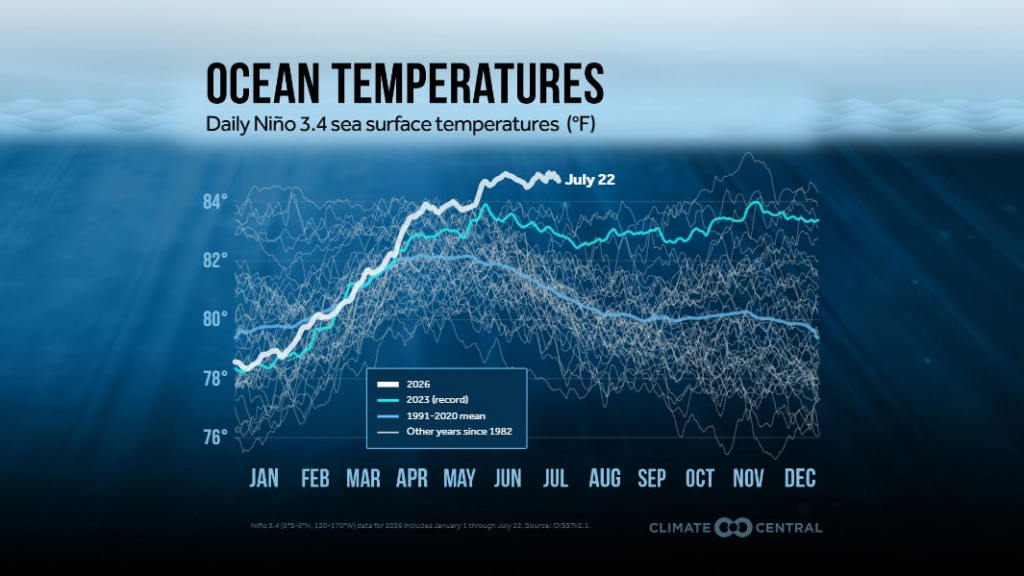
El Niño, known for altering global weather patterns, has reached unprecedented levels, marking what could be the most intense event since records began. “It may end up the strongest by a truly mind-blowing margin,” stated Zeke Hausfather, a research scientist at Berkeley Earth, in The Climate Brink.
The ramifications of this climatic shift could be significant, with experts predicting that 2026 could become the warmest year on record, followed closely by 2027. The potential for droughts, heavy rainfall, and heat waves has already raised alarms among global leaders. However, El Niño’s influence isn’t entirely negative, as it’s expected to mitigate the 2026 Atlantic Hurricane season.
In the United States, El Niño is already affecting weather patterns by reducing hurricane activity in the Atlantic while bringing unusual heat to California. Hausfather and his colleague Robert Rohde noted that sea surface temperatures have exceeded the threshold for a very strong El Niño, a change happening faster than the notable 1997-98 event.
NOAA data indicates that July’s sea temperatures in the El Niño region have never been this high. “A potentially record-breaking El Niño on top of record-breaking global temperatures to begin with is a pretty big deal,” said Daniel Swain, a climate scientist at the University of California Agriculture and Natural Resources. The odds of setting a new record for warm global temperatures either this year or next are high, according to Swain.
Climate Central, a nonprofit organization, attributes this extraordinary temperature rise to climate change, with temperatures in the El Niño region of the Pacific up to 6 degrees warmer than normal. Hausfather and Rohde suggest that this could surpass the 2015-2016 El Niño, potentially becoming the strongest one observed.
Global Weather Implications of El Niño
El Niño’s influence on global weather could be profound. “El Niño will give an extra boost to global temperatures,” stated Alvaro Silva of the World Meteorological Organization. During El Niño years, global temperatures typically reach new highs.
In the U.S., a strong El Niño can enhance the jet stream, leading to more severe winter storms in California and other southern states. Some of California’s wettest winters have coincided with strong El Niño events. While it can heighten hurricane activity in the eastern Pacific, it tends to suppress it in the Atlantic.
The economic impact of El Niño could be staggering, as highlighted by Justin Mankin, a Dartmouth professor. He indicated that the current forecasts suggest this could be the most costly El Niño on record. Regions like Central America and parts of South America might face drier-than-average conditions, while East Africa could see wetter conditions during its rainy season.
The Unpredictable Nature of El Niño
Despite strong signals pointing to a robust El Niño, predicting its peak and ultimate strength remains challenging. Michael Mann, a climate scientist at the University of Pennsylvania, emphasized the chaotic nature of El Niño and its unpredictable interactions with atmospheric conditions.
Hausfather noted that current models are exploring uncharted territories, with unprecedented agreement among predictive models. However, the exact outcomes remain uncertain. “Every event has a different flavor and this will undoubtedly have a different flavor than we’ve ever seen before,” Swain remarked.
Original Story at www.usatoday.com