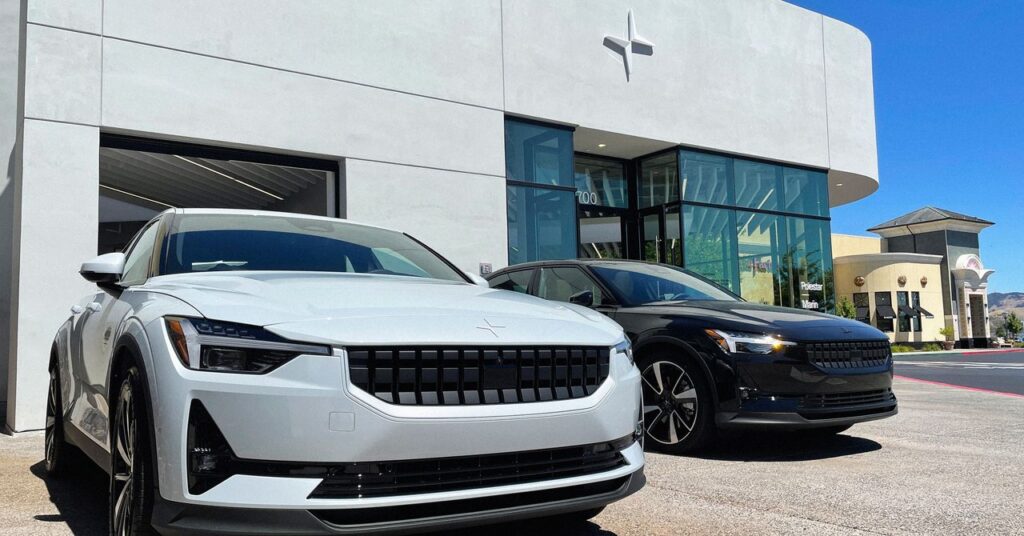
Navigating the US electric vehicle market has been an unpredictable journey throughout the 2020s.
Since the establishment of the Polestar Short Hills dealership in northern New Jersey in 2021, the business has experienced significant fluctuations. Initially, there was a COVID-19-induced surge in demand and an EV shortage, which led to some used electric vehicles having higher prices than new models. A subsequent federal tax credit of up to $7,500 spurred another wave of interest, but sales volumes later dropped following the reduction of that credit and the elimination of a state incentive. Interest once again surged when drivers distanced themselves from Elon Musk’s Tesla due to his ties with the Trump administration.
Currently, Matthew Haiken, the owner of the Polestar dealership and three other dealerships within the Prestige Collection Auto Group, is confronting a more pressing issue. In late June, Polestar announced that the US Commerce Department had refused an authorization that would permit the brand to continue US sales, citing a federal regulation restricting vehicles equipped with Chinese-made technology. Consequently, Polestar, mainly owned by China’s Geely Holding and its founder Li Shufu, plans to halt US sales starting with the 2027 model year.
“It’s so unfortunate,” Haiken expressed. “It’s hard for my customers who have been reaching out; it’s hard for my staff.” Haiken and other US Polestar dealership owners have invested “many millions” in their operations, describing the decision as “a shock to me and all the dealers.”
In contrast, Volvo, also predominantly owned by Geely, secured authorization in March from the Commerce Department to continue US sales, despite its Chinese ties. Volvo highlighted “constructive discussions” regarding its “governance, technology, and data security.” A Polestar representative declined to comment on the differing outcomes for other manufacturers.
Haiken voiced his discontent with Polestar’s global management, stating, “I am very frustrated in Polestar, globally. I think they really dropped the ball, and I blame them. I don’t blame the government.”
The connected-vehicle rule was officially endorsed by the Commerce Department under the Biden Administration in January 2025, with officials arguing that banning Chinese and Russian automotive components was crucial for national security. They contended that internet-connected vehicle features like cameras, microphones, and GPS could compromise US safety. As Commerce Secretary Gina Raimondo noted, “It doesn’t take much imagination to understand how a foreign adversary with access to this information could pose a serious risk to both our national security and the privacy of US citizens.”
The US Commerce Department did not reply to WIRED’s inquiries.
Polestar stated last week that US dealerships would focus on selling existing inventories of the Polestar 3 and Polestar 4, with a service network remaining in place to support customers. The company emphasized a strategic pivot towards Europe, noting that 94 percent of its first-quarter 2026 sales were outside the US.
Haiken criticized this portrayal, pointing out that the Polestar 4 coupe launched in Europe in January 2024 but only reached the US in December 2025.
While some Polestar service issues are managed through Volvo centers, Haiken confirmed his independent Polestar service center will continue to operate. “We have the volume to justify it,” he assured. “We have to be around to perform that work.” He acknowledged that other dealerships might choose different paths, but vehicles will likely be directed to the nearest service center for maintenance and repairs.
Original Story at www.wired.com