Navigating the complexities of workforce data is crucial for company leaders, offering a strategic advantage in investment and competitiveness. By examining hiring patterns, such as roles, skills, and regions, leaders can gain insights into market dynamics and their own strategic positioning.
GlobalData Jobs Analytics provides a nuanced view of hiring trends, collecting real-time job postings from company career pages. This data highlights where investment is ongoing and where markets are slowing, thus serving as an early indicator of industry shifts.
Is Nuclear Energy Hiring Slowing?
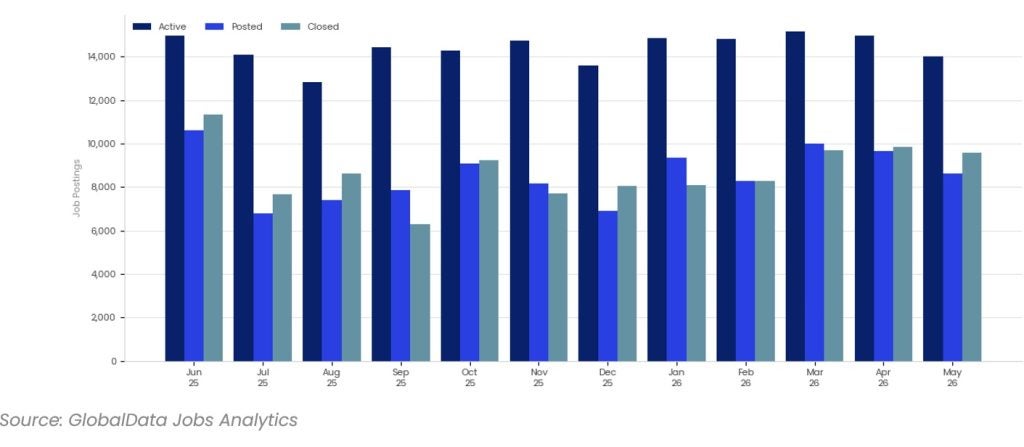
Despite a hiring expansion in North America’s nuclear energy sector during late 2025, recent data shows a downturn in 2026. Year-over-year comparisons have been negative since February 2026, indicating a downturn. However, pure-play nuclear operators are still hiring, while services and engineering contractors are reducing their workforce.
Job postings for nuclear roles peaked at 15,167 in March 2026 before declining to 14,016 by May 2026, marking a 12% year-over-year decrease. The data shows eight months of growth followed by four months of decline, with May 2026 not reaching the high levels seen in June 2025.
Closed job postings have outpaced active job postings from February to May 2026, indicating companies are filling positions quickly rather than slowing down new hiring.
The Pure-Play Nuclear Build
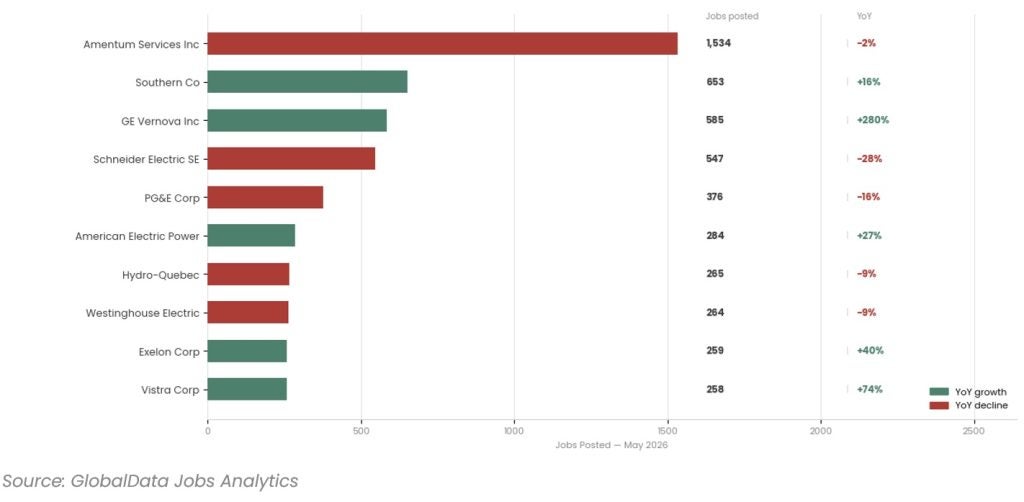
The overall contraction in hiring hides a significant divergence among different types of companies. GE Vernova, a nuclear equipment company, increased its job postings by 280% year-over-year. Meanwhile, Vistra Corp increased by 74%, and Exelon by 40%. These companies are expanding their workforce despite the sector-wide downturn.
On the other hand, Amentum Services saw a 2% decrease in job postings, and Schneider Electric saw a 28% decrease. The difference between GE Vernova’s increase and Schneider’s decrease highlights the varied responses within the sector.
Operational Scaling
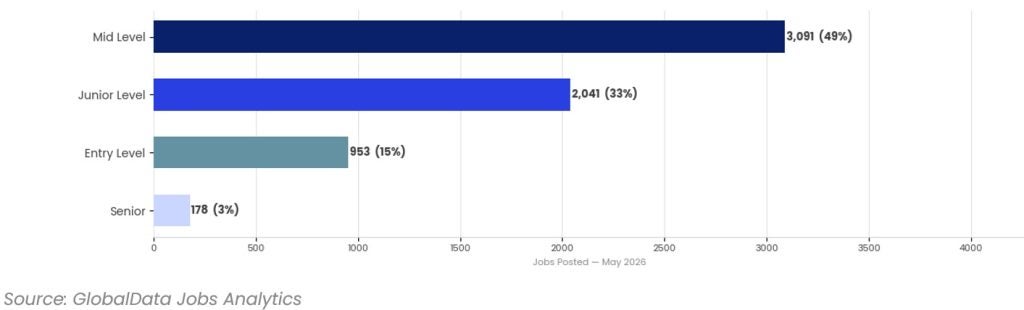
May 2026’s nuclear job postings predominantly consist of entry and mid-level roles, accounting for 97% of the total, contrasting with LNG hiring trends. This reflects the operational needs for roles like licensed operators and maintenance technicians, rather than a focus on senior-level positions.
The significance lies in companies that are investing in senior and specialist roles, which indicates a strategic move not apparent in the broader seniority data.
Sector Under Pressure
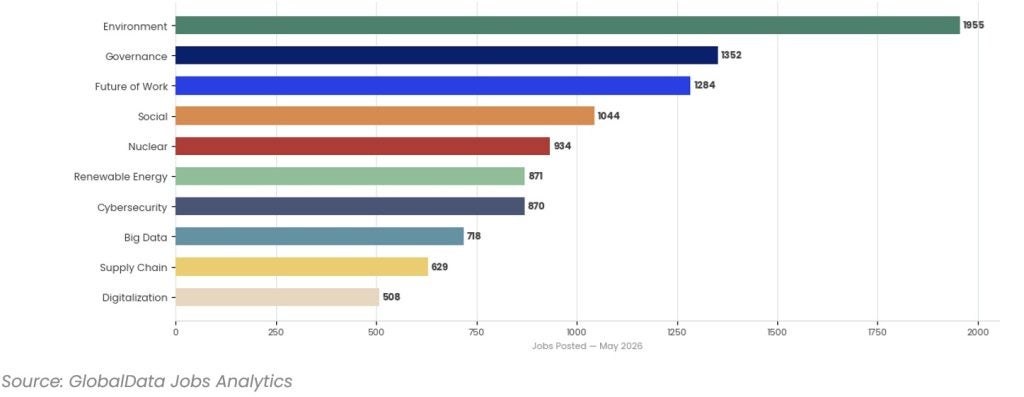
Environmental and governance roles dominate nuclear hiring themes, accounting for the largest categories with 1,955 and 1,352 postings, respectively. These themes highlight the sector’s focus on compliance and regulatory requirements.
The nuclear theme ranks fifth, followed by renewable energy and cybersecurity, each reflecting specific sector needs like critical infrastructure protection and diversification beyond a single energy source.
Canada’s Distinct Hiring Patterns
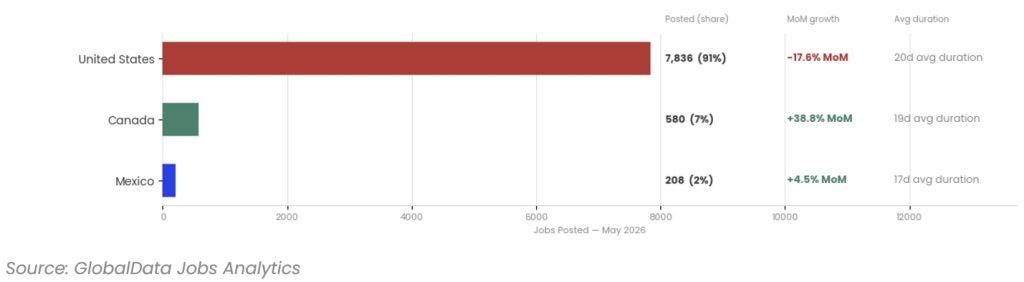
While the U.S. accounts for the majority of nuclear job postings in May 2026, Canada shows a notable 38.8% increase month-on-month. Hydro-Quebec and Ontario Power Generation are key players in this growth, reflecting a strategic expansion in Canada’s nuclear sector.
These Canadian operators are not diversified industrials but are core to the nuclear infrastructure, and their hiring trends reveal a market growth that contrasts with the U.S. scene.
Implications for Leaders
Monitoring detailed hiring data across sectors offers early insights into investment trends, capacity shifts, and emerging risks. By understanding these changes, leaders can make informed decisions about growth opportunities and competitive positioning.
GlobalData Jobs Analytics provides a comprehensive view of job postings, enabling better planning and investment decisions. For more information, contact hirendra.vikram@globaldata.com and explore how to leverage these insights.
Original Story at www.energymonitor.ai