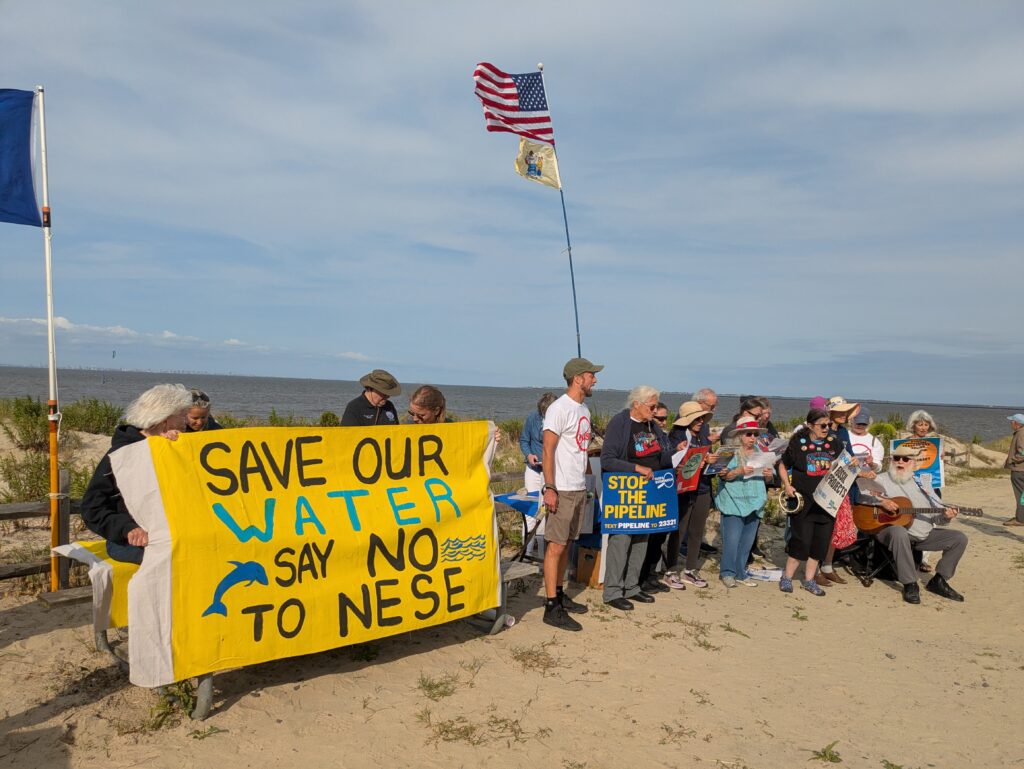
Williams Cos. has resubmitted permit applications for its Northeast Supply Enhancement (NESE) pipeline project in New Jersey, drawing opposition from environmental groups and local officials in Franklin Township, Somerset County, where a new compressor station is planned.
The New Jersey Department of Environmental Protection (NJDEP) has no statutory deadline to issue the necessary permits for the pipeline, which would extend Williams’ Transcontinental natural gas pipeline from Pennsylvania through New Jersey to New York City. A public comment period closed on September 25.
Williams reapplied for federal and state approval after the Trump administration expedited environmental reviews for energy infrastructure.
Williams, an Oklahoma-based gas company, owns the 10,000-mile transcontinental system through its subsidiary, the Transcontinental Gas Pipe Line Company LLC (Transco). The pipeline, operational since 1949, now has a capacity of 19.6 million dekatherms per day. An average U.S. three-bedroom house may use 5 to 15 dekatherms monthly.
The NESE pipeline would increase capacity by 400,000 dekatherms daily. While Texas, Pennsylvania, and Louisiana lead in natural gas production, New Jersey and New York do not permit hydraulic fracturing, or fracking.
The Delaware River Basin Commission banned fracking in the Delaware River Basin in February 2021. About half the natural gas entering New Jersey flows to other states, according to the U.S. Energy Information Administration.
The NESE project includes the 3.4-mile Madison Loop in Middlesex County, which increases New Jersey’s delivery capacity; the 23.5-mile Raritan Bay Loop under the Raritan and Lower New York Bays to Queens; and a new 32,000 horsepower compressor station in Franklin Township.
Initial plans began in 2016, but opposition resumed as activists organized protests. “Issues like this have a way of evolving and sometimes coming back,” said Charlie Kratovil, central Jersey organizer for Food and Water Watch.
Kratovil, now with Food and Water Watch, opposes the pipeline’s return. “It’s unfortunate we must defeat this again,” he said, citing missed opportunities to focus on other issues.
Original efforts in 2016 stalled after permit denials in 2019 and 2020. In May 2024, Transco informed the Federal Energy Regulatory Commission (FERC) it would not seek an extension. About a year later, it petitioned FERC for “Expedited Reissuance of Certification Authority.”
Williams argues the project is vital for meeting demand in New York City and Long Island, supporting energy resilience and economic growth. Environmentalists argue it threatens renewable energy goals and coastal ecosystems.
Kratovil noted the Trump administration “fast-tracked” the project amid a federal suspension of offshore wind projects and FERC’s energy crisis claims.
The NJDEP has a webpage detailing potential project impacts on wetlands and state open waters. On September 10, it hosted a virtual meeting on individual permit applications for various environmental areas.
Franklin Township council members opposed the compressor station. The township has passed resolutions against the project since 2016. Mayor Phillip Kramer compared the compressor’s power to a B-52’s near takeoff speed, raising concerns about emissions.
Franklin Township is considered an overburdened community under New Jersey’s Environmental Justice Law, meeting criteria for low-income and minority demographics.
The compressor’s proximity to Trap Rock Quarry raises safety concerns. “This pipeline is a regression, a 20th-century solution to a 21st-century problem,” said Council member Sivaraman Anbarasan.
Ed Potosnak, a council member, alleged Williams’ political contributions influenced project reconsideration. Some attendees at the NJDEP meeting were not allowed to speak, sparking protests muted online.
Linda Powell, a local activist, expressed frustration before being muted. A letter from climate groups criticized NJDEP’s management of the meeting and called for more in-person sessions.
Kratovil suggested NJDEP avoided further hearings to minimize public opposition. The NJDEP and Williams Cos. did not comment.
Original Story at insideclimatenews.org