
The recent London Climate Action Week (LCAW) unfolded amidst unprecedented June heat, bringing together leaders from diverse sectors including industry, academia, finance, and policy. As the city grappled with soaring temperatures that disrupted everyday life, the gathering underscored the urgent need for cooperative efforts to combat climate change.
With climate-related disasters becoming more frequent, it’s increasingly evident that energy, economic, and environmental concerns are deeply intertwined. This realization is driving cross-sector collaboration to develop comprehensive strategies addressing these interconnected risks.
Strategic Insights from LCAW
Amid discussions at LCAW 2026, a hopeful message emerged: solutions to our current climate crisis are within reach. However, scaling these solutions requires alignment across sectors to create a supportive financial and operational environment. Calls for engagement and leadership from all actors—public, private, academic, and nonprofit—resonated throughout the event.
RMI facilitated a workshop that brought together energy sector leaders to explore the complexities of ensuring energy security and affordability in an unpredictable climate. Here are the primary insights from the event’s working groups:
| Insight | Why It Matters |
|---|---|
| Security framing and energy affordability are overtaking climate framing | Foundational for near-term policy, political, and corporate action |
| Reducing methane emissions/energy waste is an immediate opportunity | High impact with existing technologies |
| Energy technologies that we need largely exist | Scaled deployment transforms markets and lessens multiple security risks |
| Data and standardized carbon accounting are foundational | Enables investment and comparisons across assets and companies |
| Policy remains essential | Markets alone cannot deliver transition |
| Demand aggregation deserves more attention in balancing energy and climate security | Scaling clean energy markets requires committed buyers |
| Finance is available but projects remain difficult to fund | Bankability is the bottleneck |
| Organizational change is as important as technology | Long-term success depends on institutional transformation |
Energy, Economic, and Environmental Security are Inseparable
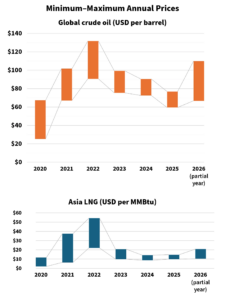
Energy security is closely linked with economic and environmental stability. Recent geopolitical events, such as the conflict in Ukraine and shifting global oil dynamics, have highlighted these connections. The pursuit of secure energy supplies must consider economic impacts, especially in regions reliant on oil imports. Developing diverse energy infrastructures can enhance overall resilience. Renewable energy sources, such as wind and solar, provide a strategic advantage by being less susceptible to geopolitical manipulation.
Renewable sources of energy are a hedge against fossil fuels because it is harder to weaponize the wind and the sun.
Wasting Energy is Unwarranted
The world’s increasing energy demands necessitate more efficient systems. Despite the vast energy losses in current systems, opportunities to reduce waste and emissions exist. Addressing inefficiencies, such as methane leaks from oil and gas operations, is essential for enhancing energy security and mitigating climate change impacts.
The Energy Technologies We Need Exist
Existing technologies have the potential to revolutionize energy systems. However, their widespread adoption requires coherent integration of data and policy support. Financial and insurance sectors play crucial roles in facilitating the deployment of these innovations, thereby reducing associated risks.
Deploying proven technologies can enhance the efficiency and security of traditional energy systems. For instance, integrating geothermal energy with oil and gas operations could significantly support data center expansion. Furthermore, strategic co-location of renewables with existing infrastructure can expand energy supply efficiently.
Better Data and Open Accounting are Foundational
Reliable data and standardized accounting practices are crucial for differentiating energy products and methods. Initiatives like the Carbon Data Open Protocol (CDOP) aim to establish a unified framework for carbon credit exchanges, facilitating market activation and investment.
Market Action is Critical, but Policy Remains Essential
The energy market’s volatility underscores the need for stable policies that support sustainable practices. Policy instruments can guide market actions towards socially beneficial outcomes and facilitate the scaling of solutions across different market dimensions.
Demand Aggregation Deserves More Attention
Balancing energy supply and demand requires understanding the needs and obstacles faced by energy buyers. Policy measures, such as establishing buyers’ clubs, can address market externalities and enhance market efficiency.
Finance is Ready but Bankability Remains a Roadblock
Although financial resources are available, project bankability remains a significant hurdle. Successful deployment of new technologies depends on sustainable business models and policy certainty to attract investment. Financial institutions can coordinate efforts across sectors, matching risk profiles to development stages.
The Energy Transition Needs Organizational Identity Shift
The energy transition extends beyond technological changes, requiring a shift in organizational identities. Reskilling within the financial and energy sectors is vital to adapt to new energy paradigms. Global systems change across various entities is necessary to implement scalable solutions effectively.
Effective solutions address multiple security concerns simultaneously. Overcoming the challenges of energy market disruptions requires collaborative efforts to advance transparent accounting, policy durability, and organizational adaptability. These measures are crucial for bolstering energy, economic, and environmental security.
Original Story at rmi.org