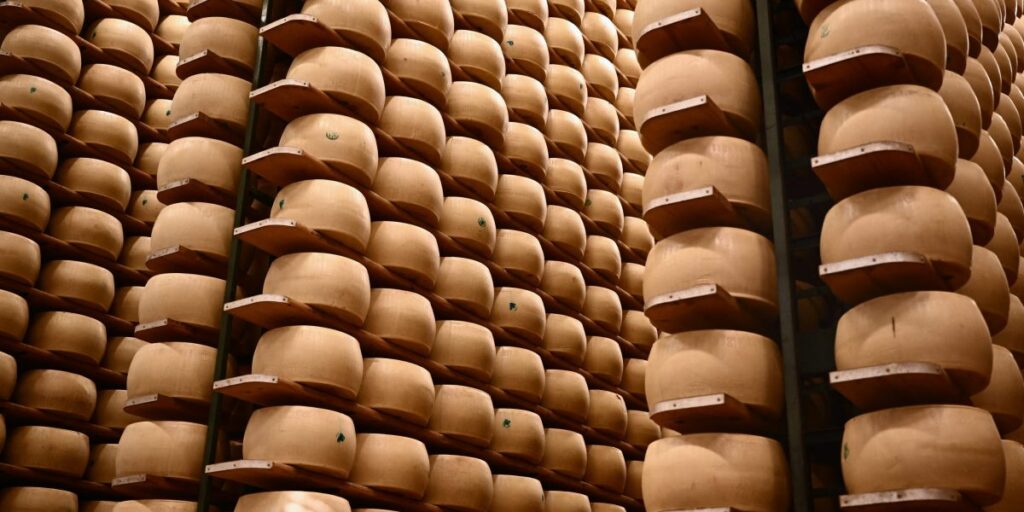
In the verdant hills of Emilia-Romagna, a unique banking practice is quietly unfolding, where cheese serves as collateral for loans. This unconventional method highlights a fascinating intersection of agriculture and finance, but rising temperatures are now threatening this system and Italy’s broader agricultural economy.
The bank Credito Emiliano, or Credem, has been accepting young wheels of Parmigiano Reggiano as loan collateral since 1953. This practice is not just restricted to one vault; it impacts vineyards, olive groves, and the overall economy, as economists caution about the effects of extreme heat.
A Blockchain-Backed Cheese Loan Collateral Program
A subsidiary of Credem, Magazzini Generali delle Tagliate, ages the cheese wheels in warehouses after receiving them from dairy farmers. Producers typically get 60% to 80% of a wheel’s value upfront. With advancements in blockchain technology, farmers can now pledge cheese stored in their facilities, thereby doubling the bank’s lending capacity. This system provides much-needed cash flow for small farms during the lengthy aging process of Parmigiano.
Italy produces approximately 4 million wheels of Parmigiano Reggiano annually, and cheese banks hold around 500,000 of these. Giancarlo Ravanetti, who oversees Credem’s cheese warehouse operations, shared with CNN that their warehouses manage about 2.3 million wheels each year.
The Parmigiano Reggiano industry, valued at 4 billion euros, faces rising costs in maintaining optimal cheese storage temperatures. This year’s record heat waves in Europe have increased daily energy consumption by about 30%, prompting upgrades in cooling systems and renewable energy expansion.
Climate change also affects dairy farmers’ milk supply. Cows produce less milk due to increased heat, leading to a 10% annual reduction. As heat events become more frequent and intense, the quality and quantity of milk are impacted, driving costs up.
Climate Change Hits the Vineyard
Similar climate challenges are affecting Italy’s vineyards. In Franciacorta, Lombardy, the 2026 harvest began earlier than ever, and in Sicily, the harvest has stretched over a hundred-day season. Record temperatures and drought are causing sugar to develop faster than flavor in grapes, a problem for late-ripening varieties like Nebbiolo.
Some vineyards are experimenting with shade netting to protect grapes from sun exposure. Coldiretti, Italy’s largest farmers’ association, points to additional costs from the conflict in Iran, increasing expenses by 250 euros per hectare for wine producers, with export values down by 7% in early 2026.
Olive groves, particularly in Puglia and Calabria, have seen production fall below the historical average. For the 2025/26 season, output is between 270,000 to 300,000 tons, compared to over 350,000 tons typically produced. Past droughts have significantly reduced Puglia’s yield.
R. Jisung Park from the University of Pennsylvania’s Wharton School notes that the impact of heat on Italy’s cheese, wine, and olive oil industries reflects broader research linking heat to economic losses. A European Central Bank paper indicates that while the GDP impact from heat is smaller in Spain and Italy than in Germany, the real damage is often hidden in supply chain disruptions and delayed effects.
The U.S. Has Its Own Cheese Caves
The concept of supporting dairy farmers during challenging times isn’t new to the U.S. During the Great Depression, the government bought surplus dairy products to stabilize prices, storing them in caves in states like Missouri. By the 1980s, the federal stockpile reached 500 million pounds. Unlike the U.S. government’s approach, Italy’s cheese banks offer loans against cheese inventory, betting on its future value.
Original Story at fortune.com