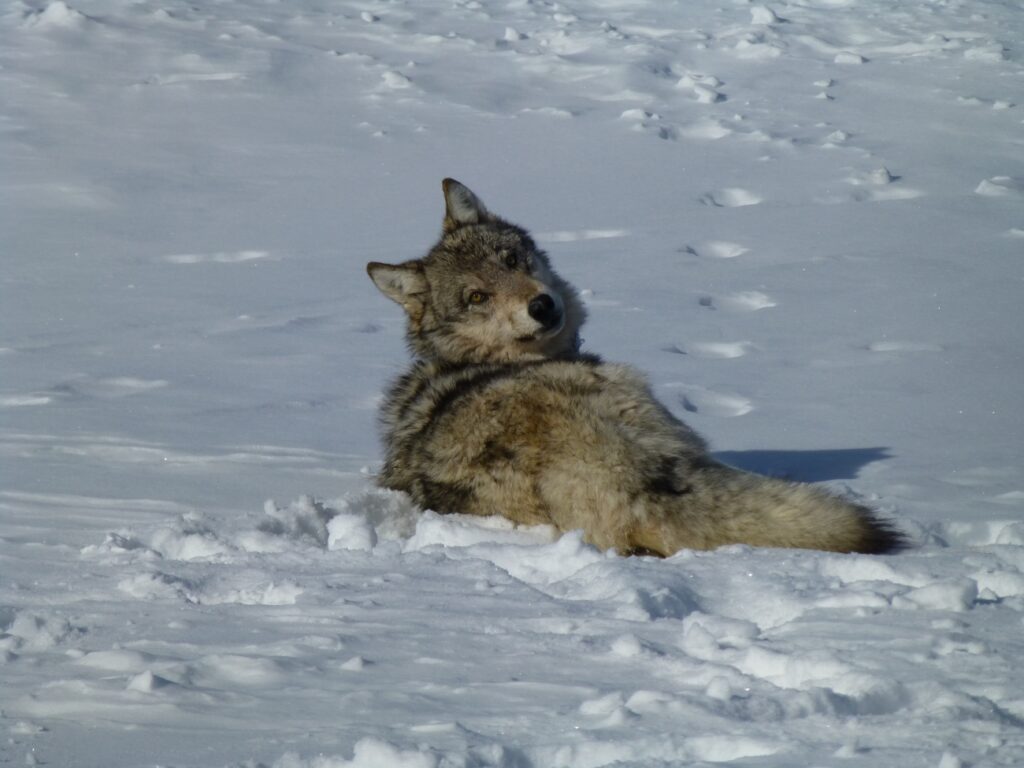
Wolf pups — some just weeks old — were legally killed in Idaho this spring, and the state paid hunters and trappers $2,000 each to do it. Now a coalition of wildlife advocates is pushing back, bringing a formal petition to state officials that would ban the killing of wolf pups and their nursing mothers.
Suzanne Asha Stone, executive director of the International Wildlife Coexistence Network, confirmed through a public records request that Idaho paid reimbursement payments for 12 wolf pups killed earlier this year. Stone, who has worked on wolf conservation since she interned with the government and Nez Perce Tribe teams that reintroduced wolves to Idaho more than 30 years ago, said the public reaction has been unlike anything she has seen.
“That’s not hunting,” Stone said.
“It’s not trapping. It’s not even professional control. That is simply persecution of a species that’s hated by someone, and I just think that’s the most disturbing thing that someone could approach animals so young, and have so little empathy, no empathy for them.”
The story first gained wide attention after a Nov. 6 investigation by the Guardian and Public Domain reported that state officials in Idaho paid thousands of dollars in reimbursement payments to hunters or trappers who legally killed 12 wolf pups in Idaho earlier this year. The pups were killed in spring 2026 under a legal framework that permits year-round wolf hunting in Idaho.
How Did Killing Wolf Pups Become Legal in Idaho?
Wolves were removed from federal Endangered Species Act protections in 2011, shifting management authority to the Idaho Department of Fish and Game. Since then, the Idaho Legislature has passed increasingly permissive wolf hunting laws. Senate Bill 1211, passed in 2021, expanded the legal methods for killing wolves, eliminated limits on wolf tags, legalized year-round trapping on private land, and allowed the state to contract with third parties to kill wolves.
With legislative backing and commission direction, Idaho Department of Fish and Game officials have publicly stated they are working to reduce the number of wolves in Idaho. Supporters of that effort argue that a smaller wolf population will mean less livestock and elk lost to predation.
Unlike protections in place for black bears and mountain lions — where hunters are prohibited from killing newborn cubs or mothers with young — no equivalent rules apply to wolves in Idaho. Wolf pups and mother wolves nursing pups can be legally killed at any time.
What Are the State’s Reimbursement Payments?
The state partners with the Foundation for Wildlife Management to reimburse hunters and trappers who kill wolves for related costs — fuel, ammunition, traps, trail cameras, and even trucks or ATVs used in scouting. Critics call the payments a bounty and say the practice echoes the government eradication campaigns of the early 20th century that wiped wolves from the American West entirely. Between 2019 and 2025, Idaho paid out $849,750 in such reimbursement payments, according to the Idaho Capital Sun.
State officials have pushed back on the bounty label. Deputy Director Jon Rachael discussed the goals of the reimbursement program in 2025 for the Idaho Capital Sun and Boise State Public Radio’s series Howl.
“Any of the funds that come from the state of Idaho, from the Wolf Depredation Control Board, or, in the past, from the Fish and Game Commission Challenge Grants did require that this money was not just a straight payment of a certain amount, but rather the individual claiming compensation present evidence of their expenses,”
Rachael said.
“And so in that regard, it was compensation for their investment of buying traps or fuel to run a trap line.”
This is not the first time the government-sanctioned killing of wolf pups has drawn controversy. In 2022, students at Timberline High School spoke out after Wildlife Services officers killed wolf pups from the Timberline wolf pack that the school had symbolically adopted and studied for years. And a 2021 letter confirmed that U.S. Department of Agriculture officials killed young wolves in Idaho that year as part of an effort to protect livestock and push adult wolves to relocate.
Hunters and Conservationists Alike Are Speaking Out
Opposition to killing wolf pups is coming from unexpected quarters. Kevin Brown, a 70-year-old hunter and hound trainer from St. Maries, Idaho, said the practice violates the ethical hunting principle of fair chase — the idea, upheld by the Boone and Crockett Club, that game should be pursued in a way that does not give hunters an unfair or improper advantage over animals.
“When I saw that the other day, I just about puked,”
Brown said.
“Now that is just f—king sick. That’s what they were doing in the 1920s, the biological survey there at the end, killing the last few wolves.”
Brown said wolves have killed several of his hounds in the backcountry, but he still supports wolf conservation because of his deep connection to intact wild ecosystems.
“It’s in a horrible state, everything is,”
he said.
“I always enjoyed hunting in a pristine environment because that’s where the (mountain) lions and bears were, you know, and that’s where the wolves were.”
Lisa Young, director of the Idaho Chapter of the Sierra Club, was equally critical.
“The disgraceful practice of paying bounties to slaughter wolf pups in their dens is more reminiscent of the 20th Century wolf extermination than modern wildlife management,”
Young said in a written statement.
“And this comes at a time when deer, elk and other big game in Idaho are at healthy numbers.”
Young added:
“This waste of public money is just another example of how ill suited Idaho is to manage these iconic wildlife species. It’s time to end these practices and move into the 21st Century with a sensible wolf management policy that recognizes the important role they play in a functioning ecosystem. Idaho has shown that we have so much further to go in wildlife management, and why states can’t be trusted to manage carnivore species including wolves, grizzly bears and mountain lions.”
What the Petition Asks For
Stone and a coalition of groups are presenting a formal petition to the Idaho Fish and Game Commission asking that wolves be managed with the same protections currently afforded black bears and mountain lions — meaning wolf pups should be protected until at least five months of age and no bounties paid for killing pups born in the current year. Dallas Gudgell of the International Wildlife Coexistence Network will deliver the petition at the commission’s meeting at 7 p.m. Pacific Time at the Idaho Department of Fish and Game Clearwater Regional Office, 3316 16th St., in Lewiston.
“What we’re asking is that wolves simply be managed as promised, like black bears and mountain lions, that their young and that the mothers are protected until they reach five months of age and that there is no bounty on pups of the year,”
Stone said.
“There’s no bounty on black bears, there’s no bounty on mountain lions, and their young are protected,”
Stone added.
“We’re just asking for the same thing with wolves.”
Jeff Abrams, Wildlife Program Associate with the Idaho Conservation League, said the double standard in state policy is clear.
“In the conversations that led up to the delisting of wolves, (Idaho Department of Fish and Game) told Idahoans that they plan to manage wolves as prized big game animals,”
Abrams said.
“This latest incident plainly shows they’re not doing that. Big game animals like black bears and mountain lions may not be taken weeks into their life cycle. The department needs to be consistent in setting big game management policies.”
Abrams also warned that the state’s approach is damaging its national image.
“We may have finally reached a point when this insane persecution of wolves is questioned, even by mainstream sportsmen,”
he said.
“This was not fair chase. There’s little doubt these pups were killed by blunt force at close range. This violates the North American model of wildlife conservation; we cannot continue to outsource wolf management to a tiny slice of sportsmen that despise native predators, let alone incentivize it with a bounty.”
Although the petition will be presented at Tuesday’s commission meeting, it will not be formally heard until the January commission meeting in Boise. Stone said the timing is critical.
“Wolves only den once a year, so our goal is to stop this before the April denning season.”