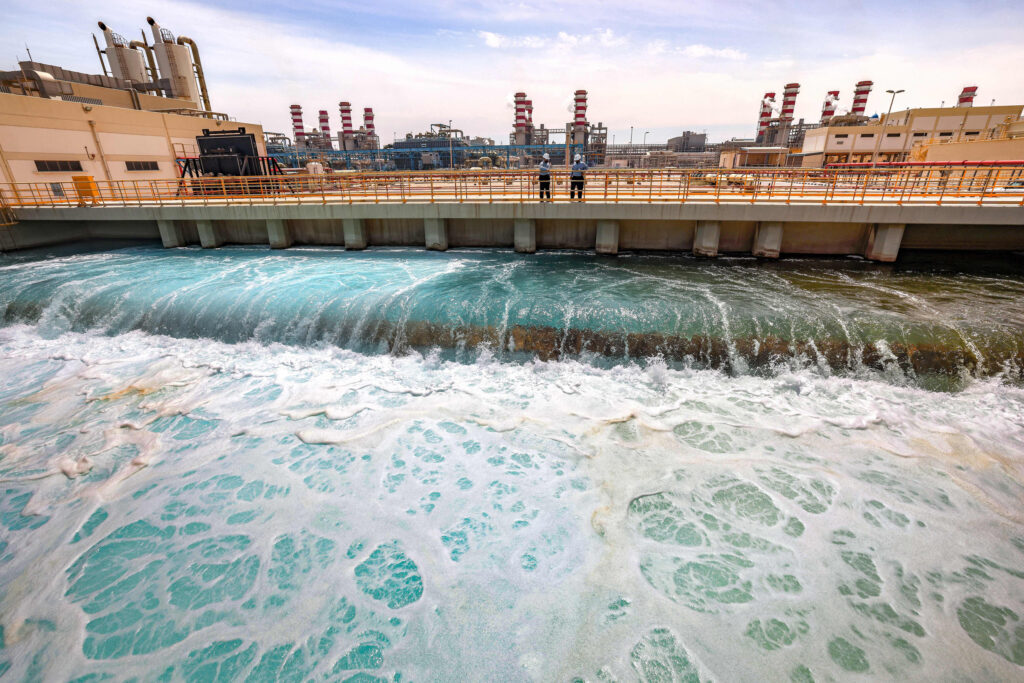
Recent attacks on desalination plants in the Middle East, which are crucial for converting seawater to drinkable water, have raised concerns about a potential humanitarian crisis. These attacks highlight the region’s dependence on fossil fuel-driven desalination methods.
Iranian Foreign Minister Abbas Araghchi accused the United States of attacking a desalination plant in southern Iran, a claim the U.S. denies. Bahrain later accused Iran of a similar attack. These incidents follow attacks on various non-military targets since the start of U.S. Operation Epic Fury in February, violating the Geneva Conventions.
Michael Christopher Low, director of the Middle East Center at the University of Utah, described these actions as a severe war crime, noting the removal of previous “red lines” on attacking essential infrastructure.
The Middle East hosts about one-third of the world’s desalination plants, including 2,382 in Saudi Arabia, as reported in npj Clean Water. The region, holding less than 2% of the world’s renewable freshwater, faces severe water scarcity, affecting 83% of its population and expected to reach 100% by 2050, according to the Aqueduct Water Risk Atlas.
Desalination relies on reverse osmosis, a costly, energy-intensive process funded by regional oil and gas resources. Low, authoring a book on the topic, emphasized the inseparable link between water production and fossil fuels.
The vulnerability extends beyond military attacks to the impacts of climate change. Rising temperatures and shrinking precipitation could exacerbate water scarcity, jeopardizing economic stability. The World Bank anticipates significant economic losses in the region by 2050 due to climate-induced water stress.
Erika Weinthal of Duke University leads the Targeting of Infrastructure in the Middle East project, which tracks attacks on infrastructure. Weinthal warns that harming civilian infrastructure like desalination plants has long-term effects beyond immediate casualties, increasing waterborne diseases and instability.
The heavy reliance on fossil fuels makes desalination a contributor to carbon emissions, with global energy consumption for reverse osmosis desalination projected to dramatically increase by 2050, according to TRENDS Research & Advisory.
Some Middle Eastern countries are exploring renewable energy for desalination, but progress is slow. Low suggests that without transitioning to solar or nuclear solutions, the region risks exacerbating its environmental challenges.
Original Story at insideclimatenews.org